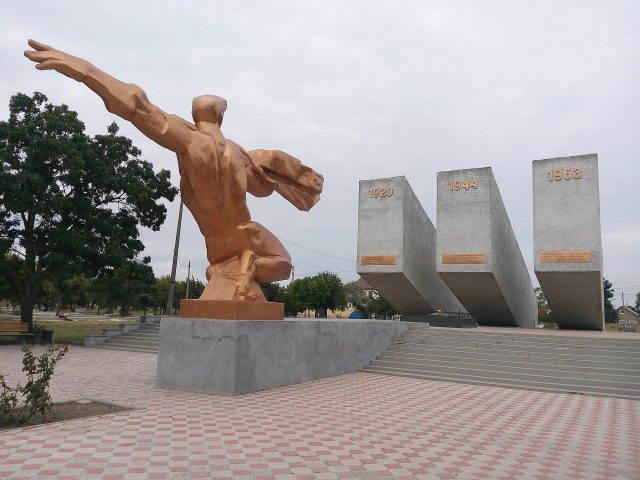
Krasnoperekopsk doesn’t appear in travel brochures. Its main landmark—a steel monument at the city’s entrance—isn’t what most visitors seek. But for those who stop, it reveals something unexpected: the unvarnished identity of a town built for industry, not tourism.
The stele was erected when Krasnoperekopsk was still forming. Founded in the mid-20th century as an industrial hub, the city grew around chemical plants. Streets and buildings were designed for production, not beauty. The monument wasn’t decoration—it was a statement. A way to claim a place on the map for a town that might have remained anonymous. Its design reflects that pragmatism: clean lines, geometric shapes, and industrial symbols—gears, pipes—all in steel, a material as unyielding as the work that defined the city.
The stele’s honesty makes it interesting. There are no heroic sculptures or lofty inscriptions. It simply names the place. The letters spelling *Krasnoperekopsk* in Russian and Ukrainian are large enough to read from the road. They mark a time when Crimea was part of Ukraine, a fact that lingers in the city’s memory. The stele doesn’t reconcile these complexities. It just stands.
For locals, the monument is a reference point. People meet here before heading into the city. Newlyweds come for photographs. Schoolchildren gather on field trips. Drivers pause to stretch their legs. There’s no grand plaza, just asphalt, benches, and the hum of traffic. The stele doesn’t demand attention, but it earns it.
Krasnoperekopsk is a city of contrasts. Towering smokestacks and sprawling industrial zones sit beside quiet residential blocks. The stele stands at the intersection of these two worlds. It doesn’t romanticize the industrial legacy—life in a factory town is harsh—but it doesn’t apologize for it either. It acknowledges a place where people have built lives and found meaning in work outsiders might never understand.
The monument blends into its surroundings. It doesn’t tower over the city like a symbol of power. It stands at the edge, guarding the threshold between Krasnoperekopsk and the rest of the world. The industrial motifs aren’t decorative—they honor the labor that built the city. The hands that assembled machinery. The engineers who kept the plants running. The stele is about the people who call it home. It celebrates not heroes or victories, but the persistence of ordinary lives.
To travelers, the stele might seem like a roadside curiosity. But stop for a moment. You’ll find a snapshot of a city outside the usual travel narratives. Krasnoperekopsk isn’t a destination, but it has its own story. It unfolds in the worn benches, the distant clang of factory shifts, the way light hits the steel at dusk. The monument doesn’t tell that story outright. It invites you to look closer.
The stele’s strength is its lack of pretension. It’s not a masterpiece of art or a symbol of national pride. It’s a marker, a point of orientation in a landscape shaped by industry and time. In its simplicity, it captures something essential about Krasnoperekopsk—a city that has never been flashy, but has always been real.