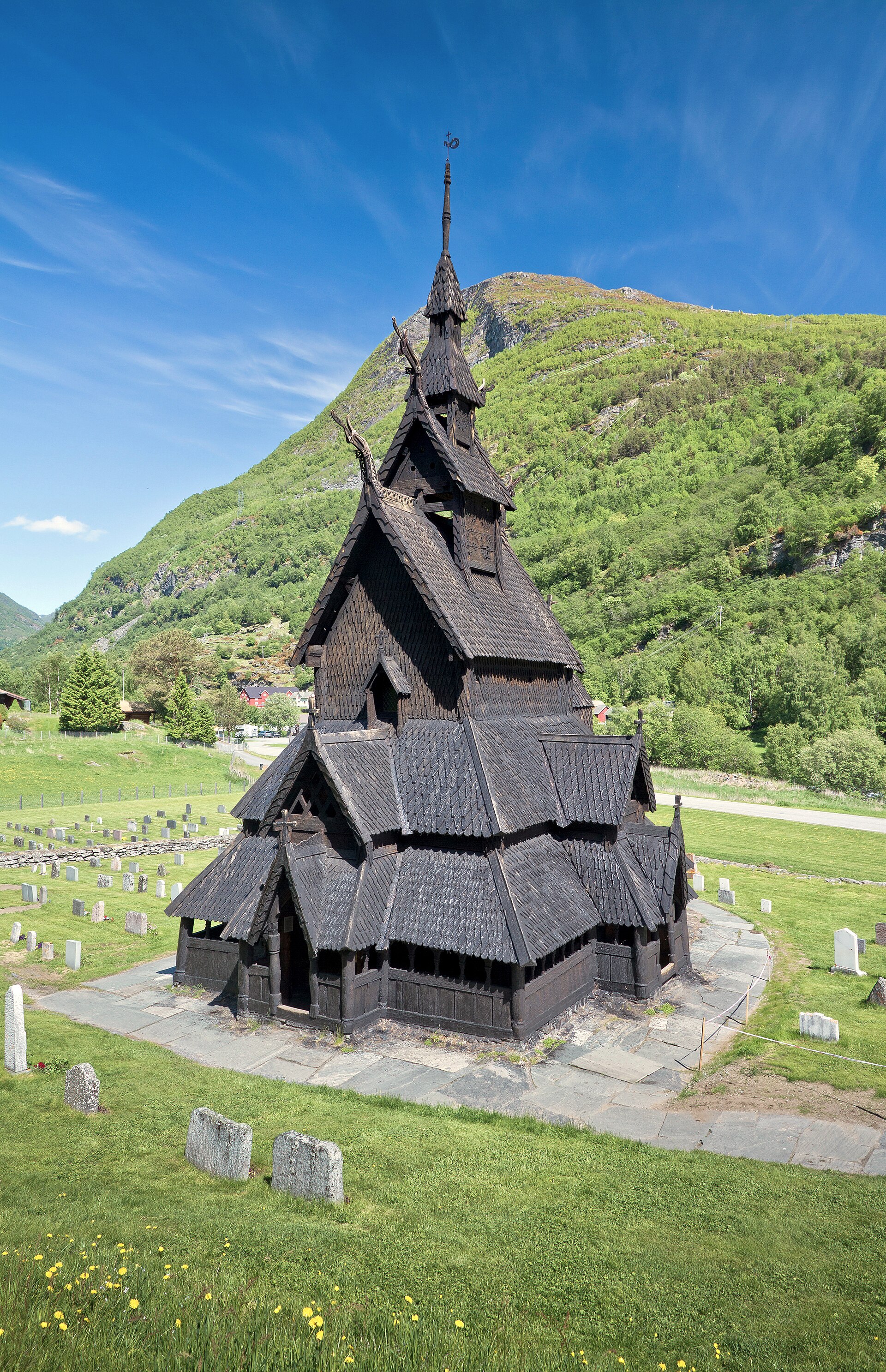
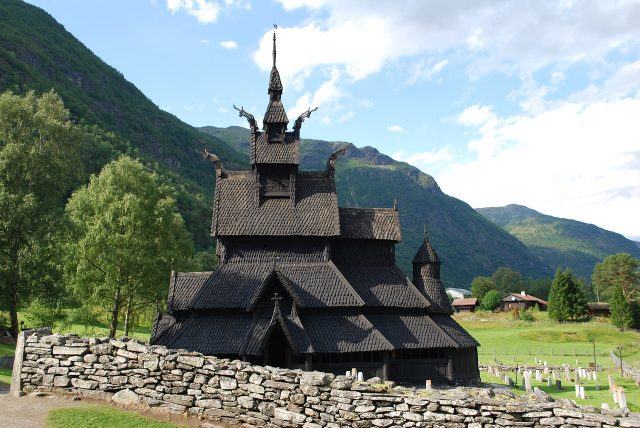
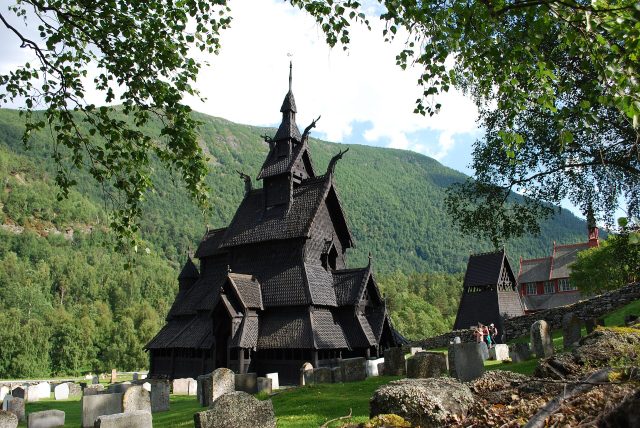
Perched on the shore of Lake Vorm, the Borgund Stave Church feels like a place where time has quietly paused. Built in the early 1200s, it stands among rolling hills and dense forests, its dark, tarred wooden walls blending seamlessly into the landscape. The church is one of Norway’s few remaining stave churches—medieval wooden structures unique to this part of the world—and Borgund is among the oldest and best preserved. Its steep, layered roofs and intricate carvings don’t just occupy the land; they seem to grow from it, as if shaped by the same forces that carved the valleys and filled the lakes.
The architecture of the stave church is unlike anything else in Europe. While stone cathedrals dominated the continent during the Middle Ages, Norway’s builders worked almost entirely in wood. The structure of Borgund resembles an upturned Viking ship, with tall, tapering walls held together by an intricate system of internal supports. The roof rises in cascading tiers, crowned with sharp spires and, at the corners, dragon heads—echoes of a time when Norse mythology still lingered in daily life. Inside, the space is intimate and low-ceilinged, with narrow passageways that swallow sound and leave only a faint echo. The air is thick with the scent of aged timber, and the dim light filtering through small windows casts shifting patterns on the floor.
Borgund was built during a period of transition, when Christianity was still taking root in Norway and old beliefs had not yet faded. The dragon heads on the roof, the serpentine carvings, and the fantastical creatures woven into the woodwork all speak to a culture that was not yet ready to abandon its myths. Christian symbols coexist with pagan motifs, creating a rare fusion of traditions. The church was more than a place of worship; it was a gathering point for the community, where disputes were settled, agreements were made, and valuables were stored. In many ways, it was the heart of village life, a role it played for centuries.
Most stave churches were lost to fire, decay, or rebuilding, but Borgund endured, partly because of its remote location. It survived wars, religious reforms, and the slow march of time, remaining largely unchanged. In the 19th century, as interest in medieval heritage grew, the church underwent careful restoration, with efforts made to preserve its original character. Some details, like the interior paintings, have been lost, but the overall impression is one of remarkable continuity. Stepping inside feels like entering a time capsule, where the past is not just remembered but still present.
Visiting Borgund is less about ticking off a tourist attraction and more about stepping into another era. The moment you cross the threshold, the silence wraps around you, broken only by the creak of old wood underfoot. There is no electricity here, and on overcast days, the interior is dim, the shadows deepening the sense of mystery. In summer, when services are held, the space comes alive with candlelight and hymns, briefly reclaiming its original purpose. The scent of resin and aged timber lingers in the air, a reminder of the hands that shaped these beams centuries ago.
The surroundings of Borgund are just as compelling as the church itself. Lake Vorm is a mirror on clear days, reflecting the sky and the surrounding hills, while in winter, snow blankets the landscape, softening the edges of the world. The area is a haven for hikers, with trails winding through forests and up gentle slopes. The local way of life has changed little over the years—fishing, farming, and foraging still shape the rhythms of the community. Nearby villages are dotted with traditional farms, their sod roofs and wooden walls blending into the countryside. It’s a place where time moves at its own pace, undisturbed by the rush of the modern world.
Borgund Stave Church is more than an architectural relic; it’s a living connection to the past. It stands as a testament to a time when buildings were crafted not just for function but for permanence, each beam carved with care and intention. In an age of glass and steel, such places feel increasingly rare. They don’t demand attention or cater to crowds; they simply exist, holding within their walls the quiet stories of those who came before. Perhaps that’s why the church resonates so deeply—it doesn’t just tell a story, it lets you feel it.