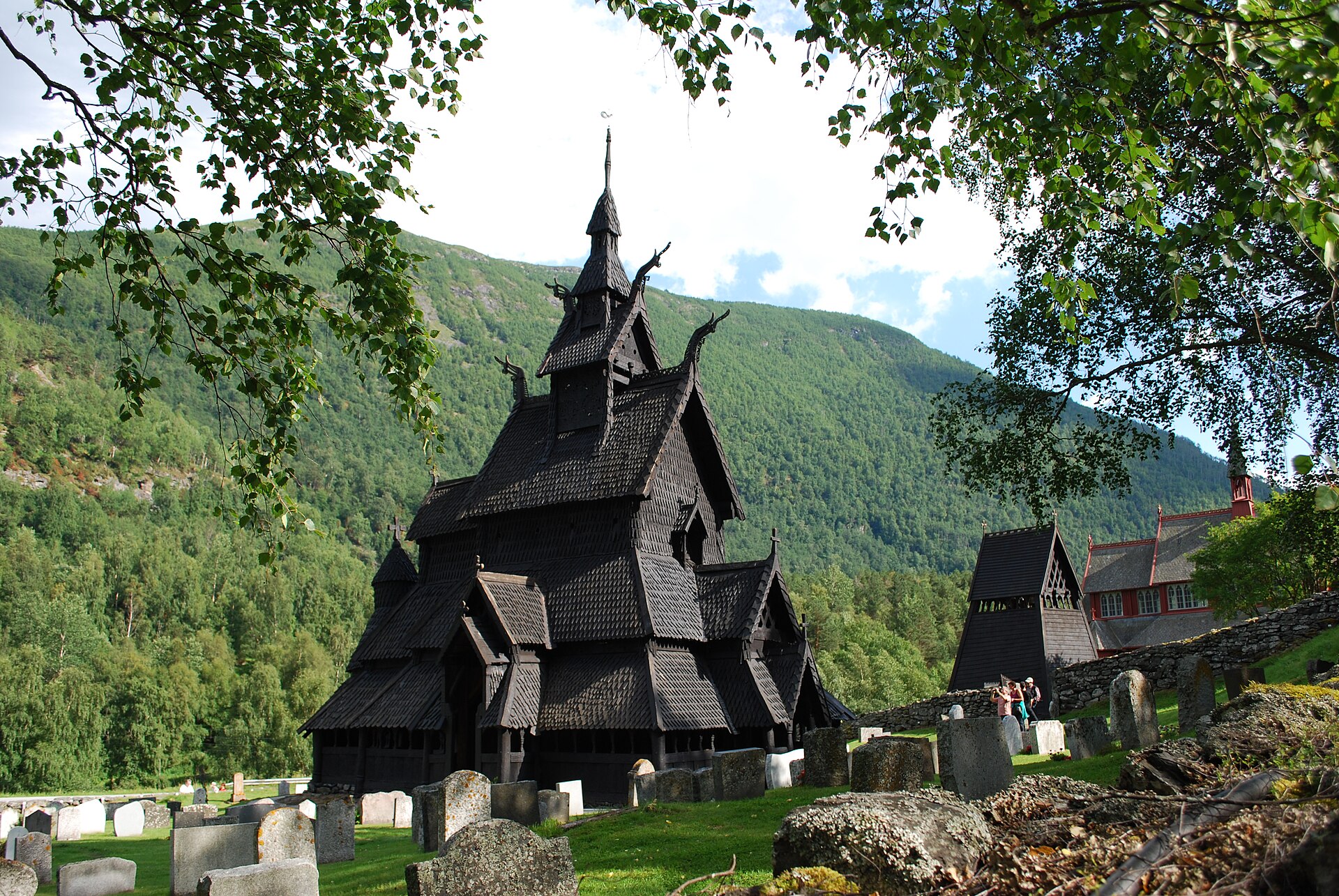
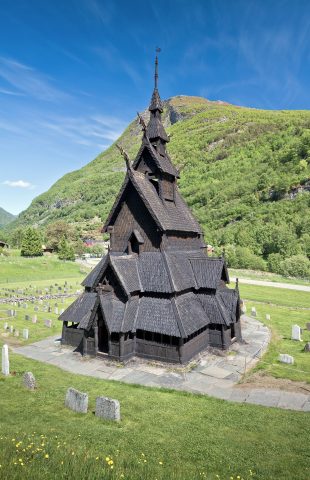
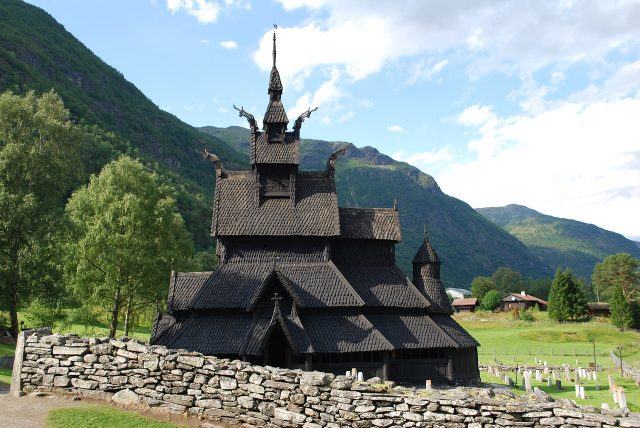
Borgund Stave Church stands quietly by the waters of the fjord, as it has for centuries. Built in the thirteenth century, when Norway was still forming as a kingdom and Viking traditions lingered in daily life, it is one of the few wooden churches from that era to survive nearly unchanged. There are no gilded altars or grand decorations here—just the scent of aged timber, the hush of time-worn silence, and the sense that the hours move differently within these walls.
The architecture tells its own story, one shaped by necessity and memory. The slender pillars supporting the roof echo the masts of Viking ships, while the steeply pitched roof was designed to shed snow without effort, a practical response to Norway’s harsh winters. Inside, the space feels intimate, almost domestic, with no soaring naves or towering altars. Instead, the low ceiling and simple layout suggest a place meant for quiet reflection rather than grand ceremony. The faded murals on the walls, once vivid, now carry the charm of medieval art—scenes from the Bible interspersed with dragons and mythical creatures, remnants of a pagan past that Christianity never fully erased.
This church is one of twenty-eight remaining stave churches in Norway, built between the twelfth and fourteenth centuries when the country was transitioning from Norse beliefs to Christianity. Borgund embodies that shift. The carved dragon heads on the roof ridges nod to old myths, while the crosses on the gables mark the arrival of a new faith. Unlike grand cathedrals, this church was never meant to impress—it was built for the people who farmed, fished, and prayed here, a humble yet enduring part of their lives.
The small cemetery surrounding the church is just as unassuming. The gravestones, some dating back to the seventeenth and eighteenth centuries, are simple slabs of stone, worn smooth by time. There are no ornate monuments, just names carved into rock, a quiet record of generations. Even now, locals are buried here, and the cemetery doesn’t feel abandoned. Instead, it feels like a natural extension of the church, a place where the past and present coexist without tension.
Borgund’s history is tied to the fjord, which was once a vital trade route. Centuries ago, ships docked along these shores, merchants bartered goods, and the village thrived on fish, wool, and timber. The fjord was both a lifeline and a highway, connecting scattered settlements. Today, the bustle is gone, but traces remain—fragments of old docks, the outlines of stone walls that once protected the village. The church has stood through it all, witnessing the fjord’s transformation from a busy waterway to the serene expanse it is now.
In the twentieth century, the church became a focus of careful restoration. Conservators worked meticulously to preserve its original character, reviving old techniques to maintain its authenticity. Nails were hand-forged, timber was treated as it had been in the Middle Ages, and every effort was made to keep the structure as close to its original state as possible. Some elements had to be replaced, but the changes are subtle. The church still feels alive, not like a relic behind glass.
Visiting Borgund is about more than history. On quiet weekdays, when few tourists come, the silence is profound. You can sit on one of the old wooden benches, listening to the creak of the floorboards, the rustle of prayer books left on stands. Sunlight streams through narrow windows, casting golden stripes across the floor. If you’re lucky, you might hear the bell—soft but clear, as if the sound comes not from the tower but from the heart of the church itself.
There’s no need for guides or explanations here. The church asks only for respect—respect for its age, its stillness, its unspoken stories. It doesn’t demand attention; it simply exists, as it has for centuries. In a world that moves too quickly, Borgund offers a rare sense of permanence. Whether you come for faith, history, or just a moment of quiet, it has something to give. For some, it’s a connection to the past; for others, a lesson in endurance. For many, it’s simply a place to sit, breathe, and feel the weight of time.