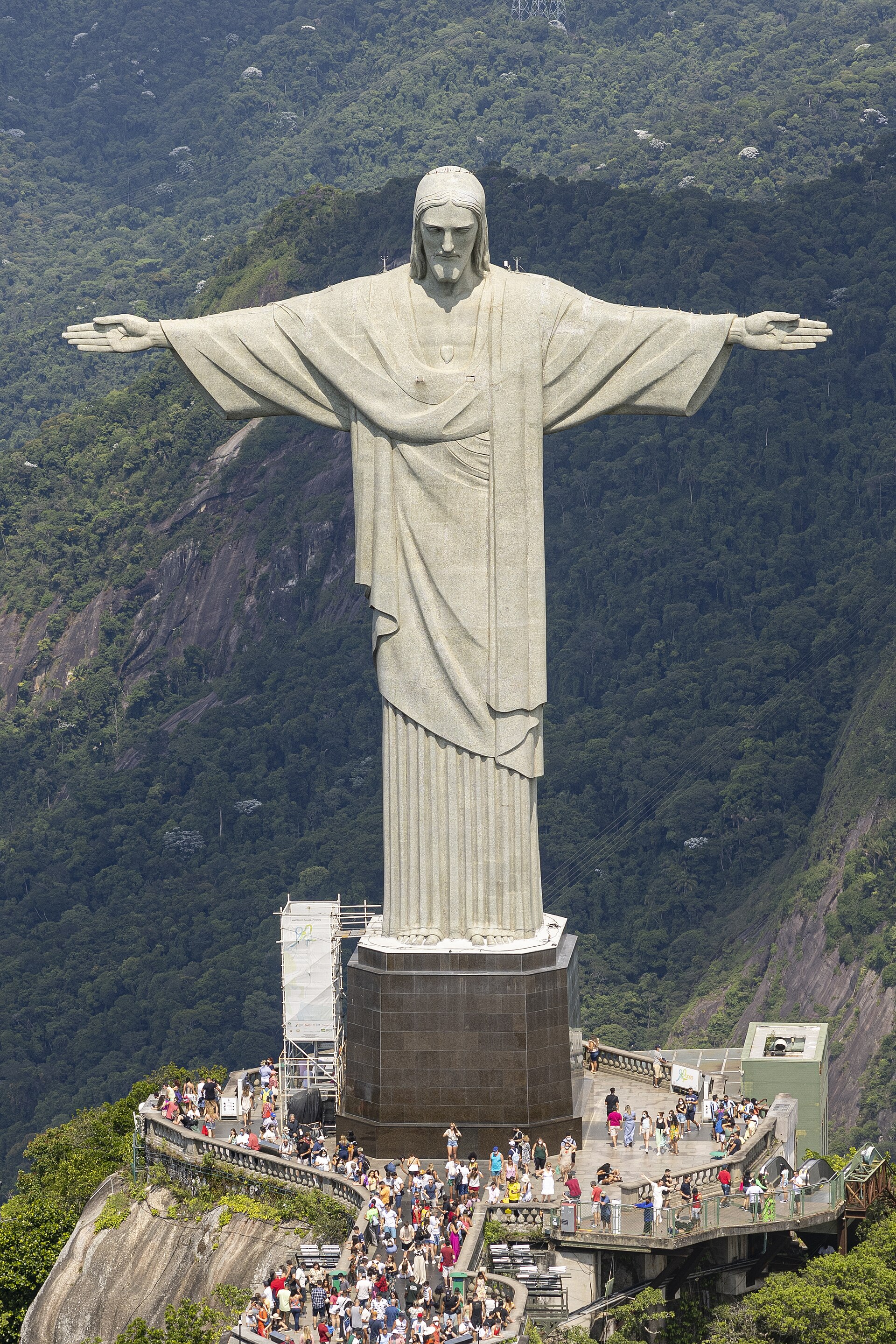
Christ the Redeemer: A Monument That Holds Rio in Its Arms
From 710 meters above Rio de Janeiro, the Christ the Redeemer statue stands on Corcovado Mountain. Below, the city unfolds: Copacabana’s crescent beaches, Ipanema’s waves, Sugarloaf’s sharp outline, Guanabara Bay’s vast blue, and the Atlantic stretching beyond. The view stays with you—not just for its beauty, but because it makes the sprawling city feel like a place you could hold in your hands.
The idea of a religious monument on Corcovado first came up in the 1850s. A local priest suggested it as a tribute to Princess Isabel. The plan faded, but the thought lingered. By the early 1900s, Brazil was preparing to celebrate its centennial of independence. A national competition was held, and engineer Heitor da Silva Costa’s design won—a Christ figure with arms outstretched, symbolizing peace. French sculptor Paul Landowski brought the vision to life, and in 1931, the statue was inaugurated.
At 38 meters tall, including its pedestal, Christ the Redeemer was an engineering feat. Its frame is reinforced concrete, chosen for strength and weight. The outer layer is thousands of soapstone tiles, picked for their weather resistance and soft glow. Bronze was originally considered, but transporting heavy materials up the mountain was impractical. Soapstone, quarried nearby, became the solution. It gave the statue its pale hue and ensured it could withstand Rio’s tropical climate.
Getting to the top is part of the journey.
The cog train is the most common way up—a twenty-minute ride through Tijuca Forest. The train moves slowly, letting you watch the dense canopy, hear toucans and monkeys, and catch glimpses of the city below. If you’d rather walk, trails like the Estrada do Corcovado offer a steady climb through shaded groves, past waterfalls, and over rocks. The statue appears gradually as you near the summit.
The moment you reach the top, the noise of the city fades. Visitors stand on the viewing platform, looking down at Rio like a living map. The statue’s serene expression and outstretched arms make you pause. Some light candles or pray. Others just take in the scale—the way the monument turns the vast landscape into something personal. Early morning is best, when the sun turns the bay gold. Late afternoon works too, as the city lights begin to flicker. Either way, time seems to stop.
Christ the Redeemer has faced storms, lightning, and time. In 2010, damage from a lightning strike was repaired. The soapstone tiles need regular cleaning to stay bright, and the internal structure is checked often. Still, its silhouette remains unmistakable against Rio’s skyline.
Corcovado is part of Tijuca National Park, a vast urban forest. The park’s trees help cool the city, clean the air, and prevent erosion. Its trails wind through rainforests, meadows, and past wildlife like capuchin monkeys and coatis. Many visitors hike the park before or after seeing the statue.
The statue is everywhere—on postcards, currency, in films, and music videos. For Brazilians, it’s more than a landmark. It’s a symbol of unity in a diverse country. It appears in celebrations like Carnival and the Olympics, and in tough times, as a reminder of resilience. Strangers talk in its shadow, sharing stories.
What makes Christ the Redeemer last isn’t just its size. It’s the way it makes you feel. Whether you arrive at dawn or dusk, the moment is yours. The statue doesn’t ask for reverence. It just gives you space to look out over the world from above and feel, for a moment, that everything is within reach. That’s why people come back—not just to see it again, but to remember what it’s like to stand there, between earth and sky.