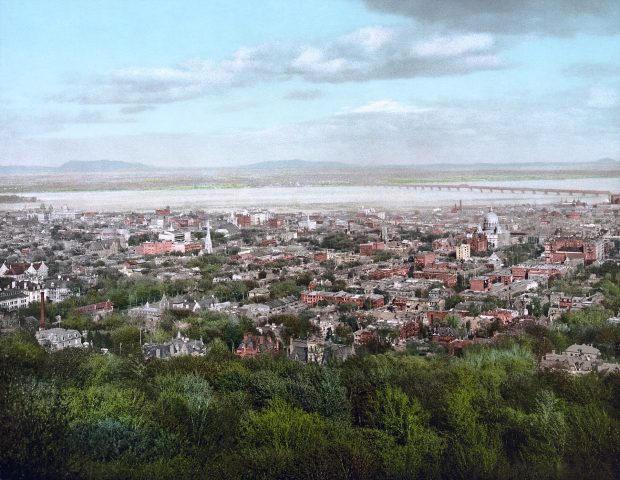
Old Montreal is where the city’s story begins. In 1642, French settlers established a fortified village called Ville-Marie along the banks of the St. Lawrence River, laying the foundation for what would become one of North America’s most vibrant cities. Today, the narrow cobblestone streets and historic buildings with their wrought-iron balconies feel like a piece of Europe transplanted onto Canadian soil. Walking through Place Jacques-Cartier or along the waterfront, it’s easy to imagine the bustling life of three centuries ago—fur traders haggling over pelts, sailors unloading ships, and monks from the nearby Notre-Dame-de-Bon-Secours Chapel praying for the colony’s prosperity.
The architecture here tells a story of its own, a layered history etched in stone. The district blends structures from different eras, from modest 17th-century houses with steeply pitched roofs to grand neoclassical mansions built in the 19th century, when Montreal was becoming Canada’s financial heart. The most striking landmark is Notre-Dame Basilica, constructed in the 1820s. Its interior is a dazzling display of craftsmanship—gilded sculptures, stained-glass windows, an intricately carved altar, and a massive organ that still fills the space with music during Sunday services. Outside, the Gothic Revival facade stands as one of the city’s most recognizable symbols.
Yet Old Montreal is more than just a collection of museums and monuments. It’s a living neighborhood where the past and present coexist. Former warehouses and merchant houses now house cafés, art galleries, and boutiques showcasing local designers. In summer, street musicians perform in front of the city hall, while in winter, the square transforms into an ice rink. As evening falls, the waterfront glows under the warm light of lampposts, their reflections dancing on the dark surface of the river. The district has a way of making time feel slower, inviting visitors to linger a little longer.
Rue Saint-Paul, the heart of the old commercial district, is one of the most atmospheric streets. Centuries ago, it was a hub of international trade, where merchants from France, England, and even distant Russia brought goods from across the globe. Today, the street is lined with antique shops selling vintage maps, coins, and furniture, alongside small restaurants serving traditional Quebecois dishes. One of the oldest buildings in the city, the Maison de Champlain, built in 1683, now houses a museum. Its walls, still standing after more than three hundred years, seem to whisper stories of the generations that once walked through its doors.
Near Place Jacques-Cartier, Montreal’s city hall stands as another notable landmark. Built in the 1870s in the Second Empire style, it resembles a smaller version of Paris’s Hôtel de Ville. Inside, opulent halls with ornate moldings and crystal chandeliers once hosted important guests. In the summer, the courtyard is filled with flowers, offering a quiet retreat under the shade of trees. It was from the balcony of this building in 1967 that Charles de Gaulle delivered his famous—and controversial—line, *Vive le Québec libre!*, a moment that left a lasting mark on both Canadian and French history.
Old Montreal also serves as a gateway to the broader history of Canada. Here, you can trace the country’s evolution from a small French colony to one of North America’s largest cities. The Pointe-à-Callière Museum, built on the site of the original settlement, displays artifacts uncovered during excavations—Indigenous tools, early settler implements, and antique maps. Beneath the museum’s glass floor, the foundations of 17th-century homes are visible, offering a literal window into the past.
But what truly makes Old Montreal special isn’t just its landmarks—it’s the atmosphere. The district has a way of making the rush of modern life feel distant. In the early morning, before the crowds arrive, you can stop by a corner bakery for a fresh croissant and stroll along the waterfront, watching gulls circle overhead and ships pass by. By midday, the streets come alive with artists sketching portraits, street performers entertaining passersby, and friends gathering on café terraces for coffee. As night falls, the district takes on a different character. The glow of lamplights reflects off the cobblestones, and the sound of live music—jazz, traditional Quebecois tunes—spills out from bars, creating a warm, inviting ambiance.
Winter transforms the neighborhood into something even more magical. Snow blankets the rooftops of historic buildings, and the scent of mulled wine and roasted chestnuts fills the air at the Christmas market in Place Jacques-Cartier. Even in the cold, the streets remain lively, with locals and visitors skating on the rink, admiring the festive decorations, or warming up with hot chocolate in a cozy café. The season adds a quiet charm to the district, making it feel like a scene from a storybook.
Old Montreal is a place where time moves differently. Every stone and street corner holds echoes of the past, yet the neighborhood remains firmly rooted in the present. It hasn’t become a static open-air museum; it’s a living, breathing part of the city. That’s why people keep coming back—not just to step into history, but to enjoy the simple pleasures of good food, warm conversations, and the beauty of old-world architecture. It’s a place where the past feels close enough to touch, but the present is just as inviting.