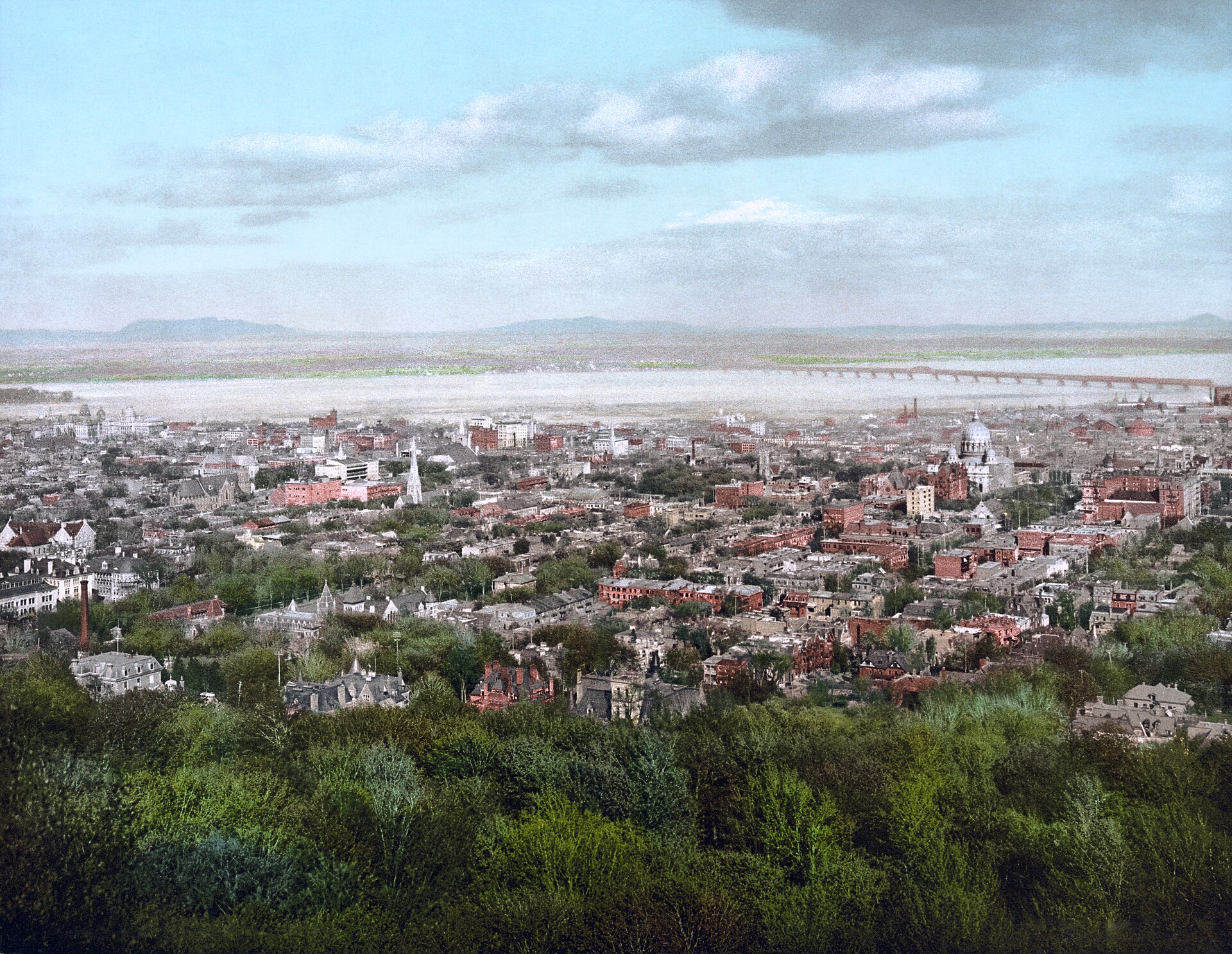
Mount Royal isn’t just a hill in the middle of Montreal—it’s the city’s green heart, a place where nature and urban life intersect in a way that feels almost effortless. Rising about 233 meters above the streets below, the mountain offers sweeping views of Montreal’s skyline, the St. Lawrence River winding through the city, and on clear days, the faint outlines of neighboring districts stretching toward the horizon. But the real magic of Mount Royal isn’t just the panorama. It’s the way the mountain absorbs the energy of the city while offering an escape from it. Within minutes of leaving the bustling streets, you can find yourself surrounded by quiet forest trails, the rustle of leaves, and the occasional call of a bird. It’s a place where locals come to unwind—whether on foot, by bike, or with a coffee in hand—without ever feeling like they’ve left the city behind.
The mountain’s history is as layered as the city itself. Jacques Cartier first climbed its slopes in 1535, naming it in honor of his patron, King Francis I of France. Yet for centuries, the land remained largely untouched, a wild contrast to the growing settlement below. It wasn’t until the mid-1800s that Montreal’s leaders decided to transform the mountain into a public park, a decision that would shape the city’s identity. The task fell to Frederick Law Olmsted, the visionary landscape architect behind New York’s Central Park. Olmsted’s approach was radical for its time: rather than imposing grand designs, he worked with the mountain’s natural contours, preserving its forests and adding only a few carefully placed paths, lookout points, and a small artificial lake—now known as Beaver Lake. His goal was simple: to create a space where people could experience nature without leaving the city. More than a century later, it’s hard to imagine Montreal without it.
The mountain’s most recognizable landmark is the illuminated cross that crowns its summit. The first wooden cross was erected in 1643, a desperate plea for divine intervention as floodwaters threatened the young settlement. The current steel structure, installed in 1924, stands as a modern symbol of the city’s resilience. At night, its glow is visible from across Montreal, a quiet reminder of the mountain’s enduring presence. Nearby, the Mount Royal Chalet offers another perspective. Built in 1932 in a neoclassical style, the chalet serves as both a lookout point and a café, its interior adorned with murals depicting key moments in Montreal’s history. From its terrace, the city unfolds below—a mix of old and new, where church spires and skyscrapers coexist.
Beyond its physical features, Mount Royal holds a special place in Montreal’s cultural life. It’s a stage for festivals, open-air concerts, and seasonal markets, a gathering spot for musicians, artists, and performers. In winter, the slopes become a playground for skiers and sledders, while summer draws picnickers, joggers, and families. Sundays are particularly lively, with locals flocking to the park for leisurely strolls or impromptu gatherings. Scattered throughout the mountain are monuments that tell fragments of the city’s story—a statue of King George VI, a Holocaust memorial—each a quiet testament to Montreal’s complex past.
The mountain’s natural diversity is one of its most understated charms. The forests here are a mix of maples, oaks, pines, and birches, their leaves shifting with the seasons—vibrant green in summer, fiery red and gold in autumn, blanketed in snow in winter. The park is home to squirrels, rabbits, raccoons, and even the occasional fox, while Beaver Lake attracts ducks, swans, and other waterfowl. Birdwatchers will find plenty to admire, from woodpeckers and chickadees to hawks circling overhead. The changing seasons transform the mountain’s character, offering something new with each visit. Spring brings wildflowers and the return of migratory birds, summer hums with the sound of crickets and rustling leaves, autumn paints the landscape in warm hues, and winter turns the trails into a serene, snow-covered retreat.
One of the mountain’s greatest gifts is the way it frames Montreal. From its lookout points, the city reveals itself in layers—the historic streets of Old Montreal with their cobblestones and church steeples, the sleek glass towers of the downtown core, the Jacques Cartier Bridge arching over the St. Lawrence, and the distant silhouette of Île Sainte-Hélène, home to the La Ronde amusement park. The view shifts with the seasons and the light, offering a different mood each time. On a crisp winter morning, the city looks like a snow globe, pristine and still. In autumn, the foliage turns the skyline into a patchwork of reds and oranges. Summer brings a sense of energy, the river glinting under the sun, while spring feels like a promise, the city shaking off its winter slumber.
What makes Mount Royal truly special is how it balances these elements—history, nature, and modern life—without ever feeling forced. It’s a place where you can spend an entire day wandering from one trail to another, stopping at a café, or simply sitting on the grass with a book. The mountain adapts to whatever you need it to be: a quiet refuge for solitary reflection, a playground for families, or a backdrop for gatherings with friends. It’s deeply embedded in the rhythm of Montreal life, a place people return to again and again, whether to clear their heads, soak in the views, or simply feel the pulse of the city from a distance.
In a place where urban and natural landscapes often feel at odds, Mount Royal is a rare harmony. It’s not just a park or a viewpoint—it’s a living part of Montreal, a reminder that even in a bustling city, there’s room for wildness, for stillness, for the kind of quiet beauty that lingers long after you’ve left its slopes. Whether you’re a first-time visitor or someone who’s walked its trails a hundred times, the mountain has a way of making you feel at home.