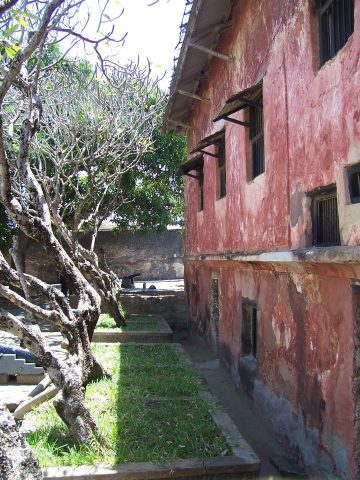
Mombasa moves at the pace of the Indian Ocean lapping against its shores—unhurried, rhythmic, as if time itself has learned to breathe with the tide. The Old Town isn’t just a collection of narrow streets and weathered buildings; it’s a living archive of centuries where trade, piracy, colonial ambition, and cultural exchange have left their marks like layers of paint on an old door. Walk its winding paths, and the creak of wooden balconies beneath your feet mixes with the scent of spices carried on the salt-tinged air. Every corner here carries the weight of history—Arab merchants haggling over ivory, Portuguese soldiers marching through the gates of Fort Jesus, Indian craftsmen carving intricate patterns into doorframes, and British administrators drafting maps in the shade of coral-stone walls.
The boundaries of the Old Town blur where the modern port’s bustle fades into the quiet of its alleys. There’s no clear line marking where one ends and the other begins, but the moment you step off the wide, sunlit avenues into the cool shade of its passages, the shift is unmistakable. The buildings here are made of coral rag, a porous stone once quarried from the ocean floor, their facades adorned with wooden balconies that hint at Indian influence. Some still bear the arched doorways of Portuguese design, while others are wrapped in the delicate geometric patterns favored by Omani architects. In places, the walls are pocked with the scars of cannon fire, silent reminders of the city’s turbulent past.
Long before European ships appeared on the horizon, Mombasa was already a crossroads of trade. Arab traders settled here as early as the 8th century, turning it into a vital hub for spices, ivory, and, tragically, enslaved people. By the 16th century, the Portuguese had seized control, building Fort Jesus as a stronghold and making Mombasa the linchpin of their Indian Ocean empire. The Omani sultans took over in the 17th century, bringing with them Islamic traditions and a new architectural language that still defines parts of the Old Town. The British arrived in the late 1800s, adding their own layer to the city’s identity with administrative buildings and the railway that would later connect Mombasa to the interior.
At the heart of the Old Town lies Diani Square, once the throbbing center of commerce where deals were struck and fortunes made. Today, it’s quieter, but the echoes of its past linger in the air. Nearby stands the Mandhry Mosque, one of the oldest in Mombasa, its simple lines and slender minaret a testament to the city’s Islamic heritage. Not far away, the Portuguese-built Holy Ghost Cathedral offers a counterpoint—a reminder of how faiths and cultures have coexisted here, sometimes uneasily, but always in close proximity.
The streets of the Old Town are a maze, deliberately so. There’s no grid, no logic to their twists and turns, just an organic tangle of alleys that lead to dead ends, hidden courtyards, and sudden glimpses of the ocean. It’s easy to lose your way, but that’s part of the charm. The shops lining these narrow passages sell everything from antique coins and carved chests to sacks of spices and bolts of fabric in bold African prints. The shopkeepers often sit outside, sipping tea, and if you show interest, they’ll happily spend hours telling you the stories behind their goods—how this spice came from Zanzibar, how that chest was made by a craftsman whose family has lived in Mombasa for generations.
One of the most striking features of the Old Town is its doors. The grand, ornate entrances of the old Arab houses are works of art in themselves—massive, studded with metal spikes, and carved with intricate geometric patterns. They weren’t just for show; they were a statement of wealth and a deterrent to thieves. Step inside, and you’ll find cool, shaded courtyards where the heat of the day feels distant. The walls are often lined with old photographs and household objects, each one a fragment of a life lived in these spaces.
The Old Town isn’t a museum, though. It’s still very much alive, even as modern development encroaches from all sides. People live here, going about their daily routines in ways that haven’t changed much over the decades. In the mornings, women in bright kikoys balance baskets of fruit on their heads as they weave through the alleys, while old men sit on benches, debating politics or the latest football scores. By evening, the streets come alive with music spilling out of bars and the smell of grilled fish and ugali cooking over open flames. Locals gather here to eat, drink, and catch up, turning the Old Town into a communal living room.
A walk through these streets isn’t just about ticking off sights. It’s about stepping into a rhythm that’s older than the city itself. There are no crowds of tourists here, no guided tours rushing from one landmark to the next. Instead, there’s time—to wander, to get lost, to duck into a tiny café where the chai is brewed with fresh ginger and served in chipped enamel cups, or to sit by the water’s edge as the sunset turns the coral walls gold. In moments like these, Mombasa reveals itself not just as a place on a map, but as a city where history isn’t something you read about, but something you feel in the worn stones beneath your feet.