Maguwoharjo Stadium isn’t just a place where football is played—it’s a quiet witness to the rhythms of life in a corner of Java where sport, history, and daily existence intertwine. Tucked away in the small settlement of Wukirsari, not far from Yogyakarta, it serves as the heart of the region’s sporting life, hosting matches and gatherings that feel far removed from the polished spectacle of big-city arenas. There’s no metropolitan hustle here, just the steady pulse of a community where football isn’t just entertainment but a way of being.
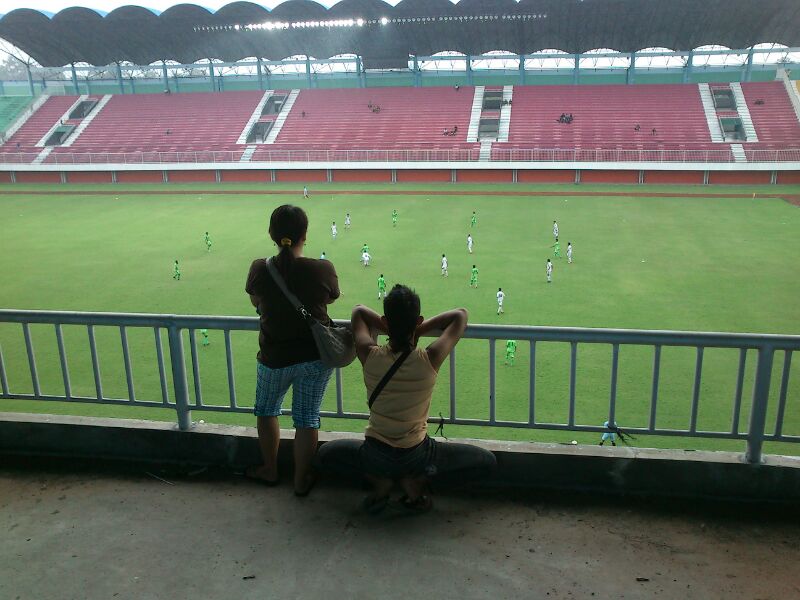
The stadium’s design is unassuming, reflecting the practicality of its surroundings. The stands hold a few thousand spectators, yet even on match days, there’s none of the suffocating crowding found in larger venues. Instead, the space feels open, almost intimate, with fans close enough to the action to feel like participants rather than distant observers. The pitch is framed by a running track, and beyond that, gentle green slopes soften the rigid lines of the structure. On clear days, the view from the upper tiers stretches over rice paddies, a reminder that this place exists where rural life and sport overlap.
Maguwoharjo is deeply tied to Yogyakarta’s football history, serving as the home ground for Persis Solo, one of Indonesia’s oldest and most storied clubs. Founded in 1923, the team once embodied the sporting spirit of Central Java, and though it no longer competes at the highest national level, its matches still draw loyal supporters. For locals, the stadium is more than a venue—it’s a living archive of victories and defeats, of players who once wore the yellow and black stripes and left their mark on the game. The club’s legacy is woven into the fabric of the place, even if the crowds today are smaller than in its heyday.
Life at Maguwoharjo moves at its own pace. On days without matches, the field becomes a playground for children kicking a ball or teenagers jogging along the track. Sometimes, it transforms into a stage for school competitions or village festivals, adapting to the needs of the community. Unlike the tightly scheduled operations of major stadiums, this one breathes with the unhurried tempo of a small town, where sport isn’t a business but a shared experience. There’s no pressure here, no sense of urgency—just the quiet understanding that the field will always be there, ready for the next game or gathering.
The stadium’s story is part of Indonesia’s broader football narrative, shaped by the country’s colonial past and its journey toward independence. In the early 20th century, sport was one of the few outlets for local expression, and stadiums like Maguwoharjo became spaces where identity took root. After independence, it witnessed pivotal moments—early international matches, games that drew thousands long before television brought the sport into homes. Today, it stands as a reminder of a time when football was simpler, when the passion of the crowd wasn’t drowned out by commercial noise.
Architecturally, Maguwoharjo makes no grand statements. Its mid-century concrete structure is functional, with open stands that lack the barriers and VIP sections of modern venues. Everything is designed to bring spectators as close to the action as possible. On hot days, makeshift awnings provide shade, but even without them, the stadium doesn’t feel unwelcoming. Perhaps that’s because its scale fits the town it serves—a place where people still know each other’s names, where the stadium isn’t an imposing landmark but a familiar part of the landscape.
For travelers who stumble upon it, Maguwoharjo offers a glimpse into a side of Indonesian football rarely seen by outsiders. There are no tourist crowds, no souvenir stalls, no guides hustling for attention. Instead, there’s the chance to experience sport as it exists beyond the big cities, where it hasn’t been walled off by ticket prices and advertising. If you’re lucky enough to catch a match, you’ll find the kind of atmosphere that defines football here: the rhythmic chants of fans, the scent of grilled corn from vendors outside, the unfiltered joy and frustration on the faces of those watching. It’s raw, unpolished, and all the more real for it.
The stadium doesn’t stand apart from its surroundings—it’s part of them. Beyond its boundaries lie villages where life moves to its own beat, where rice fields give way to rolling hills covered in tropical greenery. Wukirsari isn’t a tourist hub but a typical Javanese settlement, where people recognize each other on sight. Maguwoharjo doesn’t feel like an intrusion; it belongs here, as much a part of the scenery as the local mosque or the weekly market. That sense of belonging is what makes it feel less like a stadium and more like a communal space, one that has grown organically from the needs of the people around it.
Times change, and so does the world of football. Modern stadiums with their high-tech amenities are slowly replacing places like Maguwoharjo, but here, that shift doesn’t feel like a loss. Sport in this part of Java was never just about records or revenue—it was about connection. The stadium remains a place where that connection happens, whether the crowd numbers in the thousands or just a few hundred. For a few hours, the outside world fades, and all that matters is the game unfolding on the pitch, the shared cheers, the collective breath held in anticipation. In that moment, it doesn’t matter if the stands are full or half-empty. What matters is that they’re here, together.