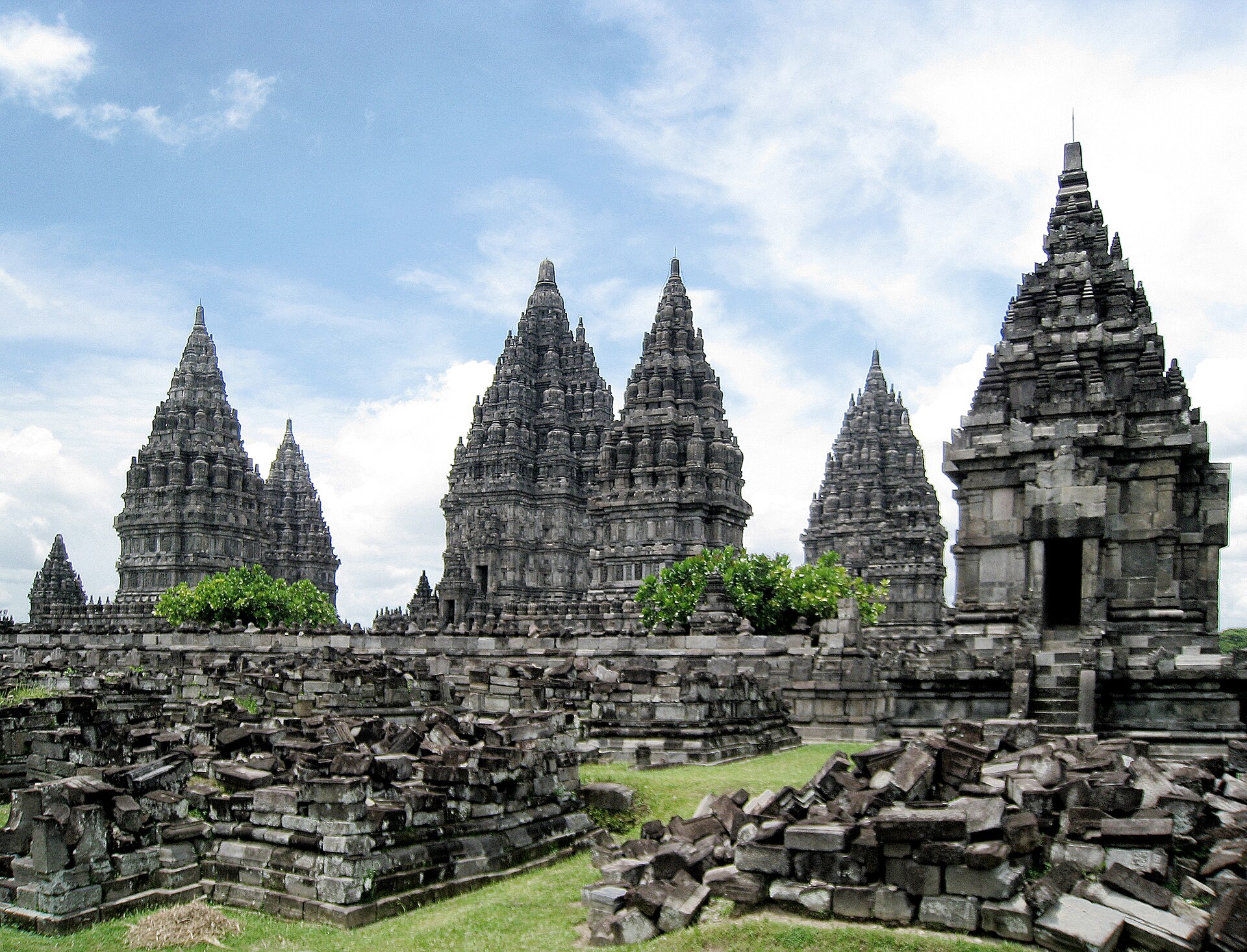
Prambanan stands on the plains of Central Java, not far from the city of Yogyakarta, its towering spires cutting sharp silhouettes against the sky. Built in the ninth century, this sprawling temple complex was conceived as a grand tribute to the Hindu Trimurti—Brahma, Vishnu, and Shiva—and remains one of the most striking examples of classical Javanese architecture. The temples were constructed during the reign of the Sanjaya dynasty, when the Mataram Kingdom flourished, and for a time, Prambanan served as both a spiritual center and a symbol of royal power. Yet within a few centuries, the complex was abandoned, swallowed by volcanic ash and jungle, only to be rediscovered by European explorers in the 19th century. Restoration efforts began in earnest in the 20th century, and while some sections are still being pieced back together, the site now welcomes visitors, offering a glimpse into Java’s layered past.
The heart of Prambanan is the towering Shiva temple, rising nearly thirty meters high. Its walls are adorned with intricate bas-reliefs depicting scenes from the Ramayana, the ancient Indian epic, their stone carvings worn but still vivid. Inside, a statue of Shiva Mahadeva stands in quiet majesty, flanked by smaller shrines dedicated to his consort Durga and son Ganesha. Nearby, the temples of Vishnu and Brahma mirror its grandeur, their symmetrical design creating a sense of balance and harmony. The architecture here is a study in contrasts—massive yet delicate, austere yet richly decorated—reflecting the sophistication of Javanese craftsmanship.
What makes Prambanan particularly striking is its setting. The complex sits on an open plain, surrounded by low hills, where the light shifts dramatically throughout the day. In the late afternoon, the stone takes on a warm, golden hue, and as the sun dips below the horizon, the shadows stretch long across the ground. It’s a time when the site feels especially alive, whether from the soft strains of traditional Javanese music drifting through the air or the quiet conversations of visitors lingering to watch the sky change color. The atmosphere is one of quiet reverence, a place where the past doesn’t feel distant at all.
Prambanan’s story is intertwined with that of Borobudur, the great Buddhist stupa located some fifty kilometers away. Together, these two monuments represent the religious pluralism that has long defined Java. In their heyday, both were major pilgrimage sites, drawing devotees from across Southeast Asia. Today, they stand as reminders of how different faiths once coexisted on the island, their legacies preserved in stone. While Borobudur is often more widely recognized, Prambanan holds its own as a testament to the island’s Hindu heritage, its temples a physical manifestation of devotion and artistry.
Walking through Prambanan, it’s easy to imagine the rituals that once took place here—the scent of incense, the murmur of prayers, the flicker of oil lamps in the dim interiors. The surrounding landscape reinforces this sense of timelessness. Rice paddies stretch out in neat green patches, and nearby villages move at a pace that hasn’t changed in generations. For many Javanese, Prambanan is more than a historical site; it’s a sacred place, still holding spiritual significance. Even now, religious ceremonies are occasionally held here, a living connection to the traditions of the past.
Though Prambanan may not have the global fame of some other ancient sites, its importance to Indonesia is profound. It’s not just a tourist attraction but a cornerstone of national identity, a symbol of the cultural resilience that has endured for over a thousand years. Recognized as a UNESCO World Heritage site, it serves as a reminder of the shared human heritage that transcends borders. For those who visit, Prambanan offers more than just a look at old stones—it’s an encounter with history, a place where the weight of centuries feels tangible.
In recent years, the site has become more visitor-friendly, with well-maintained pathways, informational signs, and small museums offering context. Yet the essence of Prambanan remains unchanged. It’s a place where time seems to pause, where the air hums with the echoes of the past. Whether you’re drawn by history, architecture, or simply the quiet beauty of the place, Prambanan has a way of leaving an impression that lingers long after you’ve left its shadowed corridors.