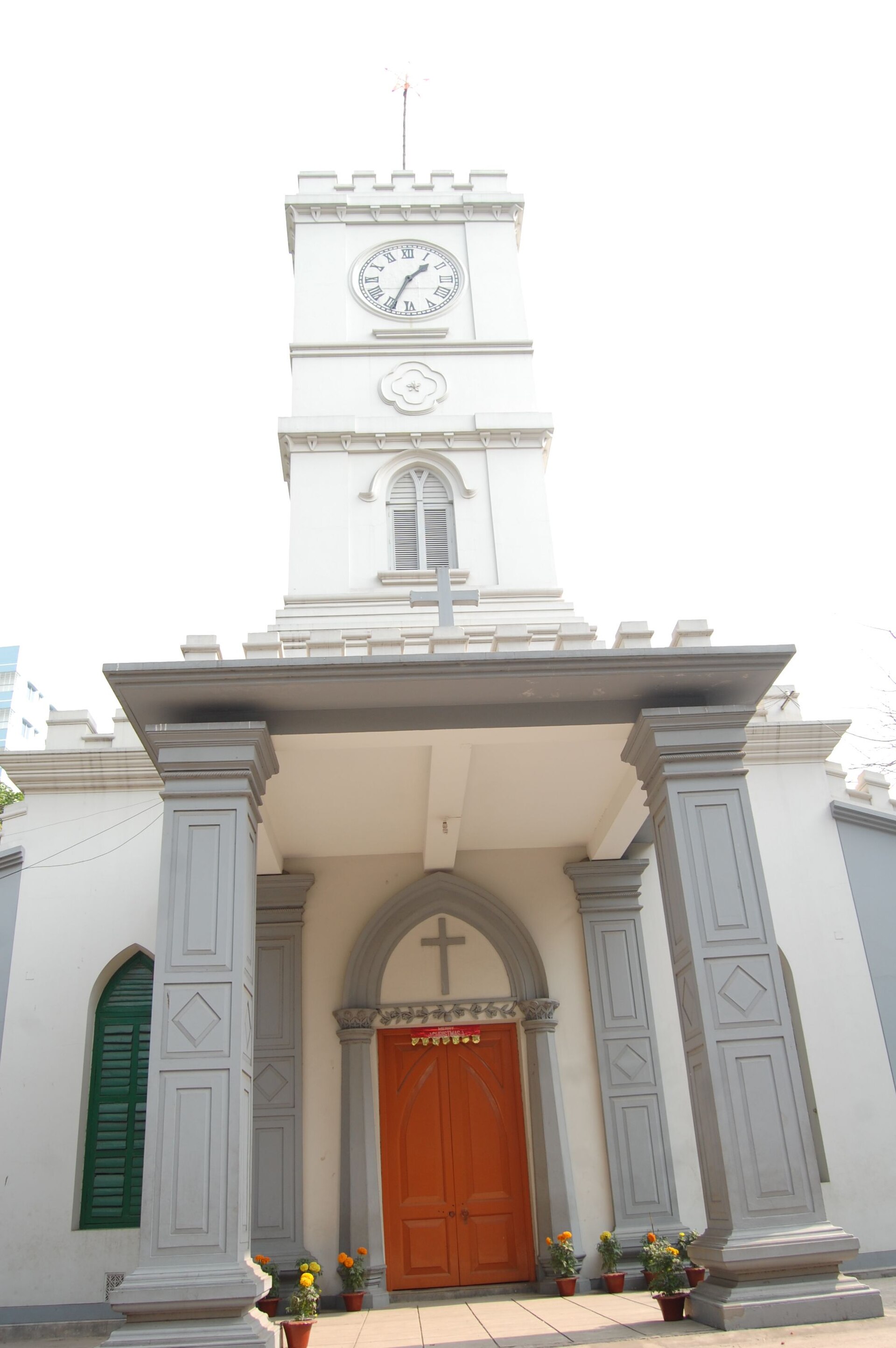
St Thomas Church in Dhaka is one of those quiet places that seem suspended in another era, a remnant of the colonial past tucked away in the heart of the city. Built in the mid-19th century, it stands on a narrow street in Nawabpur, where the frantic pace of modern Dhaka gives way to the stillness of old brick and mortar. The church is small, its modest size only adding to its charm—there’s no grandeur here, just a sense of authenticity, as if the walls themselves remember the people who have passed through over the last hundred and fifty years.
The architecture is unmistakably British, with its whitewashed brick walls, tall pointed windows, and simple bell tower, yet there are subtle hints of its South Asian setting. The wooden shutters, designed to shield against monsoon rains, and the small inner courtyard where parishioners once gathered after services, reveal its local roots. Inside, the church retains much of its original character: dark wooden pews, a carved pulpit, and memorial plaques on the walls commemorating British officials, merchants, and missionaries who once called Dhaka home.
The history of St Thomas Church is woven into the fabric of the city itself. In the 19th century, Dhaka was a thriving commercial hub of British India, attracting Europeans who came for trade or administration. For them, the church was more than a place of worship—it was a slice of familiar life in an unfamiliar land. After the partition of India in 1947, many of the British community left, and the church’s role as a center of expatriate life faded. But it was never abandoned. Local Christians kept it alive, and over time, others came to appreciate its historical significance.
Today, the church remains active, though its congregation is far smaller than in colonial times. Services are held in both English and Bengali, and among the worshippers, you’ll find descendants of old Christian families as well as foreigners living in Dhaka. Visitors are welcome, though few tourists make their way here. Those who do often remark on the peaceful atmosphere—unlike the bustling mosques or crowded markets, this is a place where you can sit quietly, watching the soft light filter through the stained glass.
The surrounding neighborhood of Nawabpur is one of Dhaka’s oldest, with narrow lanes lined by low-rise buildings from the colonial era. Small workshops, fabric shops, and spice stalls still operate here, and in the mornings, the air fills with the sounds of bargaining at the local market. It’s not a polished tourist district, but that’s what makes it interesting. This is the real Dhaka, where daily life unfolds without pretense.
St Thomas Church isn’t the kind of place that demands attention. It doesn’t feature on lists of must-see attractions, and many people walk past without noticing it. But that’s part of its appeal—it doesn’t try to impress, it simply exists, a quiet reminder of a time when Dhaka was a very different city. For those curious about history, architecture, or just looking to see the city from a different angle, this little church can be a small revelation.
In recent years, Bangladesh has shown a growing interest in preserving its historical landmarks, and St Thomas Church has caught the attention of conservationists. While no major restorations have taken place yet, the building is well-maintained, and there’s hope it will endure for future generations. After all, places like this are more than just old structures—they’re living pieces of history that help us understand how the city and the country came to be.
A visit to St Thomas Church won’t take long, but it can be a rewarding detour while exploring Old Dhaka. There are no crowds, no souvenir stalls, no pushy guides—just silence, history, and the feeling that time moves a little slower here. Maybe that’s why those who stumble upon it often find themselves returning.