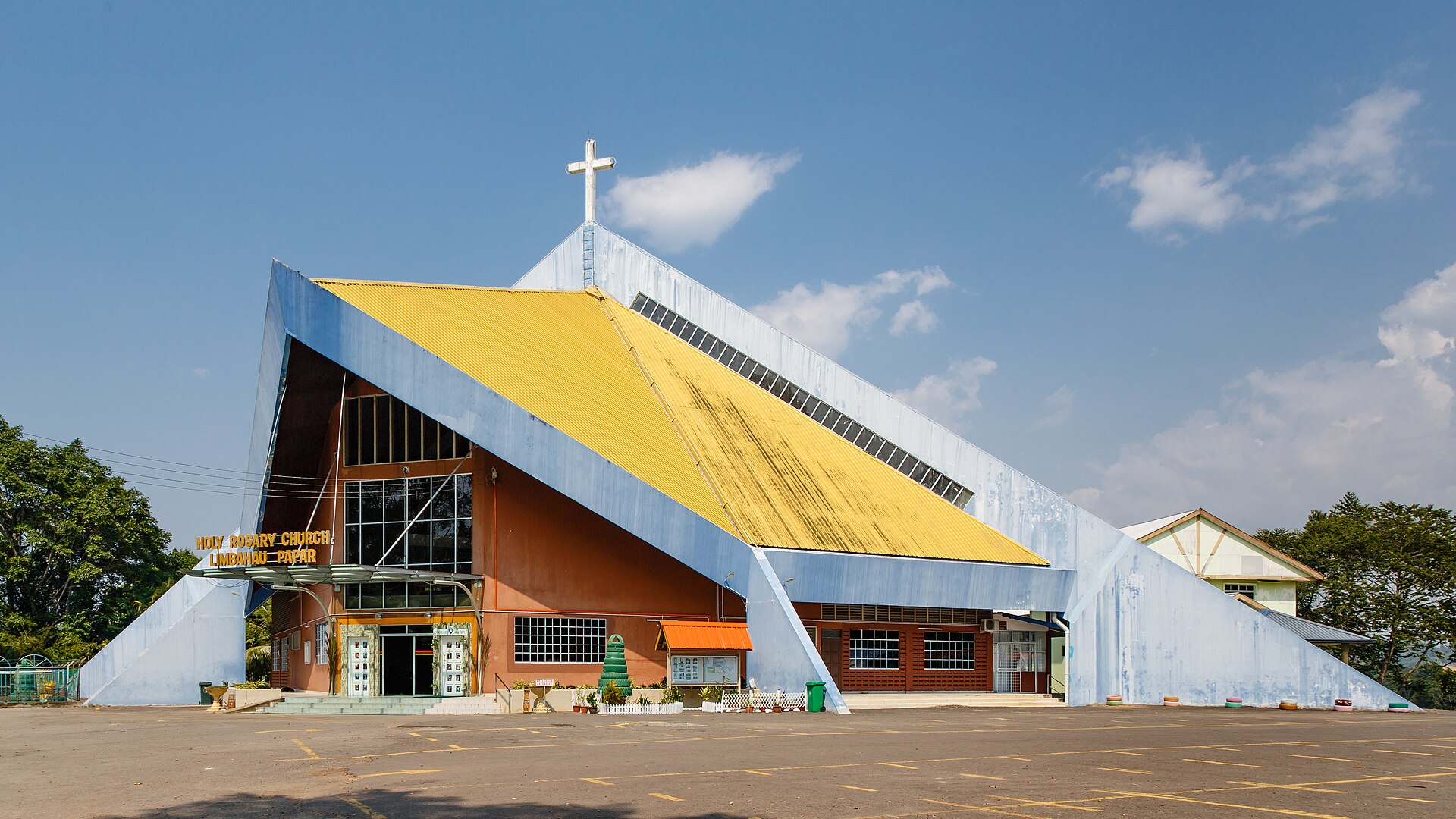
St. Rosary’s Church in Dhaka is one of those rare places that feels untouched by time. Built in 1677 by Portuguese missionaries, it is the oldest Catholic church in Bangladesh. Dhaka was then a distant outpost of the Mughal Empire, and European presence in the region was uncommon. The church’s unassuming facade does not reveal its significance—it blends colonial influences with local craftsmanship.
From the outside, the church does not stand out. Its whitewashed walls and modest bell tower are simple, almost blending into the neighborhood. This simplicity is part of what makes it appealing. The building’s proportions are human-scale, unlike the dense, chaotic sprawl of old Dhaka just beyond its walls. Inside, the space opens up with high ceilings. Wooden pews line the nave, leading to an altar adorned with images of saints, their faces worn by time. The interior is spare: stained glass filters soft light onto the stone floors, and carved details show the hands that shaped it centuries ago.
St. Rosary’s is more than a place of worship. Over the centuries, Dhaka has transformed from a Mughal capital to a British colonial hub and into the capital of independent Bangladesh. The church has stood through these changes, serving Dhaka’s small Christian community. It remains active, with parishioners lighting candles and visitors pausing to absorb the stillness.
The neighborhood around the church, Tejgaon, was once on the outskirts of Dhaka. Now it is part of the city’s core but retains an older rhythm. Narrow lanes wind past low-slung houses. Nearby, small shops sell religious trinkets and candles. In the mornings, the scent of spiced tea and frying snacks drifts from street stalls, mixing with the incense around the church. Life here moves at a different pace, even as traffic noise never quite fades.
What makes St. Rosary’s compelling is how it has survived wars, political upheavals, and urbanization. The best moments to visit are during services, when prayers in Bengali and Latin fill the air, and sunlight through the stained glass paints the walls. For those seeking respite from Dhaka’s energy, the church offers a sense of continuity.
In a country where Islam is the dominant faith, Christian sites like St. Rosary’s are uncommon. The church plays a vital role for Dhaka’s Catholic community, gathering generations during major holidays like Christmas and Easter. These events draw worshippers from across the city, reinforcing its role as a spiritual anchor.
The architecture of St. Rosary’s shows adaptation. While its origins are European, the building bears local influences. The roof curves in a style reminiscent of traditional Bengali structures, and the windows echo the arched designs of Mughal palaces. Early builders worked with available materials, blending European aesthetics with practical considerations. The result is a structure that feels at home in its surroundings.
Today, St. Rosary’s attracts more than worshippers. Tourists and history enthusiasts visit for its age and stories. Some photograph its facade or the light inside; others sit on the pews, soaking in the quiet. Nearby vendors sell postcards and religious souvenirs, and tea stalls serve visitors. It is a reminder that even in a city like Dhaka, there are pockets of calm.
St. Rosary’s Church shows how history and modernity can coexist. It is a place where the past is lived, where prayers from centuries ago still matter. For anyone exploring Dhaka, it offers a different perspective, revealing layers beneath the noise. In a city where the past is often overshadowed, the church invites visitors to pause.