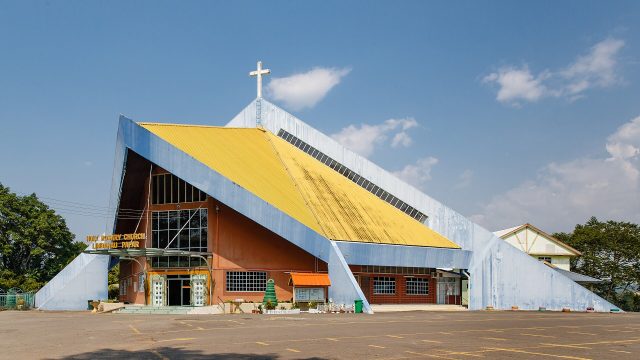
The Church of the Holy Resurrection in Dhaka is one of those quiet places that carry the weight of the city’s layered past. Tucked away on Armanian Street, it stands as a testament to the diverse influences that have shaped Bangladesh’s capital over centuries. Built in the mid-1800s, when Dhaka was still part of British India, the church was a gathering point for a small but resilient Orthodox Christian community—traders, diplomats, and missionaries who had traveled far from Russia and other parts of the world. For them, it was more than a place of worship; it was a connection to home in a city where they were outsiders.
The architecture reflects this dual identity. The building follows the neoclassical style common to many 19th-century churches, with its clean white walls, tall arched windows, and understated elegance. Yet there’s something distinctly local about it too, as if the design softened to suit the climate and the surroundings. Inside, the iconostasis and frescoes echo the traditions of Russian Orthodoxy, though the details feel adapted to the warmth and light of South Asia. The effect is subtle but striking—a blend of familiarity and foreignness that makes the church feel both timeless and rooted in its place.
Over the years, the church has become a bridge between cultures. Services are held in Bengali, English, and Church Slavonic, a nod to the changing faces of its congregation. While the original community was largely made up of expatriates, today’s parish includes locals who have embraced Orthodoxy, as well as visitors drawn by curiosity or faith. On feast days, the church comes alive with voices raised in hymns, the scent of incense lingering in the air, and the quiet hum of conversations in multiple languages. For many, it’s a rare space where the past and present coexist without tension.
Dhaka is a city of relentless motion, where the streets pulse with energy and the skyline shifts with each passing year. Yet the Church of the Holy Resurrection remains a pocket of stillness. The neighborhood around it, with its narrow lanes and colonial-era buildings, feels like a holdover from another era. Walking here, you can almost forget the modern metropolis beyond the next block. The church itself is unassuming, easy to miss if you’re not looking for it, but that only adds to its charm. It doesn’t demand attention; it simply exists, a quiet witness to the city’s evolution.
For most travelers, this isn’t the kind of place that makes it onto postcards or top-ten lists. There are no grand monuments or dramatic vistas, just a modest building with a story to tell. But for those who seek out the layers beneath Dhaka’s surface, the church offers something rare: a glimpse into the city’s religious and cultural diversity. It’s a reminder that Bangladesh, often seen through the lens of its Muslim majority, has always been a place where different faiths have found a way to coexist. The Orthodox community here was never large, but its presence was meaningful, leaving behind a legacy that endures in brick and mortar.
The church’s role has shifted over time. Once a spiritual home for Russian expatriates, it now serves a more diverse flock. Some are descendants of the original parishioners, while others are Bengalis who have converted or married into the faith. The services, with their mix of languages and traditions, reflect this change. There’s no single narrative here, just a living tradition that has adapted to the rhythms of the city. On ordinary days, the church is quiet, its doors open to anyone who wishes to step inside. On holidays, it fills with light and song, a brief but vivid moment of celebration.
What makes the Church of the Holy Resurrection special isn’t just its age or its architecture, but the way it embodies the idea of home. For the people who gather here, it’s a place where they can be both Bengali and Orthodox, where the rituals of their faith connect them to a wider world. For outsiders, it’s a window into a lesser-known side of Dhaka, one that challenges simplistic notions of what the city—or the country—is about. It doesn’t fit neatly into the usual categories of tourist sites or religious landmarks. Instead, it exists in the in-between spaces, where history and modernity, local and foreign, sacred and everyday all overlap.
Visiting the church is a low-key experience. There’s no grand entrance or guided tour, just the chance to sit quietly in the pews or admire the icons. The real draw isn’t the building itself, but the sense of continuity it represents. In a city that’s constantly reinventing itself, the Church of the Holy Resurrection is a rare constant—a place where the past isn’t just remembered, but still alive. For those willing to look beyond the obvious, it offers a different way of understanding Dhaka, one that’s richer and more nuanced than the usual narratives allow.