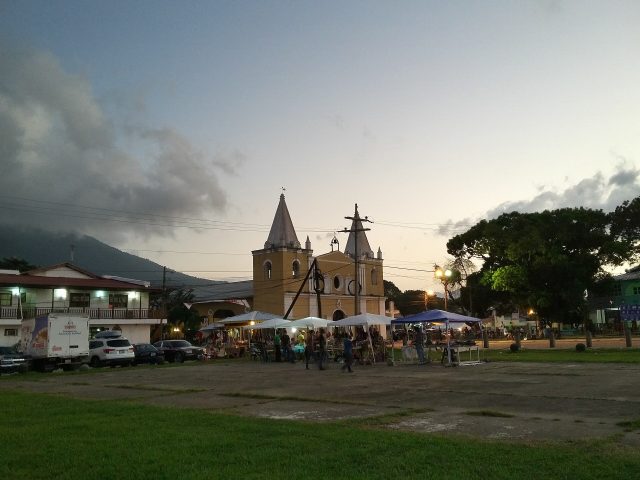
St. John the Baptist Cathedral in Trujillo is one of those places where time seems to stand still, holding within its walls the echoes of centuries past. Trujillo itself, founded by Spanish conquistadors in the early 1500s, was Honduras’ first capital, and the cathedral rose soon after as a symbol of both faith and colonial authority. Today, it occupies a quiet corner of the central square, surrounded by low-slung houses with terracotta roofs, its presence a reminder of the city’s layered history. The streets around it feel untouched by the rush of modern life, as if the footsteps of monks, the tolling of bells, and the murmur of prayers still linger in the air.
The cathedral’s architecture is a testament to the early colonial era—thick stone and brick walls, clean lines, and an almost austere simplicity. From the outside, it appears unassuming, even severe, but stepping inside reveals a different world. High vaulted ceilings, dark wooden beams, and faded frescoes create an atmosphere of solemnity, while the gilded altar, a masterpiece of Baroque craftsmanship, commands attention. Though the years have worn some details, the altar retains its grandeur, each carving and flourish a quiet tribute to the anonymous artisans who shaped it. The stained glass, though modest, casts soft light across the stone floors, and the wrought-iron grilles add a touch of intricate beauty to the otherwise restrained interior.
The cathedral has not always looked as it does today. Over the centuries, it has endured earthquakes, fires, and the raids of pirates who once plagued Trujillo’s shores. In the 17th century, the city was a frequent target for English and Dutch corsairs, and the cathedral, as the most prominent building, often bore the brunt of their attacks. After one particularly devastating assault, it was nearly reduced to ruins, only to be rebuilt again and again. Each reconstruction left its mark, turning the structure into a kind of architectural palimpsest. The bell tower, for instance, was added later and stands in contrast to the rest of the building—lighter, more delicate, with arched openings that frame the sky.
For the people of Trujillo, the cathedral is far more than a historical monument. It remains the heart of the city’s spiritual life, where baptisms, weddings, and funerals are held, and where the rhythms of daily worship continue uninterrupted. On feast days, especially Christmas and Easter, the square outside fills with music, laughter, and the scent of street food, while inside, the air hums with prayers and hymns. Even on ordinary days, the cathedral offers a refuge from the heat and noise. Elderly women kneel in quiet devotion, children fidget in the back pews, and visitors pause to trace the cracks in the walls, each one a silent witness to the passage of time. The cool interior provides a respite from the tropical sun, a place where the weight of history feels almost tangible.
Beyond its religious significance, the cathedral also serves as a keeper of Trujillo’s past. Within its walls are artifacts that tell the story of the city and the wider region—ancient religious texts, crucifixes, icons, and even pre-Columbian relics unearthed during restorations. Trujillo sits on land once inhabited by the Maya, and fragments of that earlier era occasionally surface, linking the cathedral to a time long before the Spanish arrived. In this way, the building bridges different epochs, connecting the indigenous past with the colonial era and the present day.
Trujillo itself is a city apart from Honduras’ more tourist-driven destinations. There are no crowded beaches or archaeological parks here, just the slow, unhurried pace of provincial life. The cathedral is the natural starting point for exploring the city. From its steps, you can wander down narrow streets lined with pastel-colored houses, stop for a plate of baleadas or a cup of strong coffee in a local café, or make your way to the nearby Fortaleza de Santa Bárbara, where the Caribbean Sea stretches out in the distance. The square in front of the cathedral is always alive—children chasing each other, vendors selling fresh fruit and handmade crafts, old men playing dominoes under the shade of trees.
What makes St. John the Baptist Cathedral special is that it is not a relic frozen in time, but a living place where history continues to unfold. It has survived wars, natural disasters, and the slow erosion of centuries, yet it endures, absorbing the stories of those who pass through its doors. Stepping inside, you sense that time moves differently here—slower, deeper, without the urgency of the outside world. That may be why people return, not just to admire its architecture or learn its history, but to feel, even for a moment, that connection to something enduring. In a world that often feels disconnected from the past, the cathedral offers a rare sense of continuity, a reminder that some things, no matter how old, never truly fade.