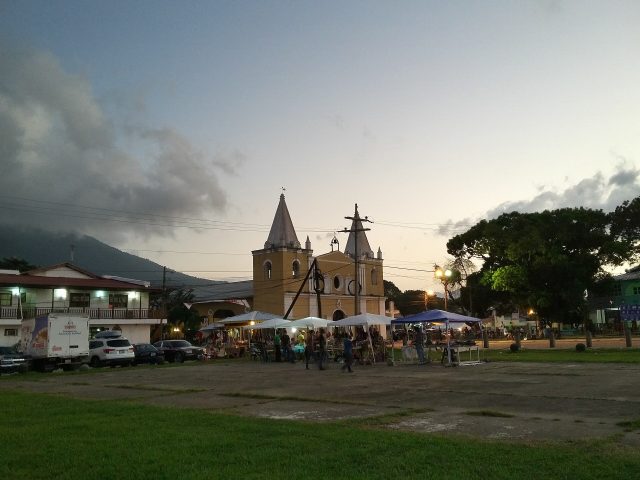
Trujillo’s Central Park isn’t just a square in the middle of town—it’s where the city’s past and present quietly collide, where the rhythm of daily life unfolds under the shade of sprawling trees. Here, the Caribbean coast of Honduras reveals itself in small, unscripted moments: elderly men hunched over domino games, children darting after pigeons, vendors arranging piles of ripe fruit and warm bread on wooden stalls. The park is modest in size, but its intimacy only makes it feel more alive, a place where every corner seems to hold a whisper of history.
Founded by the Spanish in the early 1500s, Trujillo is one of Honduras’ oldest cities, and this park was its first public space. Back then, the square wasn’t just for markets and gatherings—it was where royal decrees were announced, religious processions wound through the streets, and, occasionally, justice was meted out in more brutal forms. Little remains of that era now, save for a few architectural traces, but the park still carries the weight of those centuries. The feeling is strongest in the evenings, when the daytime bustle fades and the only sounds are the rustle of leaves and the occasional murmur of passersby.
The buildings around the park tell their own story, a blend of colonial influences and later additions. On one side stands the Cathedral of St. John the Baptist, built in the 18th century. Its whitewashed walls and unassuming facade don’t demand attention, but inside, time-worn wooden pews and faded altars hint at the generations who have worshipped here. Next to the cathedral, the municipal building—with its bright yellow exterior and white columns—serves as the city’s administrative heart. Along the other sides of the park, low-slung houses with tiled roofs and wrought-iron balconies now house cafes, small shops, and apartments. Many of these structures have been rebuilt after hurricanes, but their original character remains, a testament to the resilience of the town.
Central Park is more than a historical landmark; it’s a social hub where Trujillo comes together. Festivals, concerts, and fairs spill across the square, drawing people from all corners of the city. The liveliest time is during the Festival of San Juan, when the park transforms into an open-air stage, filled with music, dancing, and the scent of grilled corn. Local artisans set up stalls selling handwoven baskets, shell jewelry, and traditional Honduran crafts. Even on ordinary days, the park retains a festive undercurrent, though the pace slows, and the energy becomes more relaxed.
For visitors, Central Park is often the starting point for exploring Trujillo. From here, it’s easy to wander down to the waterfront, visit small museums, or head to the beach, just a short walk away. The park is also a place where directions and recommendations come naturally—locals are friendly but never pushy, happy to chat if you show interest, but just as content to let you observe. There’s no performative hospitality here, just the quiet sense that you’ve slipped into the flow of everyday life.
The park’s greenery adds to its charm. Tall palms sway alongside mango trees, their broad leaves casting dappled shade over the square. Bright flowers bloom in patches, and in the center, a small fountain draws children who splash in its cooling streams on hot afternoons. By evening, the water reflects the glow of streetlights, creating a soft, inviting atmosphere. Benches encircle the fountain, offering a place to sit with a coffee or simply watch the city go by. Street musicians often gather here, playing guitars or the marimba, a traditional Honduran instrument, their melodies blending with the hum of conversation.
Trujillo isn’t a place overrun by tourists like Roatán or La Ceiba, and Central Park reflects that. There are no crowds, no souvenir hawkers, no staged performances—just the unhurried pace of a town that exists for its own sake. The park is where that reality is most visible, where the layers of life—old and new, ordinary and extraordinary—are on full display. You might spend an hour here, watching a domino game, or linger until dusk, listening to stories from locals. Either way, the park leaves the impression of something authentic, untouched by the need to impress.
It hasn’t always been this way. Trujillo has weathered its share of hardships—pirate raids, devastating hurricanes, periods of neglect. But each time, the city rebuilt, and the park became a symbol of renewal, a place where people could gather again. Today, there’s no trace of those struggles, just the quiet strength of old trees and the easy smiles of those who call this place home. Maybe that’s why Central Park feels so compelling: it doesn’t try to be anything more than what it is, and in that simplicity, it becomes something rare—a place that feels truly alive.