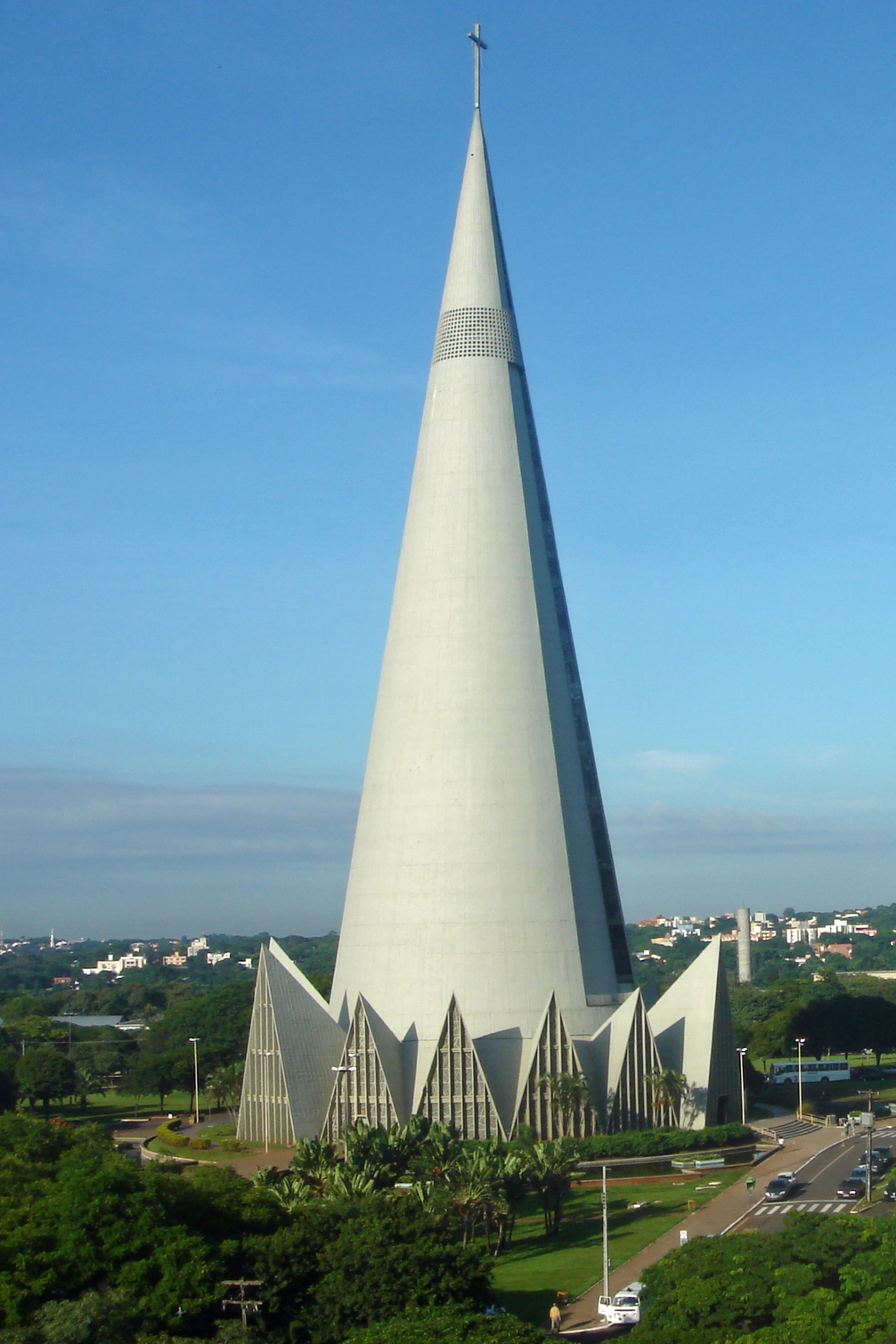
Maringá’s cathedral is the kind of place that doesn’t announce itself at first glance. It stands in the heart of the city, facing the municipal square, and its architecture defies expectations—no grand arches or ornate facades, just a towering concrete structure that feels more like a piece of modern art than a traditional church. Yet there’s something timeless in its design, a vertical pull toward the sky that echoes the soaring ambition of Gothic cathedrals, reinterpreted through the raw, unadorned language of the 20th century.
The cathedral took shape in 1959, when Maringá was still finding its identity as a young, fast-growing city. Brazil was in the midst of a transformative era, and architects were eager to build structures that captured the spirit of progress—bold, functional, and symbolic. José Augusto Bellucci, the architect behind the project, drew from modernist and brutalist principles, stripping away conventional religious forms in favor of clean lines and monumental volumes. Concrete wasn’t just a material here; it was the statement. Its rough texture and unpolished surface became part of the building’s character, a deliberate contrast to the polished marble and gilded altars of older churches.
The most striking feature is the cathedral’s tower, which serves as both a bell tower and the structural backbone of the entire building. Rising 114 meters into the sky, it’s one of the tallest church spires in Latin America. Inside, sixteen bells hang, their chimes carrying across the city. But height isn’t the only thing that makes the tower remarkable. Its shape—a slender, tapering form with narrow vertical slits—evokes a rocket or an arrow, lending it a futuristic edge. At the same time, there’s a subtle nod to tradition in its silhouette, as if Bellucci wanted to bridge the gap between the past and the future in a single gesture.
Step inside, and the interior feels just as unconventional. There are no elaborate frescoes or golden altars here. Instead, the space is open and almost austere, with light taking center stage. The narrow slits in the tower act as natural skylights, casting shifting patterns of sunlight across the walls and floor. The altar is simple, carved from stone, and any stained glass is more abstract than narrative. The effect is one of quiet focus, a place where the architecture itself encourages reflection rather than distraction.
Beyond its religious function, the cathedral has become a cultural hub for Maringá. Classical and sacred music concerts are held here, along with exhibitions by local artists and occasional literary events. During holidays like Christmas and Easter, the square outside transforms into a lively gathering spot, with families coming to see the lights, listen to choirs, or just sit on the benches and watch the city go by. The cathedral isn’t just a backdrop for these moments; it’s an active part of the community’s rhythm.
For visitors, the cathedral offers a different perspective on Maringá. The city is known as an economic powerhouse in Paraná state, a place of universities, businesses, and bustling streets. But amid the modern high-rises and shopping centers, it’s easy to overlook the quieter corners where time moves at a slower pace. The cathedral is one of those places. It doesn’t demand prior knowledge or a guidebook—just a willingness to look up and let the light and space do the talking.
When it first opened, the cathedral wasn’t universally loved. Some residents found it too stark, too removed from the warmth of traditional churches. Others thought it was too bold for a city that was still finding its footing. Over time, though, opinions shifted. Today, it’s one of Maringá’s most recognizable landmarks, a symbol of the city’s modernity and its connection to something deeper. It doesn’t resemble other Brazilian churches, and that’s precisely why it stands out.
If you find yourself in Maringá, the cathedral is worth more than a quick photo stop. The best time to visit is in the late afternoon, when the setting sun filters through the tower’s slits, bathing the interior in warm hues. Or come early in the morning, when the city is still waking up and the cathedral is bathed in soft, golden light. There are no crowds here, no rush—just a quiet sense of stillness. It may not have the centuries of history behind it that European cathedrals do, but it has its own story, its own atmosphere, and a quiet charm that lingers long after you’ve left.