Jelgava is one of those places that rarely makes it onto the well-trodden tourist trails, yet it holds stories worth uncovering. Tucked away in Latvia’s quiet heart, the city moves at its own unhurried pace, its streets lined with unassuming buildings that have witnessed centuries of change. Among them stands the Cathedral of St. Simeon and St. Anna—a structure that doesn’t demand attention like the grand cathedrals of Riga or Europe’s famous pilgrimage sites, but quietly commands respect for its place in Latvia’s history.
The cathedral’s origins trace back to the late 18th century, when Jelgava was still known by its German name, Mitau, and served as the capital of the Duchy of Courland. This was a time when the city thrived as a cultural and political hub, drawing nobility, artists, and thinkers from across Europe. The cathedral was conceived as a court church for the ruling Biron dynasty, its design reflecting the tastes of an era when grand European courts set the standard for architecture and art. The original plans were drafted by Francesco Bartolomeo Rastrelli, the Italian architect behind some of St. Petersburg’s most iconic buildings. Yet, like many ambitious projects of the time, construction stretched over decades, and the cathedral only took its final form by the mid-19th century.
From the outside, the building presents a restrained elegance, its neoclassical façade a departure from the ornate baroque that had dominated earlier decades. The tall bell tower, crowned with a clock, rises above the surrounding rooftops, while sturdy columns frame the entrance, lending the structure a sense of solidity. Inside, however, the space feels airy and open—a hallmark of Protestant church design. High windows flood the interior with light, and the absence of excessive ornamentation creates an atmosphere of quiet reflection. The main nave, supported by slender columns, leads to a modest altar, its simplicity a contrast to the elaborate iconostases found in Orthodox churches.
The cathedral’s religious identity has shifted with the tides of history. Originally Lutheran, it was converted to an Orthodox church in the 19th century after Courland became part of the Russian Empire. This transition brought changes to its interior—frescoes were added, and an iconostasis installed. But after Latvia regained independence following World War I, the cathedral reverted to its Lutheran roots. The 20th century brought further upheaval: during World War II, the building suffered damage, and in the Soviet era, it was repurposed for non-religious use. Despite these changes, the cathedral endured, a silent witness to the city’s turbulent past.
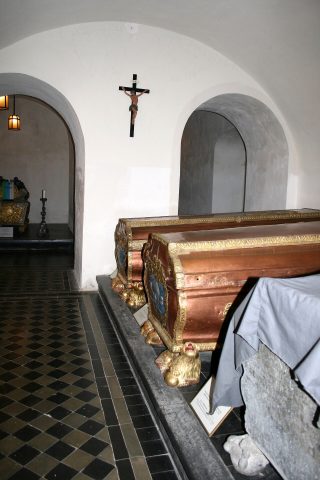
Today, the Cathedral of St. Simeon and St. Anna remains an active place of worship, its doors open for services, organ concerts, and cultural events. The organ, considered one of the finest in Latvia, draws music lovers from near and far, its rich tones filling the vaulted space. Visitors can also find memorial plaques honoring figures tied to the cathedral’s history—dukes of Courland, local dignitaries, and others whose lives intersected with Jelgava’s past. These small markers serve as reminders of the people who shaped the city and the role the cathedral played in their lives.
Stepping inside on a weekday, when the crowds are absent, offers a chance to experience the cathedral’s quiet presence. The light streaming through the tall windows casts shifting patterns on the walls, and the occasional sound of footsteps or a whispered prayer breaks the stillness. For locals, the cathedral is more than a historical landmark; it’s a place where personal and collective memories converge. Some come to pray, others to sit in silence, but all carry with them a sense of connection to the past.
Jelgava doesn’t try to impress with grand gestures or tourist traps. Instead, it invites visitors to slow down and notice the details—the way the cathedral’s bell tower punctuates the skyline, the worn cobblestones underfoot, the way the light falls on the old buildings that surround the square. The Cathedral of St. Simeon and St. Anna stands as a testament to the city’s resilience, its architecture and atmosphere reflecting the broader story of Latvia: a land of shifting borders, cultural layers, and quiet endurance.
There’s no need to rush here. The cathedral doesn’t clamor for attention, but if you take the time to look, you’ll find in its walls echoes of the past—of dukes and emperors, of wars and peace, of ordinary people who once stood where you stand now. It’s a place where history isn’t just remembered; it’s felt. And that, perhaps, is why it lingers in the mind long after you’ve walked away.