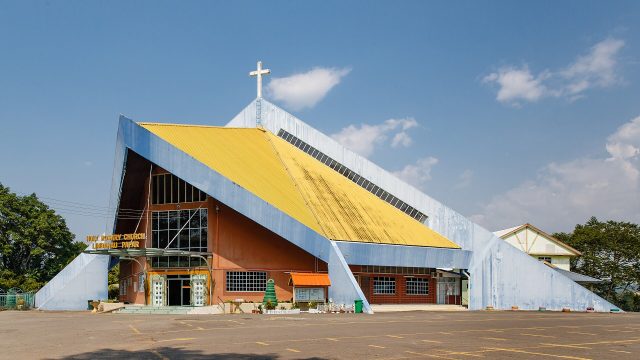
The Cathedral of the Immaculate Conception stands quietly in the heart of Dhaka, a place where faith and daily life intertwine without fuss. It’s tucked away on a busy street where rickshaws clatter past, vendors call out their wares, and the city’s relentless energy hums just beyond its walls. Dhaka is a city shaped by Islam, yet this Catholic cathedral has been a steady presence for over a century, offering solace to its congregation and a sense of continuity in a place where change is constant.
Built in the early 1900s, when Bangladesh was still part of British India, the cathedral’s origins are modest. Records from that time are patchy, but by the 1920s, it was already serving as a parish for Dhaka’s small but active Christian community. Back then, it wasn’t just a place of worship—it was a gathering point, a symbol of resilience. The cathedral has weathered the upheavals of history, from the partition of India in 1947 to the bloody struggle for Bangladesh’s independence in 1971. Through it all, it remained a refuge, a place where people could find comfort when the world outside felt uncertain.
The architecture reflects a blend of influences, though not in an ostentatious way. The pointed arches and tall windows hint at Gothic traditions, but the brickwork and unadorned lines keep it grounded in the local context. Inside, there’s no grand opulence—just whitewashed walls, simple wooden pews, and a handful of stained-glass windows depicting saints. The statue of the Virgin Mary behind the altar has a quiet warmth, as if welcoming visitors rather than commanding reverence. The space feels intimate, almost domestic, a place where faith isn’t performed but lived.
Beyond its religious role, the cathedral has become a bridge between communities in a city where different faiths coexist. It hosts charity events, concerts of sacred music, and interfaith dialogues, drawing people from all walks of life. During major Christian holidays, like Christmas, the cathedral comes alive in a way that feels distinctly Dhaka. The streets around it are strung with lights, bells ring out, and after services, crowds spill into the courtyard for shared meals. Even those who don’t share the faith often stop by, drawn by the sense of celebration.
Yet the cathedral isn’t just for special occasions. On ordinary days, it offers a rare pocket of calm in the middle of the city. The small garden surrounding the building is a place where people sit in silence, read, or simply escape the heat. Locals sometimes call it an oasis, and it’s easy to see why. The trees provide shade in the summer, while in winter, sunlight filters through the leaves, casting dappled patterns on the paths. The cathedral seems to exist at its own pace, untouched by the frenzy of the metropolis outside.
Its history is woven into Dhaka’s own story. During the 1971 war for independence, the building itself was spared, but many of its parishioners were caught up in the violence. Some later recounted how the cathedral became a sanctuary for those in need, a place where fear could be set aside, even if only for a moment. These stories are still told today, passed down through generations, a reminder that faith and solidarity can endure even in the darkest times.
Over the years, the cathedral has been repaired and restored, but its essence hasn’t changed. There’s no pretension here, just a sense of authenticity. The congregation tends to the building as if it were their own home—polishing the floors, arranging flowers, preserving the icons with care. In a city where everything seems to shift overnight, the cathedral remains a constant, unassuming presence. It doesn’t demand attention; it simply offers a space for reflection.
For visitors, the cathedral might not be the first place that comes to mind when exploring Dhaka. The city is full of more obvious attractions—ancient mosques, bustling markets, historic landmarks. But those who do step inside often find something unexpected. On a weekday, when there’s no service, you might see an elderly woman praying quietly in a corner or a young couple speaking softly with the priest. There’s no performance, no tour-guide spiel—just the quiet rhythm of a place that’s still very much alive.
The Cathedral of the Immaculate Conception isn’t just a building. It’s a thread in the fabric of Dhaka, a testament to the city’s layered history and the people who call it home. In a world where divisions often feel stark, places like this remind us that faith, in all its forms, can be a common ground. It teaches us to find beauty in simplicity, to seek stillness amid chaos, and to remember that even in a crowded city, there’s always room for quiet moments.