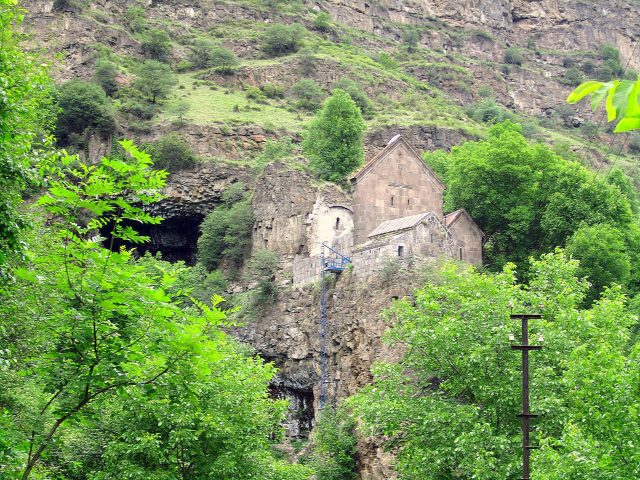
Perched on the edge of Lori Berd, a quiet village in northern Armenia, this unassuming viewpoint offers more than just a sweeping panorama of the Debed River valley. It’s a place where the landscape itself tells a story—one of ancient trade routes, shifting borders, and the enduring rhythm of rural life. Unlike manicured tourist spots, this is simply a patch of earth where the land unfolds naturally, inviting you to pause and take it all in.
The Debed valley has long been a crossroads, a place where cultures and histories intersected. In medieval times, it marked the boundaries of Armenian kingdoms, later becoming a frontier for empires that rose and fell over centuries. The villages here, including Lori Berd, still bear traces of that past—crumbling fortresses, abandoned monasteries, and old settlements tucked into the folds of the hills. The viewpoint isn’t just a place to admire the scenery; it’s where you first sense the weight of that history, etched into the very rocks and contours of the land.
From this slight elevation, the valley stretches out in layers of green and gold, depending on the season. The Debed River winds through it like a silver thread, its banks lined with dense vegetation and the occasional stone bridge or old mill. On clear days, the view extends all the way to the horizon, where rolling hills give way to rugged cliffs. The air carries the scent of wild herbs and damp earth, and the only sounds are the rustle of leaves and the distant murmur of the river. It’s the kind of place where time feels slower, where the quiet seeps into you.
The villages around here have a distinct character, shaped by the land and the people who’ve lived on it for generations. Homes are built from dark local basalt, their steep-pitched roofs designed to shed snow in winter. Small windows keep out the cold, and the thick stone walls hold the warmth of wood stoves. Life moves at its own pace—farmers tend to orchards and vegetable patches, livestock graze on the hillsides, and the occasional tractor rumbles down the dirt roads. There’s no pretense, no performance for visitors; just the steady, unhurried pulse of rural Armenia.
This isn’t a place you come to for guided tours or Instagram backdrops. It’s for those who want to step off the beaten path and wander. From the viewpoint, you can follow a trail down to the river, where the water rushes over smooth stones, or take one of the old footpaths that lead to neighboring villages. Locals still use these routes, and if you’re lucky, you might meet someone willing to share a story or point out a hidden spot—a spring, a ruined chapel, a particularly good place to pick wild berries. The land here rewards curiosity.
Seasons transform the valley in subtle ways. In spring, the hills burst with wildflowers, and the air is sweet with blossoming fruit trees. Summer brings long, golden evenings, when the light lingers on the slopes and the river glints like metal. Autumn turns the landscape into a patchwork of reds and ambers, while winter drapes everything in snow, softening the edges of the hills. Each time of year offers something different, and the viewpoint is the perfect place to watch the changes unfold.
There’s a sense of continuity here, a feeling that the land has always been this way and always will be. The people who live in Lori Berd and the surrounding villages are part of that rhythm—they’ve farmed these fields, crossed these rivers, and climbed these hills for generations. The viewpoint isn’t just a place to look out; it’s a place to look back, to imagine the merchants, pilgrims, and travelers who once passed through this valley. It’s an invitation to slow down, to walk the same paths, and to see the landscape not just as scenery, but as something alive.
For those who make the journey, this corner of Armenia can feel like a discovery. It’s not a grand monument or a famous landmark, but a quiet intersection of history and nature. The viewpoint is just the beginning—the first glimpse of a place where the past isn’t locked away in museums, but woven into the very fabric of the land. And if you let it, it might leave you with something deeper than a photograph: a sense of connection, a memory of stillness, or the faint echo of a story that began long before you arrived.