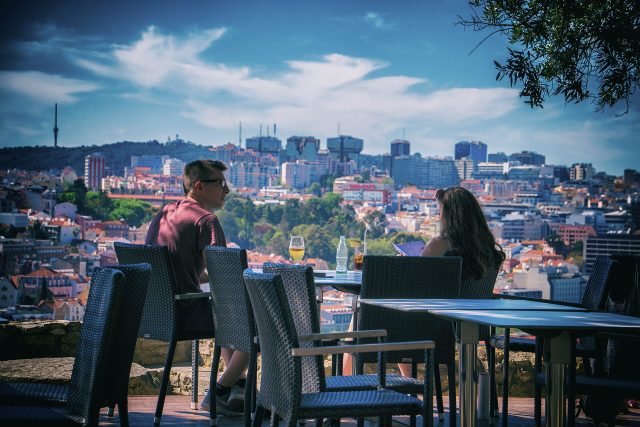
There are places in Lisbon where the city reveals itself not just as a collection of streets and buildings, but as something deeper—a mood, a rhythm, a quiet conversation between past and present. The Santa Justa viewpoint is one of them. Perched on a hill, it offers a sweeping panorama of the city unfolding between the Tagus River and the surrounding slopes. From here, the rooftops of old neighborhoods stretch out in uneven layers, punctuated by church spires and the occasional bridge. On clear days, the view extends beyond the city limits, where the river meets the ocean, and the horizon blurs into the same endless expanse that once called to Portugal’s explorers.
The viewpoint isn’t just a random vantage point—it’s part of the Santa Justa Lift, an engineering marvel built in the late 19th century. Designed by Raoul Mesnier de Ponsard, a student of Gustave Eiffel, the lift was a practical solution to a long-standing problem: how to connect the lower city with the upper districts without forcing people to navigate steep, winding streets. The structure itself is a blend of elegance and utility, its iron framework hidden behind a façade of stone and glass that resembles a miniature palace. It’s a reminder that even functional projects can carry a sense of beauty, especially in a city where history is etched into every corner.
The terrace itself is small, little more than a narrow platform in front of the lift entrance, but it’s where visitors gather to take in the view. Below lies Baixa, the downtown district rebuilt after the devastating 1755 earthquake. Its grid of straight streets and symmetrical squares was an attempt to impose order on chaos, a rare moment of rational planning in a city that otherwise seems to grow organically, defying logic. Yet even here, the past lingers—the clatter of trams, the scent of pastéis de nata drifting from cafés, the blue-and-white azulejo tiles that adorn shop fronts and walls.
Reaching the viewpoint on foot is an experience in itself. The most rewarding route winds through Alfama, Lisbon’s oldest district, where time seems to move at a different pace. The streets twist and turn, passing tiny squares where elderly men play dominoes, crumbling churches with faded facades, and houses covered in intricate tilework. Alfama has survived centuries with its character intact, its labyrinthine alleys offering glimpses of a Lisbon that existed long before tourists arrived. The climb is steep, but the reward is more than just the view—it’s the sense of having walked through layers of history.
This isn’t just a place for photographs, though the images taken here are undeniably striking. The Santa Justa viewpoint offers something more: a way to understand Lisbon’s geography and soul. The city’s uneven terrain, its sudden drops and sharp inclines, its love of waterfront benches and slow afternoons—all of it makes sense from this height. Lisbon doesn’t give up its secrets easily, but at sunset, when the light turns golden and the shadows stretch long and soft, the city’s rhythm becomes clearer. It’s a place that invites lingering, not just looking.
The crowds here are different from those at more famous landmarks. There are locals showing off their city to friends, students mapping out their evening plans, and older couples sitting quietly on benches, watching the world below. Sometimes, the sound of a guitar drifts up from the streets—a fado musician playing one of those melancholic, beautiful songs that seem to capture the city’s mood. When that happens, even the usual hum of traffic fades into the background, as if the music has temporarily rewritten the rules of the city.
The Santa Justa Lift has been in operation for over a century, and in that time, it’s become more than just a mode of transport. Its wooden and brass cabins feel reassuringly solid, like an old friend who’s always there when you need them. The ride itself is brief, but it’s a chance to appreciate the mechanics of the thing—the hum of the motor, the slight sway of the cabin, the way the city unfolds below as you ascend. It’s a reminder that Lisbon is both ancient and alive, a place where the past isn’t preserved in amber but woven into the fabric of everyday life.
Early mornings here are a different kind of magic. Before the crowds arrive, the air is filled with the scent of coffee and fresh bread, and the streets below are still quiet. It’s a rare moment of stillness in a city that’s usually in motion. By evening, when the streetlights flicker on, Lisbon transforms into a sea of lights, each one a tiny actor in the larger drama of the city. From this height, it’s easy to imagine the whole place as a stage, where every building, every alley, has its part to play.
The Santa Justa viewpoint isn’t just about the view—it’s about the feeling of standing at the intersection of history and modernity, of nature and urban life. There’s no pressure here, no agenda, no sense that you’re being sold something. Just the city, the river, the sky, and the quiet understanding that some places don’t need to shout to be heard. If you’re lucky, you might catch a glimpse of that conversation between them—a moment of connection that lingers long after you’ve left.