The Daugava River bends gently near Aizkraukle, carving its way through the Latvian landscape in a slow, deliberate curve. From the viewpoint on the high bank, the scene unfolds like a quiet revelation—one that even those familiar with nature’s beauty might pause to absorb. The river stretches wide and unhurried, winding between rolling hills covered in dense forests that fade into the horizon. On clear days, the view extends all the way to the next bend near Pļaviņas, where the distant silhouettes of factory chimneys serve as a subtle reminder that this land has long been shaped by both the forces of nature and human industry.
The platform itself is unassuming, designed for function rather than spectacle. A small paved area, bordered by a low railing, offers just enough space to stand and take in the surroundings. A few benches invite visitors to sit, while an information board maps out the nearby landscape. There are no crowds here, no souvenir stalls or loud announcements—just the quiet rustle of wind through the trees and the occasional murmur of passersby. Locals often come with thermoses of coffee or packed lunches, settling in for an hour or two of reflection or simply to watch the river flow. For them, this place feels familiar, almost like a second home, while for travelers, it might come as an unexpected discovery.
The Daugava here is different from the one in Riga, where it moves between embankments and bridges, alive with the hum of the city. In this stretch, the river is broad and serene, its current so slow it seems to encourage stillness. Centuries ago, the Daugava was a vital trade route, connecting the Baltic region to the heart of Europe. Merchants transported furs, wax, and grain downstream, returning with salt, metals, and textiles. The river carried not just goods but stories, news, and people, linking distant communities. Today, the waterway is quieter, with only the occasional pleasure boat breaking the surface. Yet if you watch closely, you’ll see the river still carries its own cargo—twigs, leaves, even entire trees—drifting past as if to remind us that the Daugava follows its own rhythm, untouched by the pace of modern life.
The banks here rise steeply in places, their layers of sandstone and clay telling a story millions of years in the making. Long before humans walked this land, an ancient sea covered the area, leaving behind sedimentary deposits. Later, glaciers sculpted the terrain, depositing boulders and sand, while the river gradually carved its path through the earth. In some spots, exposed sandstone reveals the imprints of prehistoric plants, silent witnesses to a time when the world was vastly different. Geologists find these formations fascinating, but for most visitors, they’re simply part of the landscape’s quiet charm—a natural frame for the river’s timeless flow.
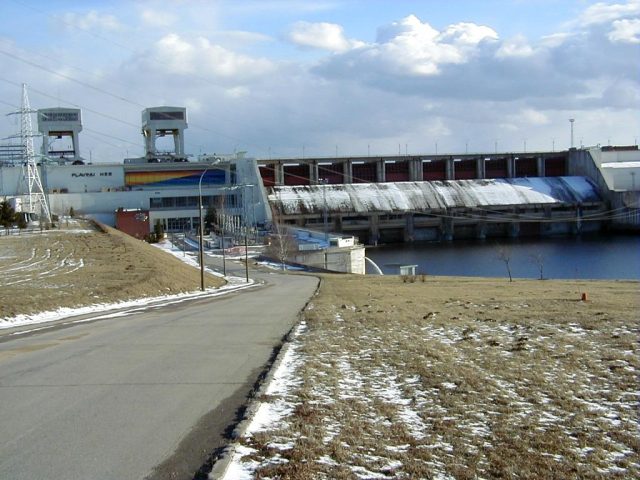
Aizkraukle itself is a small town, often overlooked by travelers. It emerged in the mid-20th century as a settlement tied to the construction of the Pļaviņas Hydroelectric Station, and many still associate it with that era. Yet beyond the main roads, the area holds traces of a deeper history. Nearby lie the ruins of Aizkraukle Castle, built by Livonian knights in the 13th century. Though little remains of the fortress today, its earthen ramparts and ditches are still visible, and on a quiet evening, it’s easy to imagine the clatter of armored horsemen or the bustle of a medieval market along the riverbank.
This viewpoint is more than just a place for photographs, though the scenery certainly lends itself to striking images. It offers something less tangible but perhaps more meaningful—a sense of the land’s enduring presence. There are no towering mountains or dramatic coastlines here, no grand castles with centuries of legends. Instead, there’s the quiet vastness of the river, the stillness of the forests, and the feeling of connection to a landscape that has sustained generations. In that way, the platform isn’t just a spot on a map; it’s a reminder that beauty often lies in the unassuming places, the ones that don’t demand attention but simply exist, waiting to be noticed.
Winter transforms the scene entirely. The river freezes, its surface hardening into a sheet of ice, while snow blankets the banks in white. On cold days, smoke rises from the chimneys of scattered farmhouses, and crows circle overhead. Summer brings a different kind of life—lush greenery, the occasional boat on the water, and the scent of wildflowers drifting on the breeze. Yet no matter the season, the place invites contemplation. Perhaps it’s the river’s steady flow, a silent reminder that time moves on, and we are only passing through.
If you find yourself in this part of Latvia, take a moment to stop. Climb the bank, sit on one of the benches, and listen to the river’s murmur. You might not find answers to all your questions, but you’ll likely leave with a sense of peace, or at least a quiet appreciation for the world’s understated wonders. And if you’re lucky, you’ll witness a sunset—when the sky and water blaze with hues of gold and crimson, and for a brief moment, it feels as though time itself has paused.