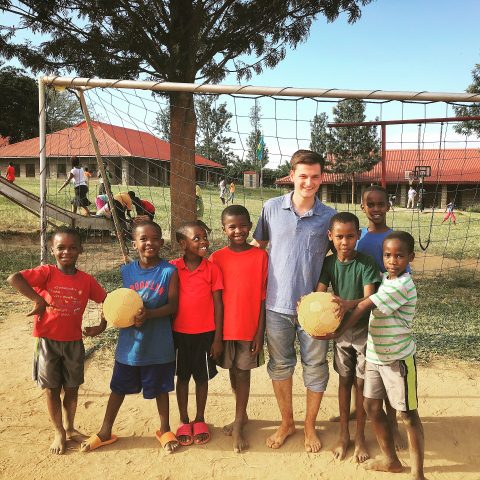
Nyamata is a quiet town about half an hour’s drive from Kigali, Rwanda’s capital. It’s not the kind of place that appears on most travel itineraries, but for those who seek to understand the country’s history, it holds a significance that goes beyond its modest size. While Nyamata is often associated with its genocide memorial, the Groupe Scolaire de Nyamata school stands as another, less obvious marker of Rwanda’s past—a place where the weight of history lingers in the everyday.
The school itself is unassuming. Low red-brick buildings, a simple perimeter fence, and a spacious courtyard with a few scattered trees give it the appearance of any other rural school in the region. There’s nothing in its architecture or layout to suggest the horrors that unfolded here in April 1994. During the genocide, when violence erupted between Hutu and Tutsi communities, thousands of people fled to the school, believing it might offer safety. Instead, most were killed on the grounds or taken to nearby hills, where they were executed. The school became a site of betrayal, where hope turned to devastation.
Today, the buildings still function as a school, and in many ways, that’s the most striking thing about the place. Children of different backgrounds—no longer officially divided by ethnicity—fill the classrooms, learning the same lessons under the same roof. Rwanda’s government abolished ethnic classifications after the genocide, a deliberate step toward unity. The school embodies this effort, though the past is never far away. Occasionally, visitors arrive—journalists, researchers, or travelers drawn to Nyamata’s memorial—walking quietly through the courtyard. For some locals, the school is a place of mourning; for others, it’s simply where their children go to learn. The balance between the two is delicate.
The architecture is practical, designed for function rather than aesthetics. The buildings, with their high ceilings and large windows, reflect a colonial influence, built to keep the heat at bay in Rwanda’s climate. Inside, the classrooms are sparse: wooden desks, chalkboards, and educational posters. There are no grand memorials or overt reminders of what happened here, just the quiet hum of daily life. But if you look closely, traces remain. Bullet marks scar some of the walls, and in a corner of the courtyard, a small memorial plaque stands as a subtle acknowledgment of the lives lost.
For Rwanda, the school is more than just an educational institution. It represents the country’s broader struggle to reconcile with its past while moving forward. After the genocide, Rwanda made a conscious choice to reject ethnic divisions, promoting programs that encourage unity and healing. Groupe Scolaire de Nyamata plays a part in this process. Children whose families were once on opposing sides now sit together in the same classrooms, learning the same lessons. It doesn’t erase the past, but it offers a different kind of future—one where shared education becomes a quiet act of rebuilding.
Visiting the school isn’t like visiting a museum. There are no guided tours, no informational displays, and no official protocols for visitors. If you choose to go, it’s best to do so with respect, remembering that this is still an active place of learning. Some teachers and students may be willing to share their experiences, but such conversations require sensitivity. Most Rwandans don’t openly discuss the genocide with outsiders, preferring to keep those memories within their communities. The school isn’t a tourist attraction; it’s a living space where history and the present coexist.
Nyamata itself is a town that carries its past lightly, if at all. The market bustles with vendors selling fresh produce, children play in the streets, and elders sit outside their homes, watching the day pass. Yet the echoes of 1994 are never entirely absent. Stories circulate—of survivors, of those who didn’t make it, of the quiet resilience that followed. The school is part of that narrative, a place where tragedy and routine intersect. It doesn’t demand attention, but for those who pause to consider it, it offers a glimpse into how a community carries its history while still moving forward.
There’s no grand monument here, no dramatic retelling of events. Just a school, doing what schools do—teaching, learning, growing. But in Rwanda, where the past is never far from the surface, even the most ordinary places can hold extraordinary weight. Groupe Scolaire de Nyamata is one of them. It doesn’t ask for pity or reverence; it simply exists, a quiet witness to both the darkness and the resilience of human nature. For those who take the time to understand it, the school becomes more than a building—it’s a reminder of how fragile peace can be, and how much work it takes to sustain it.