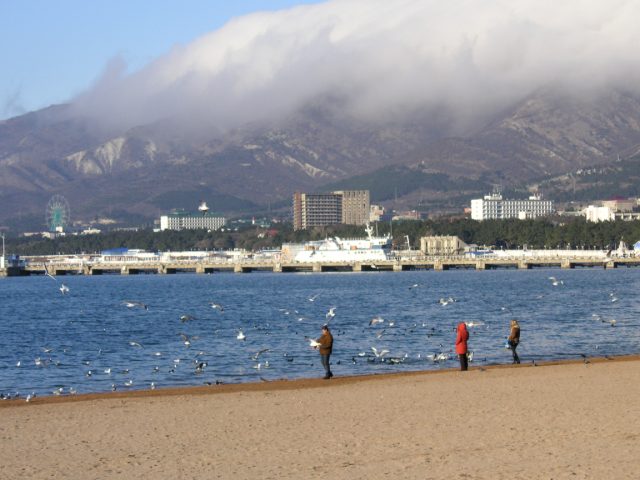
Sail Rock rises from the waters of Gelendzhik Bay like a silent sentinel. Its sheer limestone walls, carved by time, form a shape so distinct its name needs no explanation. The rock stands about thirty meters high, separated from the mainland by a narrow strip of land. From the sea, its vertical cliffs plunge into the water, their surfaces marked by deep fissures and layers of sediment.
Geologists say the rock formed millions of years ago when this region was submerged beneath an ancient sea. Layers of sediment hardened into limestone, and wind and waves sculpted it into its current form. The natural arch at its base is wide enough for a small boat to pass through. Local legends claim pirates hid treasure here or that cannon fire blasted the hole through. The truth is simpler—erosion did the work—but the myths endure.
For generations, Sail Rock has been a symbol of Gelendzhik. Its silhouette appears on souvenirs, postcards, and the town’s official emblem. In the 19th century, when the area was a quiet fishing village, visitors came just to see this formation rising from the sea. Today, the coastline has beaches, cafes, and promenades, but the rock remains unchanged.
Reaching Sail Rock is straightforward. From Gelendzhik’s center, walk along the waterfront and follow the coastal path toward the rock. The journey takes about half an hour, offering glimpses of the bay and surrounding mountains. Alternatively, a short drive or taxi ride brings you to a nearby parking area, from where a descent leads to the shore. The paths can be uneven, so take care, especially after rain.
The rock itself is inaccessible—its walls are too sheer for climbing. Most visitors admire it from the shore or the water. Renting a boat or kayak lets you approach closely and, if conditions are calm, pass through the arch. From the water, the rock looms larger, its details more pronounced.
People come here to mark moments. Couples pose for wedding photos, artists capture its changing light, and fishermen share tales with tourists. In the late afternoon, the sun dips behind the mountains, turning the rock gold and rose while the water darkens to violet. At such times, it’s clear why this spot captivates so many.
The rock hasn’t always looked as it does today. In the mid-20th century, a small restaurant stood at its base. It was demolished in the 1970s to restore the coastline’s natural appearance. Now, there’s only stone, sea, and sky. Old photographs and stories keep the memory alive.
For those interested in geology, Sail Rock is an open-air textbook. Its layers reveal fossilized shells of ancient mollusks, while its cracks offer clues to tectonic forces. Even without studying the science, touching the rock feels like connecting with something far older than human history. The stone is warm under the sun, rough to the touch.
What makes Sail Rock special? It doesn’t demand anything. There are no crowds like on central beaches, but it’s rarely empty. People come to watch the waves, listen to the wind, and let their thoughts wander. The rock doesn’t offer ready-made experiences—it provides the space for them. Everyone finds something different here. Some see a natural wonder, others a piece of history, and a few might glimpse old legends. No one leaves unchanged.