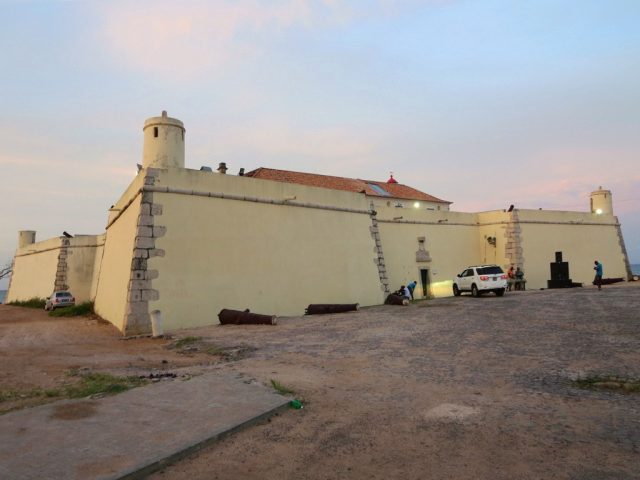
The São Sebastião Museum sits quietly along the waterfront in São Tomé, a place where the past lingers in the salt-tinged air. Housed within a 16th-century Portuguese fort, it was built when the islands were still raw outposts of empire, a time when every stone laid was a claim to power. The fort’s original purpose was practical—defense against pirates and rival colonial powers—but its thick basalt walls and rusted cannons now serve as silent witnesses to centuries of trade, conflict, and cultural exchange. Walking through its arched gate feels like stepping into a different era, one where the Atlantic winds carried both opportunity and danger.
The building itself is a relic of colonial architecture, constructed from local volcanic rock and imported materials. Its design follows the compact, functional style of Portuguese fortifications of the time, with a central courtyard that once echoed with the drills of soldiers. Over the years, the fort has been repaired and altered, but its core remains unchanged: narrow staircases, vaulted ceilings, and small windows that were once used to spot approaching ships. The air inside is cool and still, as if the walls themselves are holding their breath, waiting for the next visitor to listen to the stories they’ve absorbed over the centuries.
Inside, the museum traces the history of São Tomé and Príncipe from its discovery by Portuguese explorers to its independence in 1975. The exhibits unfold like chapters in a book, each one revealing a different layer of the islands’ past. Early colonial maps show how the Portuguese first charted these lands, while yellowed documents and faded photographs depict the rise of the plantation economy, when São Tomé became one of the world’s largest producers of cocoa. The displays also confront a darker legacy—the transatlantic slave trade, which left an indelible mark on the islands’ culture and demographics. Artifacts like shackles and ledgers of human cargo serve as stark reminders of the brutality that once defined life here.
Among the most compelling pieces are the African masks and sculptures, brought to the islands by slave traders and missionaries. These objects are more than just art; they represent the collision of cultures that shaped São Tomé. Some were likely used in rituals, while others were collected as curiosities, but all of them carry the craftsmanship of the regions from which they came. Nearby, colonial-era furniture, tools, and household items paint a picture of the European settlers who lived here, their lives built on the labor of others. The contrast between these two worlds—one of opulence, the other of suffering—is impossible to ignore.
Beyond history, the museum also celebrates the natural wonders of São Tomé and Príncipe. The islands are a biodiversity hotspot, home to species found nowhere else on Earth. The exhibits include taxidermied birds like the São Tomé ibis, which exists only here, and pressed plants that thrive in the islands’ lush forests. These displays highlight why scientists and nature enthusiasts are drawn to this remote archipelago, where evolution has taken its own unique path. The museum doesn’t just tell the story of people; it reminds visitors that the land itself has a voice, one shaped by isolation and time.
Visiting the museum is as much about the atmosphere as it is about the exhibits. São Tomé’s capital hums with a slow, unhurried rhythm, and the fort is no exception. Outside its walls, the city moves at its own pace—fishermen mending nets, vendors selling tropical fruit, the occasional burst of laughter from a nearby café. The museum’s location near the waterfront makes it easy to pair a visit with a stroll along the shore or a stop at a local eatery, where the scent of grilled fish and spices lingers in the air. There’s no sense of artificiality here; the past and present coexist naturally, as if the fort has simply adapted to a new role over time.
What makes the São Sebastião Museum special is its lack of pretension. It doesn’t try to impress with grand narratives or flashy displays. Instead, it offers something far more valuable: authenticity. The artifacts, the building, even the quiet corners of the courtyard all feel like pieces of a larger puzzle, one that tells the story of a place caught between continents. For those interested in the complexities of colonialism, the cultural exchanges between Africa and Europe, or the way small islands carve out their own identities, the museum is a revelation. It doesn’t provide easy answers, but it invites reflection.
Perhaps because São Tomé and Príncipe remain off the beaten path, the museum doesn’t always get the attention it deserves. Many travelers come for the beaches or the jungles, overlooking the layers of history that lie beneath the surface. But those who take the time to visit rarely leave disappointed. This isn’t a place for quick selfies or hurried tours. It’s for those who appreciate the weight of history, who are willing to linger over a faded document or a weathered artifact and consider what it represents. The São Sebastião Museum isn’t just a stop on a map; it’s a doorway to understanding how this small, often overlooked corner of the world came to be.