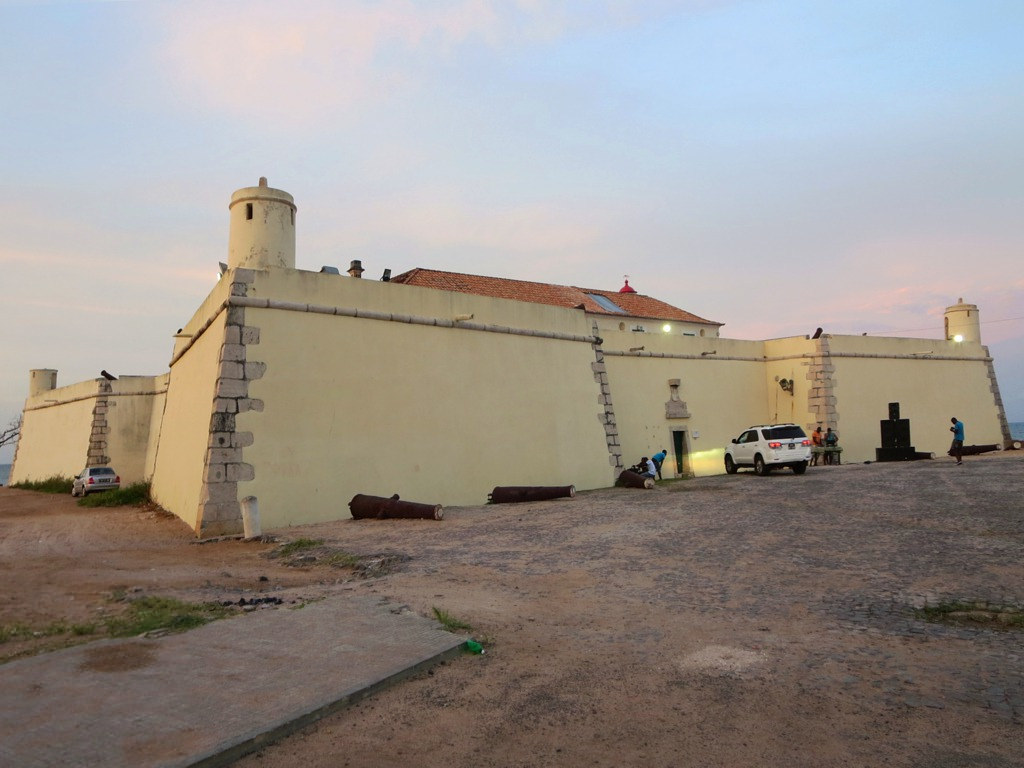
Perched on the northern tip of São Tomé Island, Fort São Sebastião stands as a quiet witness to centuries of history, trade, and colonial ambition. Built in the mid-16th century by the Portuguese, it was one of the first permanent structures on the island, designed to protect the fledgling settlement from pirates, rival European powers, and the unpredictable forces of the Atlantic. The fort’s sturdy stone walls, though weathered by time and salt-laden winds, still convey a sense of resilience, a reminder of the era when São Tomé was a crucial stopover in the transatlantic slave trade and a hub for sugar production. Today, it occupies a small peninsula where the ocean crashes against the rocks below, offering a stark contrast between the fort’s somber past and the lush, tropical beauty that surrounds it.
The architecture of Fort São Sebastião is modest but purposeful, reflecting the military pragmatism of its time. The structure follows a simple rectangular plan, with thick walls reinforced by bastions at each corner. Inside, the courtyard is open to the sky, a space that once buzzed with activity—soldiers drilling, supplies being unloaded, and prisoners held in the damp cells beneath. The fort’s chapel, dedicated to Saint Sebastian, was a rare concession to comfort, a place where the garrison could seek solace amid the isolation. Over the centuries, the fort has seen periods of neglect and revival, its stones patched and repurposed as the island’s fortunes shifted. Now, it stands partially restored, its rooms housing a small museum that tells fragments of São Tomé’s story through artifacts, maps, and faded documents.
For much of its history, Fort São Sebastião was more than just a military outpost; it was a symbol of Portugal’s determination to hold onto its colonial possessions in the face of growing competition. São Tomé, though small, was strategically vital, lying along the routes that connected Africa, Europe, and the Americas. The fort’s cannons, now silent, once guarded the harbor where ships laden with sugar, slaves, and later cocoa would dock. The island’s economy thrived and faltered with these trades, and the fort bore witness to it all—the wealth, the suffering, and the slow unraveling of colonial rule. By the time São Tomé and Príncipe gained independence in 1975, the fort had long since lost its military significance, but its legacy endured as a physical link to the island’s complex past.
Visiting Fort São Sebastião today is a quiet experience, far removed from the bustle of modern tourism. The approach to the fort is along a narrow road lined with coconut palms, the air thick with the scent of salt and vegetation. The entrance is unassuming, marked only by a low wall and a gate that creaks in the wind. Inside, the museum’s exhibits are sparse but evocative—a rusted cannon, a model of a 16th-century ship, yellowed letters from colonial administrators. The real draw, however, is the fort itself, its walls offering sweeping views of the ocean and the distant outline of the mainland. On a clear day, the horizon seems endless, a reminder of how isolated São Tomé must have felt to those who were stationed here centuries ago.
The fort’s location adds to its atmosphere. It sits on a rocky promontory where the waves crash against the shore, sending up sprays of saltwater that settle on the stone. The sound of the ocean is constant, a rhythmic backdrop to the stillness of the fort. At low tide, the exposed rocks reveal tide pools teeming with small fish and crabs, a stark contrast to the fort’s austere history. Nearby, the old lighthouse stands as another relic of the island’s maritime past, its beam long since extinguished but its presence still reassuring. Together, the fort and lighthouse create a sense of timelessness, as if the island has paused to remember its own story.
Despite its historical weight, Fort São Sebastião is not a place that overwhelms with grandeur. Instead, it invites reflection, offering a space to consider the layers of history that have shaped São Tomé. The island’s past is not always easy to confront—the legacy of slavery, the exploitation of resources, the struggles of independence—but the fort provides a tangible connection to these narratives. It’s a place where the personal and the political intersect, where the stories of soldiers, slaves, and settlers are etched into the very stones. For those who take the time to explore it, the fort reveals itself slowly, its significance unfolding with each step through its corridors and courtyards.
Beyond its historical role, Fort São Sebastião has become a part of the island’s cultural identity. Locals sometimes refer to it simply as *o forte*, as if no other name is needed. It appears in old photographs and postcards, a familiar landmark that has watched over São Tomé for generations. In recent years, efforts have been made to preserve the fort, not just as a monument but as a living piece of history. The museum, though small, is a step toward keeping the island’s past alive, offering visitors a chance to engage with the stories that might otherwise be forgotten. The fort’s restoration is ongoing, a delicate balance between preserving its authenticity and making it accessible to those who wish to learn.
The surrounding area adds another layer to the experience. The fort is just a short walk from the center of São Tomé city, where the streets hum with the energy of daily life. Nearby, the old market bustles with vendors selling fresh fish, tropical fruits, and handmade crafts, while the harbor remains a working port, its docks lined with fishing boats. The contrast between the fort’s quiet solitude and the vibrancy of the city is striking, a reminder that São Tomé is a place where history and modernity coexist. The fort doesn’t dominate the landscape; it blends into it, a subtle but enduring presence that anchors the island’s past in its present.
For travelers, Fort São Sebastião is more than just a stop on a sightseeing itinerary. It’s a place to pause, to look out at the ocean and imagine the countless lives that have passed through this small island. The fort doesn’t offer dramatic ruins or elaborate exhibits, but it doesn’t need to. Its power lies in its simplicity, in the way it quietly tells a story that is both deeply local and universally human. Whether you’re drawn by history, architecture, or simply the desire to stand in a place where the past feels tangible, the fort delivers an experience that lingers long after you’ve left its walls. In a world where so much is forgotten, Fort São Sebastião stands as a reminder that some stories are worth remembering.