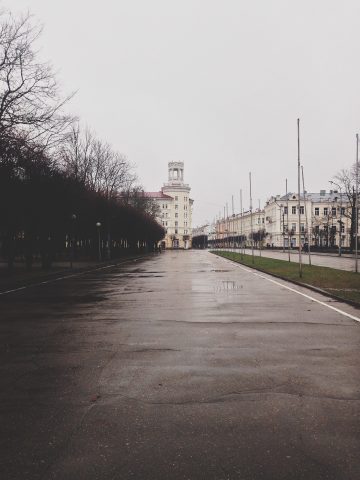
Blonie Garden is one of those rare spots in Smolensk where the city’s usual hum fades into quiet, leaving room for slow walks and moments of stillness. Tucked in the heart of the city, it feels like a small green island amid the dense urban landscape, a reminder of what old Russian parks used to be—no flashy attractions, just well-kept paths, mature trees, and benches where you can sit and watch the clouds drift by. It’s not a large space, but its size doesn’t stop it from being one of the most cherished local retreats. There are no crowds of tourists here, just regulars who come out of habit: retirees with newspapers, mothers pushing strollers, students with books.
The garden’s story begins in the 19th century, when Smolensk was growing as a provincial center. Back then, on what was then the edge of the city, a private garden appeared, owned by the Blonie family—French entrepreneurs who had settled in Russia. Over time, the land passed into public hands, and the garden became a place for everyone. During the Soviet era, it was redesigned a few times, but the core remained the same: straight alleys, symmetrical flowerbeds, and old linden trees that have stood since before the revolution. Today, it looks much as it did a hundred years ago, though the benches are more comfortable now, and the paths smoother.
There’s nothing grand about Blonie’s design—it’s simple and practical, just as a city park should be. You won’t find ornate fountains or towering sculptures here, but there are light metal gazebos that offer shade in summer and turn into fairy-tale cottages under winter snow. The main alley leads to a small stage where local musicians sometimes perform in warmer months. Deeper in the garden stands a modest war memorial, a simple obelisk surrounded by flowers. It doesn’t demand attention, but people still stop to lay flowers at its base.
What makes Blonie special is that it doesn’t try to be anything more than it is. It’s not an amusement park or a botanical garden with rare plants. There are no exotic trees or artificial ponds, just the kind of green space that feels like a natural extension of the city rather than a separate attraction. In summer, the air smells of freshly cut grass and linden blossoms; in autumn, of damp leaves; in winter, the snow blankets everything in quiet white.
For locals, Blonie isn’t just a place to walk—it’s part of the city’s memory. People meet here for dates, stroll with their children, or gather with friends. In Soviet times, there was an open-air cinema in the garden, and many still remember sitting on wooden benches, watching the flickering screen. The cinema is gone now, but the tradition lives on. On summer evenings, groups bring guitars, singing old songs or new ones, the music blending naturally into the surroundings.
The garden is woven into Smolensk’s history. During the war, like the rest of the city, it saw fighting, and some trees still bear the marks of bullets and shrapnel. After the war, the garden was restored by the community—new trees were planted, paths repaired, flowerbeds tended. Today, it’s filled with lindens, maples, and birches—ordinary trees for this part of Russia, but they create the kind of warmth that keeps people coming back.
In recent years, Blonie has seen a few changes: new lampposts, a playground, and the main alley turned into a pedestrian zone. But these updates haven’t altered its essence. It remains a place where you can escape the city’s rush without going far. There’s nothing extraordinary about it, and that’s the point—Blonie doesn’t try to impress. It simply exists, quiet and green, a living part of the city that locals hold dear.