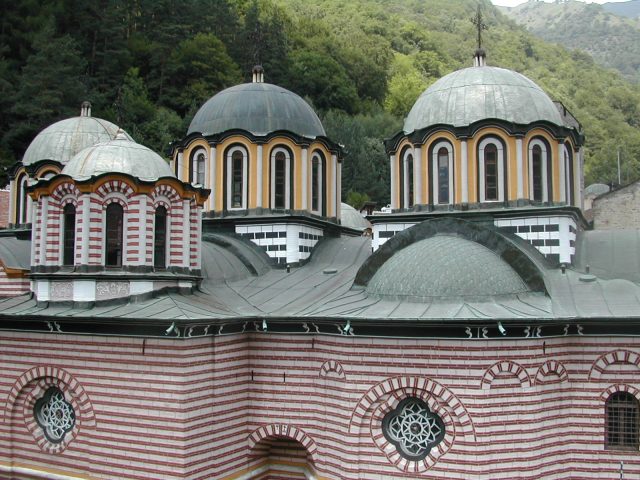
Perched on a quiet slope in the Rhodope Mountains, Rozhen Monastery feels like a place where the world slows down. The dense forests around it muffle the noise of modern life, leaving only the rustle of leaves, the distant toll of bells, and the occasional call of birds. Unlike Bulgaria’s more famous monastic sites, Rozhen hasn’t been polished for mass tourism. There are no crowds here, no souvenir stalls, just the same stillness that has settled over these hills for centuries. It’s the kind of place where you can sit on a wooden bench in the courtyard and feel the weight of history in the air.
The monastery’s origins are shrouded in the kind of mystery that often clings to old religious sites. Some believe it dates back to the 13th century, when Bulgaria’s Second Empire was at its height and monasteries served as both spiritual refuges and centers of learning. But the first written records only appear much later, in the 17th century, when the country was under Ottoman rule. Back then, monasteries like Rozhen were more than just places of worship—they were strongholds of Bulgarian identity, preserving language, traditions, and faith when both were under threat. The monks who lived here weren’t just praying; they were keeping a culture alive.
The architecture tells its own story, a patchwork of styles that reflect the monastery’s long and turbulent past. The main church, dedicated to the Nativity of the Virgin Mary, follows the traditional Bulgarian cross-domed design, but with subtle variations that hint at later influences. Inside, the walls are covered in frescoes, some dating back to the 17th century. The colors are surprisingly vivid—deep blues, rich reds, gold leaf—standing out against the rough stone. The scenes are familiar: saints with solemn faces, biblical stories unfolding in intricate detail. The bell tower, added later, rises above the complex like a sentinel, its chime carrying for miles across the valleys.
Rozhen hasn’t always been the peaceful place it is today. By the 18th century, it had fallen into disrepair, its buildings crumbling, its community dwindling. But in the 19th century, as Bulgaria began to shake off Ottoman rule, the monastery experienced a revival. Monks returned, restoring the old structures and adding new ones. The library, once home to rare manuscripts, became a hub of learning again. Scribes copied texts by hand, and a school opened its doors to local children. For a time, Rozhen was more than a monastery—it was a lifeline for a people rediscovering their independence.
Today, the monastery remains an active religious site, though its doors are open to visitors. The monks who live here follow a strict routine of prayer and work, but they welcome those who come seeking quiet or reflection. There’s no grand hospitality, no guided tours with rehearsed scripts—just the chance to wander through the courtyards, light a candle in the church, or sit in the shade of an old tree. In summer, the air is thick with the scent of wild herbs and blooming gardens, and in the evenings, mist often rolls in from the mountains, softening the edges of the stone walls.
The surrounding Rhodope Mountains add another layer to the experience. These are ancient lands, steeped in folklore and legend. Locals still tell stories of Thracian tribes who once roamed these hills, and of Bulgarian rebels who hid in the forests during the Ottoman era. The nearby village of Rozhen offers a glimpse into rural life, where time moves at its own pace. You might stop at a small tavern for a bowl of hearty bean soup or a plate of grilled lamb, or browse the stalls of a weekend market for handwoven textiles and jars of mountain honey.
Visiting Rozhen isn’t about ticking off a tourist attraction. It’s about stepping into a different rhythm, one that hasn’t changed much in centuries. There’s no pressure to hurry, no agenda to follow—just the quiet invitation to slow down and listen. The monastery doesn’t try to impress with grandeur or spectacle. Instead, it offers something rarer: a sense of continuity, a connection to the past that feels tangible in the worn stone steps, the faded frescoes, the way the light slants through the church windows in the late afternoon.
If you find yourself in this part of Bulgaria, it’s worth taking the detour. The main roads lead to more famous destinations, but Rozhen is the kind of place that lingers in your memory long after you’ve left. It’s not just a stop on a map; it’s a pause in time, a reminder of what it means to build something that lasts. And in a world that moves too fast, that’s a rare gift.