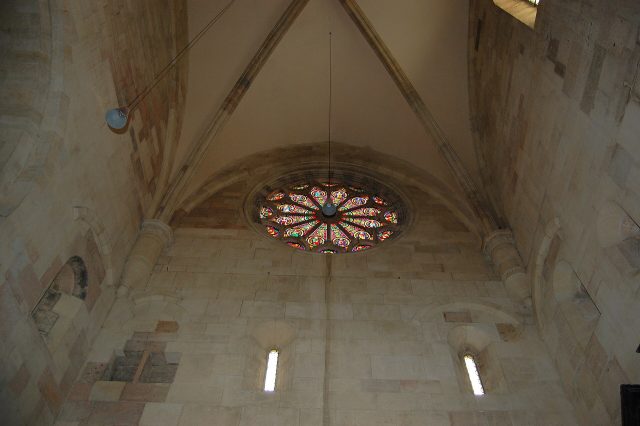
Alba Iulia is a city where history lingers in every stone, a place where empires once clashed and cultures intertwined. At its heart stands St. Michael’s Roman Catholic Cathedral, one of Romania’s oldest and most significant religious landmarks. More than just a place of worship, it has witnessed coronations, wars, and shifting faiths, its walls holding stories that span centuries. Today, it remains a living monument to the past, a quiet witness to the events that shaped this region.
The cathedral’s origins trace back to the 11th century, when these lands were part of the Kingdom of Hungary. Built initially as a Romanesque basilica, it evolved over time, reflecting the architectural trends and political changes of each era. By the 13th century, Gothic elements had been incorporated, and later, Renaissance details softened its robust medieval lines. Despite these transformations, the cathedral retained its original three-aisled structure with a transept, making it a rare surviving example of early medieval design in Transylvania.
The 15th century marked a turning point in the cathedral’s history. In 1442, it hosted the coronation of Matthias Corvinus, one of Hungary’s most celebrated rulers, known for his military prowess and patronage of the arts. Over a century later, in 1599, the cathedral bore witness to another historic moment—the coronation of Michael the Brave, who briefly united Wallachia, Transylvania, and Moldavia under his rule. These events elevated the cathedral’s status, though its significance has always been tied to the shifting fortunes of the region.
Architecturally, St. Michael’s Cathedral is a layered record of styles. Romanesque arches and thick walls stand alongside Gothic stained glass and pointed windows, while Renaissance touches add a sense of refinement. Inside, the contrasts continue: medieval frescoes share space with intricately carved wooden altars and the tombs of nobility. Among the most notable is the resting place of John Hunyadi, the famed military leader and regent of Hungary, whose legacy is forever linked to the defense of Europe against Ottoman expansion.
The 16th century brought another challenge—the Reformation. As Transylvania became a center of Protestantism, the cathedral’s role diminished, its Catholic identity temporarily overshadowed. Yet the Counter-Reformation restored its prominence, and by the 17th century, the building had been renovated and expanded. A Baroque altar was added during this period, still standing today as a testament to the cathedral’s resilience through religious and political upheaval.
Now, St. Michael’s serves as both a place of worship and a museum, welcoming visitors to explore its history. The collection includes ancient manuscripts, religious artifacts, and works of art that trace the cathedral’s evolution. A particularly striking feature is the assortment of medieval tombstones, many belonging to Transylvanian nobles, their inscriptions worn by time but still legible. These remnants offer a tangible connection to the past, a reminder of the lives once lived within these walls.
The atmosphere inside the cathedral is one of quiet reverence. High vaulted ceilings, the soft glow of stained glass, and the hush of the space create a sense of timelessness. Even those indifferent to history or religion often find themselves lingering, drawn by the stillness and the weight of centuries. In summer, the cathedral hosts classical music concerts, the sound of the organ filling the air, its notes echoing through a space that has heard countless prayers and hymns over the ages.
The cathedral stands within Alba Iulia’s fortress, a sprawling 18th-century complex encircled by sturdy walls and bastions. The fortress itself is a journey through history, its cobblestone paths lined with buildings from different eras. Walking here feels like stepping into another time, where the echoes of empires and nations still resonate. St. Michael’s remains a constant amid this change, a symbol of continuity and faith that has endured through conquests and revolutions.
For visitors to Alba Iulia, the cathedral is more than a stop on a tour—it’s a place where history feels immediate. Here, you can touch stones worn smooth by centuries, study frescoes painted by long-forgotten hands, and sense the layers of time that have settled into the very air. St. Michael’s is not just an architectural marvel; it’s a reminder that the past is never truly distant, only waiting to be rediscovered.