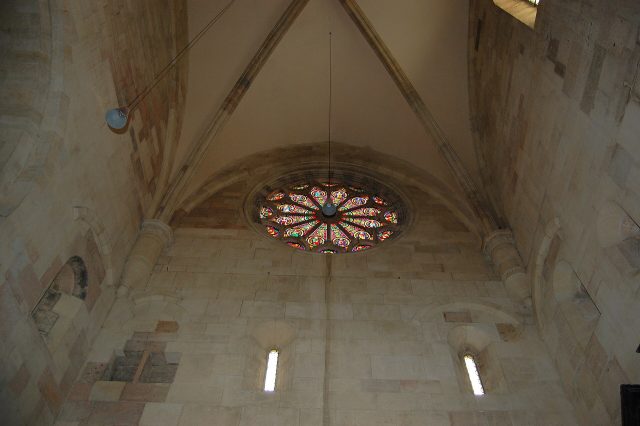
St. Michael’s Cathedral in Alba Iulia is one of those rare places where history isn’t just remembered—it lingers in the very stones beneath your feet. Standing at the heart of the city, within the boundaries of the ancient Roman fortress of Apulum, the cathedral has witnessed nearly a thousand years of shifting borders, faiths, and powers. It was here that Hungarian kings were crowned, where Transylvanian princes took their oaths, and where, for a brief moment in 1599, Michael the Brave united the Romanian principalities under one rule. Today, it remains a living church for the region’s Catholic community, but its significance stretches far beyond religion. The building itself is a chronicle of architectural evolution, a silent testament to the cultural and political currents that have shaped this corner of Europe.
The first records of a church on this site date back to the 11th century, when a modest Romanesque structure stood here. Little of that original building remains, as the cathedral was rebuilt and expanded multiple times, particularly between the 13th and 14th centuries, when Gothic elements began to take hold. The interior, too, transformed over time—from the stark simplicity of its early days to the richly decorated space it is today, filled with frescoes, carved altars, and stained glass. One of the most striking features is the Chapel of St. Stephen, added in the 15th century, its walls adorned with vivid murals depicting scenes from the life of Hungary’s first Christian king, St. Stephen. These paintings are among the few surviving examples of medieval art in Transylvania, offering a glimpse into a time when the region was a crossroads of cultures and kingdoms.
Architecturally, St. Michael’s Cathedral is a layered story of European design. The heavy, rounded arches of the Romanesque style coexist with the soaring, pointed windows of Gothic architecture, while later Baroque additions lend the building a touch of grandeur. The western façade, dominated by its tall tower, is the most recognizable feature, but the interior holds its own quiet wonders. The nave’s height and spaciousness create a sense of awe, while the side chapels—each dedicated to a different saint—offer pockets of intimacy. The choir stalls, intricately carved with figures of saints and biblical scenes, are particularly striking. They once accommodated the canons who gathered here for prayer, and even now, it’s easy to imagine the echo of their voices beneath the vaulted ceilings.
The cathedral’s history is deeply intertwined with that of Alba Iulia and Transylvania itself. In the Middle Ages, it was not just a place of worship but a political stage, where coronations and treaties were sealed. The most famous of these events was the 1599 union under Michael the Brave, a moment that still resonates in Romanian history. When Transylvania later became part of the Habsburg Empire in the 18th century, the cathedral took on a new role as a symbol of Catholic influence in a predominantly Orthodox region. This shift is reflected in the building’s design, where Baroque flourishes were added to the Gothic and Romanesque bones, blending the old with the new in a way that mirrors the region’s complex identity.
Inside, the cathedral houses the tombs of some of Transylvania’s most notable figures. Among them is the grave of John Hunyadi, the 15th-century military leader who played a crucial role in defending Europe against Ottoman expansion. His tomb, adorned with sculpted figures, is one of the most revered in the cathedral. Nearby lie the remains of other historical figures, each with their own stories of power, faith, and conflict. Together, these memorials form a mosaic of the past, offering a tangible connection to the people who shaped this land. Walking among them, it’s impossible not to feel the weight of history pressing in—not as a distant abstraction, but as something immediate, almost alive.
Despite its storied past, the cathedral exudes a sense of quiet dignity. There’s none of the hustle often found in tourist-heavy sites; instead, the atmosphere is one of timeless calm. In summer, sunlight filters through the stained glass, casting soft, colored patterns across the stone floors. In winter, the warmth of candles and the murmur of prayers create a cocoon of tranquility. Even for those who don’t consider themselves religious, the space invites reflection. It’s easy to lose track of time here, whether you’re studying the faded frescoes, tracing the lines of a centuries-old tomb, or simply sitting in silence, listening to the faint echo of footsteps on the worn stones.
St. Michael’s Cathedral has survived wars, regime changes, and religious upheavals, yet it remains what it has always been: a place of worship, remembrance, and contemplation. For the people of Alba Iulia, it’s a familiar presence, a constant in a city that has seen so much change. For visitors, it offers a chance to step into history—not as a spectator, but as someone momentarily sharing the same space where kings once knelt and soldiers once prayed. That’s the cathedral’s enduring power: it doesn’t just preserve the past; it makes it feel present, as if the centuries between then and now have momentarily dissolved.
What makes this place special isn’t just its age or its architecture, but the way it carries the stories of those who came before. The cathedral isn’t a museum, frozen in time; it’s a living part of the city, still used for services, weddings, and quiet moments of prayer. The wear on the stone steps, the flicker of candlelight in the chapels, the occasional sound of an organ playing—all of it serves as a reminder that history isn’t just something we read about. It’s something we can touch, hear, and even feel, if we take the time to listen. In that sense, St. Michael’s isn’t just a monument to the past; it’s a bridge to it.