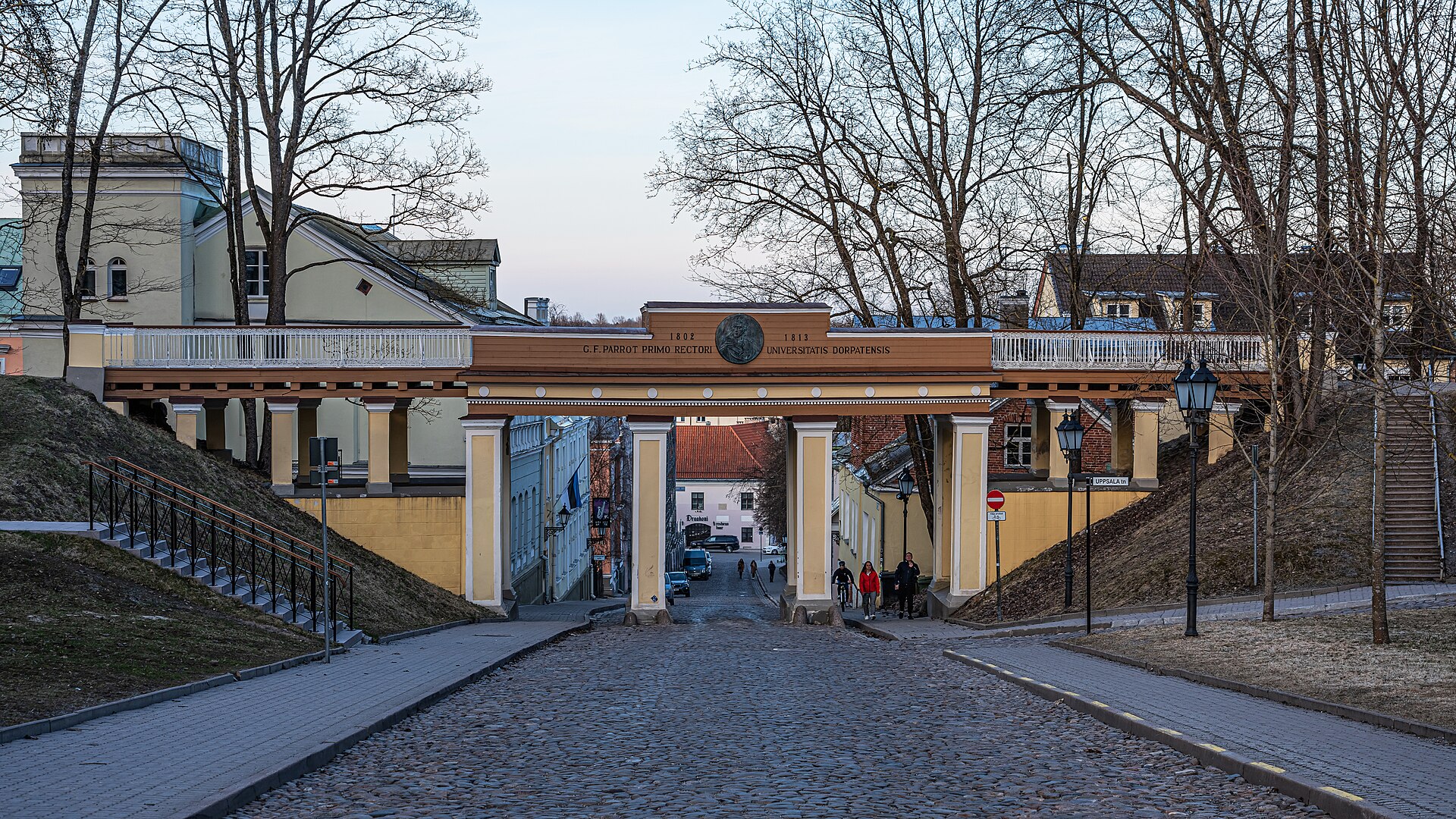
Angels’ Bridge in Tartu is one of those quiet landmarks that doesn’t announce itself with grand gestures but lingers in memory long after you’ve passed it. Built in the mid-19th century, it spans the narrow stretch of the Emajõgi River just upstream from the city’s old town, connecting two parts of Tartu that have always felt distinct yet inseparable. The bridge itself is unassuming—low, wide, and built of stone, with a gentle arch that barely rises above the water. What makes it special isn’t its engineering, though it has held steady for nearly two centuries, but the stories and traditions that have grown around it over time.
The bridge was originally constructed in 1838, part of a broader effort to modernize Tartu’s infrastructure during a period of relative prosperity. At the time, the city was a key center of the Russian Empire’s Baltic provinces, and its university, one of the oldest in Northern Europe, attracted scholars, students, and travelers from across the continent. The bridge wasn’t just a practical crossing; it became a symbolic link between the academic heart of Tartu and the more residential, working-class districts on the other side of the river. Over the years, it has witnessed countless daily routines—students hurrying to lectures, merchants transporting goods, and townspeople simply going about their lives.
What gives Angels’ Bridge its name isn’t immediately obvious to the casual observer. There are no statues of angels here, no overt religious symbols. The name is said to come from a local legend, though the details have blurred over time. Some versions claim that the bridge was named after a nearby church or a long-gone tavern, while others suggest it was inspired by the way the bridge’s reflection in the river at dusk resembles a pair of wings. Whatever the origin, the name has stuck, and today it carries a certain poetic weight, as if the bridge itself is a quiet guardian of the city’s past.
Walking across Angels’ Bridge today, you’re following in the footsteps of generations of Tartu’s residents. The river beneath it, the Emajõgi, has always been central to the city’s identity. It’s one of the few rivers in Estonia wide and slow enough to be navigable by larger boats, and in centuries past, it was a vital trade route connecting Tartu to Lake Võrtsjärv and beyond. The bridge offers a vantage point to watch the water flow, its surface shifting with the seasons—glassy in summer, dotted with ice in winter, and often shrouded in mist during the damp autumn months.
The bridge is also a place where the layers of Tartu’s history become visible. On one side, the old town unfolds with its pastel-colored wooden houses, cobblestone streets, and the towering presence of St. John’s Church, its brick facade a testament to the city’s medieval roots. On the other side, the Karlova district, with its grid of tree-lined streets and modest 19th-century homes, speaks to a different era—one of growth and urban planning. Angels’ Bridge sits between these two worlds, a threshold rather than a barrier.
For students at the University of Tartu, the bridge has long been a rite of passage. It’s said that walking across it before an exam brings good luck, a superstition that persists even now. Some claim the tradition dates back to the 19th century, when students would cross the bridge on their way to the university’s main building, whispering prayers or reciting last-minute notes. Whether or not the ritual actually works, it’s a reminder of how deeply the bridge is woven into the fabric of student life. On warm evenings, you’ll often see groups of young people gathered here, leaning against the railing, chatting, or simply watching the river drift by.
The bridge has also been a silent witness to some of Tartu’s darker moments. During World War II, the city suffered heavy damage, and Angels’ Bridge was no exception. It was partially destroyed in the bombings of 1944 but later restored, a small but meaningful act of resilience. In the decades that followed, under Soviet rule, the bridge became a place where people could gather without drawing too much attention—a spot for quiet conversations, stolen glances, or simply a moment of solitude in a city that was often under watchful eyes.
Today, Angels’ Bridge is neither a tourist hotspot nor a forgotten relic. It’s a place that locals use without fanfare, a part of their daily landscape. You might see an elderly couple taking their evening stroll, a cyclist pausing to check the river’s current, or a street musician setting up near the railing, their notes drifting over the water. There’s no grand monument here, no plaque detailing its history—just the bridge itself, the river, and the quiet rhythm of the city around it.
What makes Angels’ Bridge worth lingering on isn’t its grandeur, but its ordinariness. It’s a reminder that history isn’t just found in palaces or battlefields, but in the places where life has unfolded, unremarkably and yet meaningfully, day after day. In Tartu, a city that wears its history lightly, the bridge is a perfect reflection of that spirit—modest, enduring, and quietly significant. Whether you cross it in a hurry or take your time, it leaves an impression not through spectacle, but through the quiet weight of time.