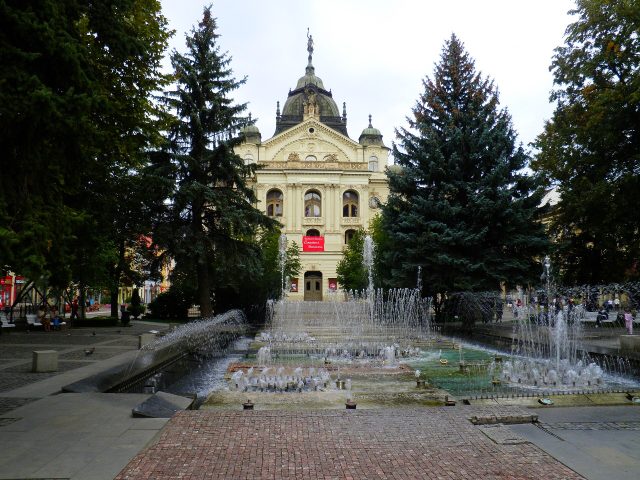
Rožňava’s town hall is one of those buildings that seems to exist outside of time, a quiet witness to centuries of change while remaining firmly rooted in the present. Standing on the main square, it has seen the ebb and flow of daily life—markets bustling with traders, officials making proclamations, and townspeople gathering for festivals or protests. Though it still serves as an administrative hub, the building has become something more: a silent storyteller of the city’s past.
The architecture reflects the era in which it was built, blending typical features of Slovak town halls with its own distinct character. The facade, adorned with Baroque details, gives the structure a sense of lightness despite its solid construction. The clock tower, once a landmark for travelers and locals alike, still keeps time, though the original mechanism has long since been replaced. Inside, the high-ceilinged halls that once hosted city council meetings now accommodate official events and occasional exhibitions, preserving the grandeur of their original purpose.
Rožňava wasn’t always the quiet town it is today. In the Middle Ages, it was a thriving center of mining, rich in gold and silver deposits that drew merchants, craftsmen, and fortune-seekers from across Europe. The town hall was built during this golden age, a symbol of prosperity and order. Within its walls, disputes between miners and mine owners were settled, and decrees from Hungarian kings—who ruled over Slovakia at the time—were announced. The building stood at the heart of a city that was growing, confident, and full of ambition.
As mining declined, so did Rožňava’s prominence. The town shrank, its streets grew quieter, and its role in the region diminished. Yet the town hall endured, surviving wars, political upheavals, and economic shifts. In the 19th century, it underwent renovations, but its core identity remained intact. Today, it serves as a reminder of a time when Rožňava was a hub of activity, its streets alive with the energy of people from all corners of the continent.
The area around the town hall is a snapshot of old Rožňava. Narrow cobblestone streets lead to the 13th-century Church of St. Mary or past historic houses with intricately carved facades. It’s easy to imagine the square filled with merchants selling cloth, wine, and handcrafted goods during one of the town’s many fairs. The town hall wasn’t just a seat of government—it was the center of public life, where the fate of the city and its people was decided.
Modern Rožňava is a place for those who seek an authentic slice of Slovakia, far from the crowds of more tourist-heavy destinations. The town hall still plays a role in daily life, though a quieter one. Local officials work within its walls, and occasionally, it hosts exhibitions or concerts. Tourists pause to photograph its facade, but the real value of the building lies in the sense of continuity it provides—a tangible link to the past that lingers in every corner of the town.
The square in front of the town hall feels like a place where time moves at its own pace. Old-fashioned streetlamps, wooden signs for cafes, and small shops selling local goods create an atmosphere of unhurried charm. There’s no rush here, no sense of urgency. The town hall seems to guard this rhythm, a reminder that history isn’t something confined to books; it’s alive in the stones beneath your feet and the air around you.
For those interested in architecture, Rožňava’s town hall offers a fascinating example of how different styles coexist in a single structure. Baroque flourishes sit alongside classical elements, and the interior bears traces of the building’s many transformations. While not all of its halls are open to the public, even the exterior tells a story of its significance. It’s not a museum piece but a living part of the city, still serving its original purpose while carrying the weight of centuries.
Rožňava rarely appears on tourist itineraries, and that’s part of its appeal. There are no crowds here, just the quiet hum of everyday life. If you take the time to ask, locals will gladly share stories about their town. The town hall is just one of many landmarks, but it sets the tone for the entire city—a reminder that even small places have their own histories, heroes, and secrets waiting to be discovered.