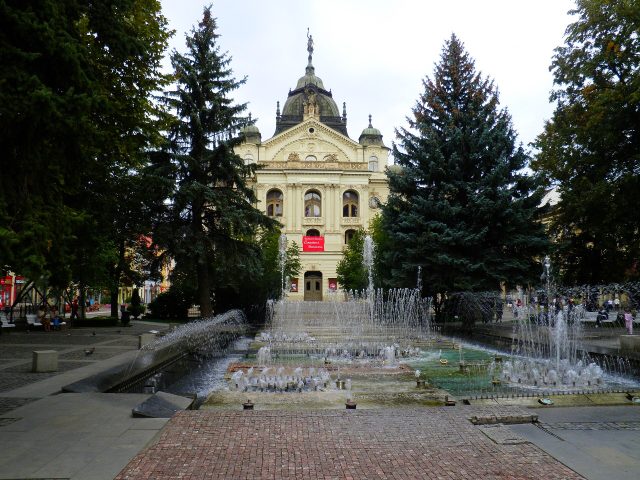
Rožňava is one of those quiet Slovak towns where the past lingers in the air like the scent of old wood and damp stone. Tucked away in the eastern part of the country, it doesn’t draw crowds or boast grand monuments, but that’s precisely what makes it feel real. The town unfolds in layers—low-slung houses with terracotta roofs, narrow streets winding between gentle hills, and above it all, the slender silhouette of St. Mary Magdalene Church. Perched on a small rise, it has watched over Rožňava for centuries, a silent witness to the slow rhythm of life here.
The church first appeared in the 14th century, when Rožňava was a thriving hub of mining. Silver and other metals pulled merchants and craftsmen to the area, and with them came the need for a place of worship. The earliest records mention the church in 1304, though little remains of that original structure. What stands today is a blend of styles—Gothic arches, Baroque flourishes, and even a touch of Neo-Gothic—each layer telling a story of the town’s changing fortunes. The building has been rebuilt, restored, and adapted over the years, yet it still feels like the heart of Rožňava.
From the square below, the church’s tall clock tower rises above the rooftops, a familiar landmark for anyone navigating the town. The entrance is framed by an intricately carved portal, where saints and floral motifs twist together in stone. Above the door, a rose window filters sunlight into soft, colored patterns, casting a warm glow over the interior. Inside, the space feels vast, the high vaulted ceilings supported by thick columns. The walls are adorned with frescoes depicting scenes from the life of Mary Magdalene and other biblical figures, their faded colors hinting at the passage of time.
The Baroque main altar dominates the space, its gilded carvings catching the light as figures of angels and saints seem to hover above the congregation. At its center stands Mary Magdalene, the church’s namesake, her presence a quiet reminder of the faith that has sustained this place for generations. Nearby, the old pulpit still bears the marks of sermons delivered over centuries. In the side chapels, smaller altars and icons tell their own stories—some crafted by local hands, others brought from distant corners of Europe. Each piece feels like a fragment of a larger history, one that’s still unfolding.
Beyond its religious role, the church has long been a gathering place for the town. In the Middle Ages, it served as a meeting point where merchants haggled, disputes were settled, and news was shared. During wars and plagues, people turned to it for solace, its doors always open. Even in the 19th century, when Rožňava’s mines began to empty and the town’s prosperity waned, the church remained a symbol of continuity. Today, it still plays a part in the life of the community, though the town around it has changed in ways no one could have predicted.
A small park surrounds the church, offering a quiet spot to sit beneath the shade of old trees. From here, the view stretches over Rožňava’s rooftops toward the rolling hills beyond, where forests and vineyards blur into the horizon. In summer, the only sounds are the occasional chime of the church bells and the murmur of voices from the square. Winter transforms the scene entirely—the church stands like a postcard image, its stone facade dusted with snow, the town hushed beneath a thick white blanket.
For visitors, St. Mary Magdalene Church is more than just a historical monument. It’s a chance to step into the unhurried pace of a Slovak town that hasn’t been polished for tourists. There are no crowds here, no guided tours rushing you along. You can sit on a wooden pew, tracing the lines of the frescoes with your eyes, or simply listen to the silence. If the tower is open, climbing it offers a different perspective—Rožňava spread out below, its streets and squares laid bare. Either way, the church leaves an impression of something enduring, a place where time moves differently.
Rožňava itself is easy to overlook. It’s not a destination that makes it onto most itineraries, and that’s exactly why it feels authentic. The church on the hill isn’t just a landmark; it’s the quiet center around which the town’s life revolves. It doesn’t demand attention or shout its importance, but it’s always there—a reminder that history isn’t just made by grand events, but by the everyday lives of ordinary people. If you ever find yourself in this part of Slovakia, take a moment to wander the streets, step inside the church, and let the town’s unhurried rhythm settle over you. You might just find that time here moves at its own pace, slow and steady, just as it always has.