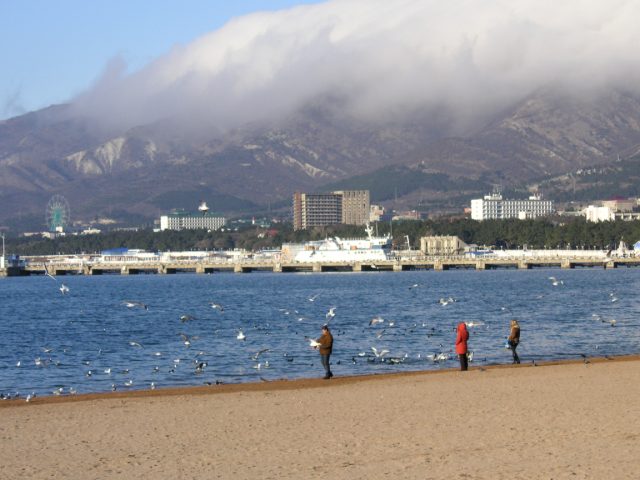
Gelendzhik’s Primorsky Boulevard is where the town quietly slips into the sea, as if the two have always belonged together. There’s no forced grandeur here, no staged spectacle for visitors—just a stretch of shoreline that feels like it’s been part of the city’s rhythm for as long as anyone can remember. It’s a place where the past lingers in the shade of old trees, where the sound of waves blends with the murmur of conversations, and where both locals and travelers end up without quite knowing why.
The boulevard’s story began in the late 19th century, when Gelendzhik was just starting to shed its skin as a small settlement and take on the role of a seaside resort. Back then, a simple promenade lined with trees and a few benches appeared along Tsemess Bay. Over time, it grew into something closer to what it is today—a place where people came not just to escape the heat, but to be near the water, to watch the sunset, or to meet friends without any particular reason. By the Soviet era, the boulevard had become the heart of the town, with open-air cinemas, cafes, and monuments springing up along its length. Many of those additions have since disappeared, but the atmosphere they left behind remains: unhurried, a little old-fashioned, and deeply lived-in.
The architecture here doesn’t demand attention, and that’s part of its charm. There are no towering landmarks or flashy designs—just modest two- and three-story buildings that have accumulated over the decades, their styles blending into something familiar and unpretentious. Some date back to the early 20th century, with their delicate balconies and tiled roofs, while others bear the straightforward lines of the Soviet period. The wide pedestrian walkway, paved with stone and shaded by rows of trees, runs the length of the boulevard, offering enough space for everyone. In summer, it’s lively but never crowded; people read on benches, stroll along the railing with the sea at their side, or simply watch the world go by.
The sea is never far away. Even when you’re not looking at it, you can feel it in the salt on the breeze, the cry of gulls, the gentle rocking of boats at the dock. The boulevard follows the curve of the bay for several kilometers, and from different points along its length, the view shifts—now framing the mountains that rise from the water, now the breakwaters, now the distant cape of Doob. The evenings are especially quiet here, when the sky turns pink and gold, and the lights of the town begin to flicker on the darkening water. It’s the kind of place where you might find yourself walking slowly, with no destination in mind, just listening to the waves.
For Gelendzhik, Primorsky Boulevard is more than just a waterfront—it’s the town’s signature, the place where everything comes together. Festivals, concerts, and public celebrations all unfold here, drawing crowds in the warmer months. In summer, the boulevard hosts markets selling local honey, fruit, and wine, while in winter, when the tourists thin out, it becomes a space for locals—joggers, dog walkers, or anyone who just wants a breath of fresh air. For many who grew up in Gelendzhik, the boulevard holds memories: childhood bike rides, first dates along the promenade, or the simple, enduring impression of sea air and the sound of footsteps on stone.
Despite how much Gelendzhik has changed over the years, the boulevard has stayed much the same. New cafes and shops have appeared, but the essence of the place hasn’t shifted. It still feels like the kind of spot where time moves at its own pace, where even a quick stop for ice cream turns into a longer pause by the railing, watching boats drift by or listening to children laughing as they run along the shore. There’s no rush here, no need to perform or document the moment—just the quiet pleasure of being near the water.
What makes the boulevard special is how it adapts to the seasons. In summer, it’s alive with music, the hum of conversation, and the clink of glasses from open-air cafes. By autumn, when the crowds disperse, it grows quieter but no less beautiful, the trees turning gold, the sea deepening in color, the air crisp with the first chill. Winter brings a different kind of stillness—fewer people, the sound of waves more pronounced, the sense that the town has paused to gather itself before the next season. Then spring arrives, and the boulevard wakes early, the trees budding, the air sweet with blossoms, the sea soft and inviting once again.
Primorsky Boulevard isn’t the kind of place that dazzles immediately. Its appeal unfolds slowly, like a story told in passing. There’s nothing extraordinary about it—just ordinary buildings, ordinary people, an ordinary stretch of sea. But that’s where its magic lies. It’s a place where you can simply exist, without the pressure to hurry, to capture the moment, or to prove anything to anyone. Here, it’s easy to think, to daydream, or to sit in silence. And perhaps that’s the real gift of the boulevard: it doesn’t try to impress. It just offers a little peace, a little space, and the quiet understanding that some places are meant to be lived in, not just seen.