Nouadhibou clings to the edge of the Atlantic like a place that refuses to be forgotten. The city is little more than a thin strip of land between the desert and the ocean, a shape dictated by necessity rather than design. Its existence hinges on the port, a sprawling complex of docks, cranes, and warehouses that has shaped the rhythm of life here for decades. Without it, Nouadhibou would be just another speck in the vast emptiness of the Sahara, but the port gives it weight, drawing people from across Mauritania and beyond. It’s not a place that invites you in with open arms—there are no manicured promenades or carefully curated views. Instead, it offers something rarer: a glimpse of how the world actually works.
The port’s origins lie in the mid-20th century, when Mauritania began exporting iron ore from its interior. The country’s vast mineral wealth needed an outlet, and Nouadhibou was the logical choice. The bay here is deep and sheltered, the desert close enough to make overland transport feasible. What emerged was one of the most striking industrial landscapes in Africa. A three-kilometer-long train, one of the longest in the world, carries ore from the mines near Zouerate to the coast, where ships wait to take it across the ocean. Watching the train arrive is like seeing a mechanical beast crawl out of the desert—an endless line of rust-red cars, groaning under the weight of their cargo, moving with deliberate slowness toward the docks. It’s a sight that feels almost mythic, a reminder of how far raw materials travel before they become the things we take for granted.
The port itself is a place of relentless efficiency. There’s no room for ornamentation here—every structure, every piece of machinery, serves a single purpose: moving ore from train to ship as quickly as possible. Conveyor belts hum, cranes pivot with precision, and mountains of iron sit in neat piles, waiting to be loaded. The air is thick with the smell of salt and diesel, the ground littered with scraps of metal and the occasional discarded glove. This isn’t a place for tourists, and it doesn’t pretend to be. The workers who keep it running—dockhands, mechanics, crane operators—know the port’s rhythms intimately. Many of them come from families who have worked here for generations, their lives tied to the ebb and flow of ships and trains. For them, the port isn’t a curiosity; it’s where they earn their living, where their children play, where the years pass in the shadow of industry.
But the port isn’t just about iron ore. Nouadhibou has long been a fishing hub, and the Atlantic off Mauritania’s coast is one of the richest fishing grounds in the world. Local fishermen set out in wooden boats that look almost fragile against the vastness of the ocean, returning with catches of sardines, tuna, and octopus. The fish market is one of the city’s most vivid scenes—a chaotic, sensory overload of shouting, bargaining, and the sharp tang of saltwater and fresh fish. Fishermen lay out their haul on rusted tables, while buyers inspect the catch, their hands moving quickly over scales and gills. The market isn’t just a place to buy food; it’s where the city’s pulse is strongest, where the day’s work is measured in kilos and dirhams.
The port also serves as a crossroads for people as well as goods. Mauritania is a transit country for migrants from West Africa, many of whom pass through Nouadhibou on their way to Europe. Some come looking for work, others for a way across the ocean, and the city becomes a temporary home where languages and stories mix. You might meet a young man from Senegal waiting for a job on a fishing boat, or a family from Mali hoping to find passage to the Canary Islands. The port is where these journeys begin or end, where dreams collide with reality. It’s not a story you’ll find in travel brochures, but it’s part of what makes Nouadhibou feel alive in a way that polished tourist destinations rarely do.
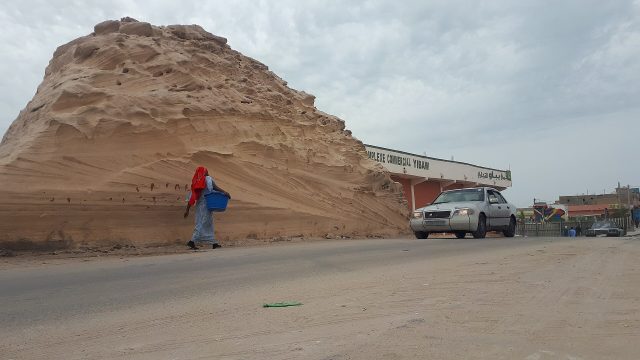
The city itself is a study in contrasts. The architecture is purely functional—low, flat-roofed buildings made of concrete and metal, designed to withstand the harsh coastal climate. Salt and sand eat away at everything, leaving walls pockmarked and rusted. There are no grand boulevards or historic landmarks here, just a grid of streets where life unfolds in small, unremarkable ways. The waterfront is lined with cafés serving strong tea and grilled fish, their plastic chairs spilling onto the pavement. Guesthouses cater to truck drivers and migrant workers, offering little more than a bed and a fan. It’s not a place that tries to impress; it simply exists, shaped by the needs of those who live and work here.
The weather in Nouadhibou is as much a part of the city as the port itself. The Atlantic here is wild, waves crashing against the shore with enough force to send spray skittering across the promenade. The wind carries sand that stings your skin and grits between your teeth. Summers are oppressively hot, the air thick with humidity, while winters bring a damp chill that seeps into your bones. Fog rolls in without warning, swallowing the port in a white haze, the lights of ships barely visible through the mist. Locals move through it all with practiced ease, but visitors often find the coast far harsher than they imagined. There’s no gentle tropical breeze here, just the raw, unfiltered force of the ocean.
Despite its roughness, Nouadhibou has a quiet kind of appeal. There are no crowds, no souvenir stalls, no guided tours promising an "authentic" experience. Instead, there’s the sound of waves against the docks, the occasional blast of a ship’s horn, and the murmur of voices in Arabic, French, and Wolof. In the evenings, when the sun dips below the horizon, the port glows in shades of orange and red, the cranes silhouetted against the sky. Locals gather by the water, drinking tea and watching the ships come and go. For a moment, the city feels almost peaceful, though never soft. It’s a place where life is lived without pretense—where people work, endure, and find small joys in the spaces between.
Nouadhibou’s port isn’t a place you visit for beauty or comfort. It’s where you come to see the world as it is, not as it’s packaged for tourists. There’s no romance in the rusted metal and the salt-stained docks, just the unvarnished reality of industry and survival. If you ever find yourself in Mauritania, take the time to walk along the waterfront, to watch the ore train arrive, to stand in the fish market and breathe in the scent of the ocean. It won’t be an easy visit, but it will be one you remember. This is a city that doesn’t need to be liked—it just is. And that, in its own way, is enough.