Place de l’Étoile, or Star Square, is one of Cotonou’s most recognizable landmarks, though it’s not the kind of place you’d linger for hours. It sits at the heart of the city’s busiest intersection, where Boulevard Saint-Michel meets the main thoroughfare leading toward the port. The square itself is modest—a small paved circle with a few benches, a handful of palm trees, and a central monument that gives it its name. The monument is simple: a tall, slender obelisk topped with a five-pointed star, its metallic surface weathered by the coastal humidity. At night, the star is illuminated, casting a faint glow over the surrounding traffic and the occasional street vendor selling roasted corn or cold drinks.
The square’s name and design are no accident. The star is a nod to Benin’s national flag, which features a similar emblem, and the monument was erected in the decades after independence as a symbol of the country’s new identity. Cotonou, though not the capital, has long been the economic and cultural hub of Benin, and Place de l’Étoile reflects that role. It’s not a grand plaza like those in older colonial cities, but rather a functional space, a pause in the urban rhythm where people cross paths on their way to work, the market, or the nearby beaches.
The area around the square is a mix of the old and the new. To the north, the streets are lined with low-rise buildings, some with fading facades that hint at the city’s mid-20th-century growth. These structures house everything from small shops selling fabric and electronics to offices for local businesses. To the south, the port looms large, its cranes and warehouses a reminder of Cotonou’s role as a key trade gateway for West Africa. The port’s presence shapes the city’s character—it’s a place where goods from Europe, Asia, and other African nations flow in and out, and where the scent of saltwater and diesel often hangs in the air.
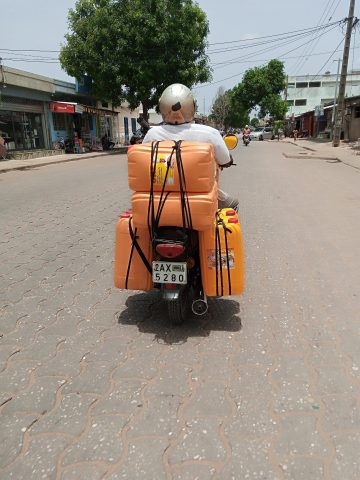
Place de l’Étoile isn’t a destination in the traditional sense. There are no museums nearby, no grand cathedrals or historic ruins. Instead, it’s a place that reveals the everyday life of Cotonou. In the early mornings, the square is quiet, save for the occasional taxi honking as it navigates the roundabout. By midday, it buzzes with activity—motorbike taxis weaving between cars, pedestrians waiting for the light to change, and the hum of generators from nearby buildings. In the evenings, the pace slows slightly, and the square becomes a gathering spot for young people, some sitting on the benches, others leaning against the monument, scrolling through their phones or chatting in Fon, Yoruba, or French.
The monument itself has a quiet dignity. It’s not ornate, but its simplicity feels deliberate, a contrast to the chaos of the traffic swirling around it. The star at the top is slightly tilted, as if worn down by years of wind and rain, yet it still stands. For locals, it’s a familiar landmark, a point of reference in a city that’s constantly changing. For visitors, it’s a small but telling detail—a reminder that Cotonou is a place where history and modernity coexist, often in unexpected ways.
The square’s location makes it a natural starting point for exploring the city. From here, it’s a short walk to Dantokpa Market, one of West Africa’s largest open-air markets, where the air is thick with the scent of spices, grilled fish, and fresh produce. To the east, the road leads toward the beaches of Fidjrossè, where the Atlantic crashes against the shore and fishermen mend their nets. To the west, the city’s administrative buildings and embassies cluster, their architecture a mix of colonial-era designs and more recent, utilitarian structures.
Place de l’Étoile doesn’t demand attention, but it rewards those who take a moment to notice it. It’s a place where the city’s energy is distilled into a single point—where the past and present collide in the form of a weathered monument, a busy intersection, and the constant movement of people. It’s not the kind of square that makes it into glossy travel brochures, but it’s the kind that stays with you, a small but vivid snapshot of life in Cotonou. If you find yourself here, take a seat on one of the benches, watch the world go by, and let the city reveal itself in its own time.