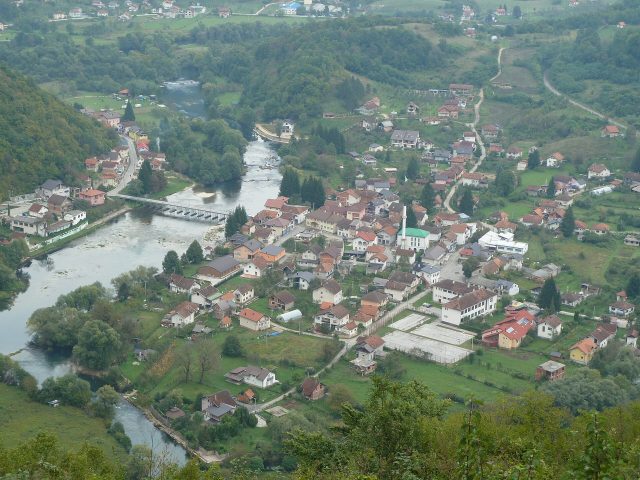
Hasanbegovica Square in Bihać is one of those places where city life moves at its own unhurried pace, steady and unforced. There’s no rush here, no crowds of tourists, just the quiet rhythm of a Bosnian town going about its day. The square isn’t large, but its size only makes it feel more intimate, more real. This is where the city reveals itself not through grand monuments or polished facades, but through the small, everyday moments that define it.
The square takes its name from Hasanbeg Resulbegović, a local figure tied to Bihać’s Ottoman past. During that era, the town was a strategic outpost on the empire’s frontier, and the square likely served as a gathering place for merchants, soldiers, and townspeople. Today, traces of that history linger in the narrow streets leading to it, their medieval layout still intact. Some buildings bear fragments of older stonework, remnants of a time when the square was at the heart of the town’s life.
The architecture around Hasanbegovica Square is a patchwork of different eras. Nineteenth-century houses with high ceilings and wooden shutters stand alongside Yugoslav-era structures, their facades weathered but unpretentious. Some buildings appear neglected, their paint peeling, but this only adds to the square’s authenticity. It’s a place that hasn’t been polished for tourists, where the past and present coexist without fuss.
At the center of the square, a small fountain trickles water into a shallow basin, surrounded by benches. In summer, the shade of the trees makes it a cool retreat, where locals sit with their children or simply enjoy the quiet. The fountain isn’t grand, but its steady murmur blends into the background, a soothing soundtrack to the square’s life. In winter, the scene changes—snow dusts the cobblestones, and a Christmas tree stands where the fountain’s water once caught the light, turning the square into something out of an old postcard.
This isn’t a place you visit for world-famous landmarks or museum-worthy sights. There are no tour groups here, no souvenir stalls, no crowds. Instead, Hasanbegovica Square offers something quieter: the chance to slow down and watch the city breathe. You can stop at a bakery for a fresh burek, buy a handful of cherries from a street vendor, or just sit on a bench and listen to the hum of conversation. Bihać isn’t a city that demands attention, but it’s the kind of place that lingers in your memory long after you’ve left.
Just steps from the square stands the Fethija Mosque, one of the oldest in Bosnia. Built in the 16th century, it has survived wars, occupations, and the passage of time. Today, its minaret rises above the rooftops, a silent witness to the town’s layered history. The mosque is still in use, its presence a reminder of Bihać’s role as a crossroads of cultures—where Muslim, Orthodox, and Catholic traditions have coexisted for centuries.
As evening falls, the square takes on a different mood. Lanterns cast a warm glow over the cobblestones, and cafes spill out onto the pavement, their tables filled with the scent of grilled meat and fresh bread. Young people gather near the fountain, while older residents stroll past, their voices low and unhurried. There are no nightclubs here, no late-night revelry—just the quiet, steady pulse of a town winding down for the day.
For visitors, Hasanbegovica Square is a good place to start exploring Bihać. From here, you can wander along the Una River’s embankment, visit the local museum, or lose yourself in the maze of old streets. But even if you don’t venture far, the square offers something just as valuable: the chance to sit with a cup of coffee and watch the city live its life. It’s a place where time moves differently, where the weight of history feels present but not overwhelming, and where the simplest moments often leave the deepest impression.