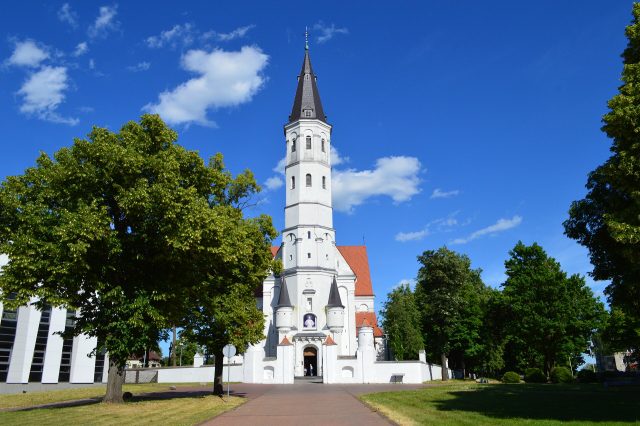
Vytautas the Great Square is where the city’s rhythm and its past meet without pretense. It’s not a grand plaza designed to impress—it’s smaller, quieter, and lived-in. People gather here after work, students pause between classes, and markets or street performances occasionally take over the space. The buildings around it tell their own stories: Soviet-era structures stand beside restored early 20th-century houses, remnants of Šiauliai’s time as a trade hub at the crossroads of merchant routes.
A statue of Vytautas the Great, the medieval Lithuanian ruler, dominates the square. Erected in 1993, it shows the grand duke on horseback. Vytautas ruled in the late 14th and early 15th centuries, when the Grand Duchy of Lithuania stretched across Eastern Europe. His legacy is part of Lithuania’s identity, and here, the statue feels less like a relic and more like a familiar landmark—something locals pass daily without much thought.
The architecture around the square mixes eras. The former House of Culture, a Soviet-era building with columns and reliefs, now holds offices and small shops. Nearby, the city administration building blends into the background with its modern lines. The old market halls have become cafes and boutiques, their worn stone and arched doorways hinting at their past. These buildings create a sense of continuity, as if the square absorbed each chapter of the city’s history rather than being reshaped by it.
Šiauliai’s history is one of resilience. First mentioned in the 13th century, it flourished later as a key stop on trade routes between Europe and Russia. By the 16th century, it was a thriving commercial center, but wars, fires, and invasions—especially the Swedish incursions in the 17th century—left it in ruins. It wasn’t until the 19th century, under Russian rule, that Šiauliai took on the look of a provincial town, with the architecture still visible today. The square carries traces of these changes, a quiet witness to time’s passage.
What makes Vytautas the Great Square special is its lack of pretense. There are no grand fountains or tourist attractions—just a place where life unfolds at its own pace. In the mornings, it’s nearly empty. By midday, it fills with students, shoppers, and locals taking breaks. In summer, small events—folk festivals, concerts, or craft fairs—take over. In winter, it becomes a skating rink for families. The atmosphere is casual, as if the space exists for the people who use it, not for show.
The square’s charm is in its imperfections. Some buildings need paint, and the sidewalks aren’t smooth, but that feels real. Šiauliai doesn’t put on a show for visitors. It lacks the polish of Vilnius or Klaipėda’s coastal appeal, and that’s why it’s worth exploring. You won’t find tourist crowds or souvenir shops. Instead, there’s everyday life, unfiltered and unhurried. The square isn’t trying to be anything—just a gathering place, a shortcut, a backdrop to small moments.
From the square, you can wander into older parts of Šiauliai. Wooden 19th-century houses stand beside newer buildings. The Bicycle Museum shows Lithuania’s cycling history, and the Photography Museum displays images of the city across eras. But you don’t need a museum to understand Šiauliai. Sometimes, the best way to experience a place is to walk its streets, watching how past and present coexist—how a centuries-old trade route becomes a quiet lane, or how a Soviet-era building finds new purpose.
For travelers who go beyond Lithuania’s famous destinations, Šiauliai offers something different. There’s no pressure to see sights or follow a checklist. Just sit on a bench in Vytautas the Great Square, listen to conversations, and watch people come and go. Here, history isn’t behind glass—it’s in the way a street curves or a building leans with age. And that’s enough.