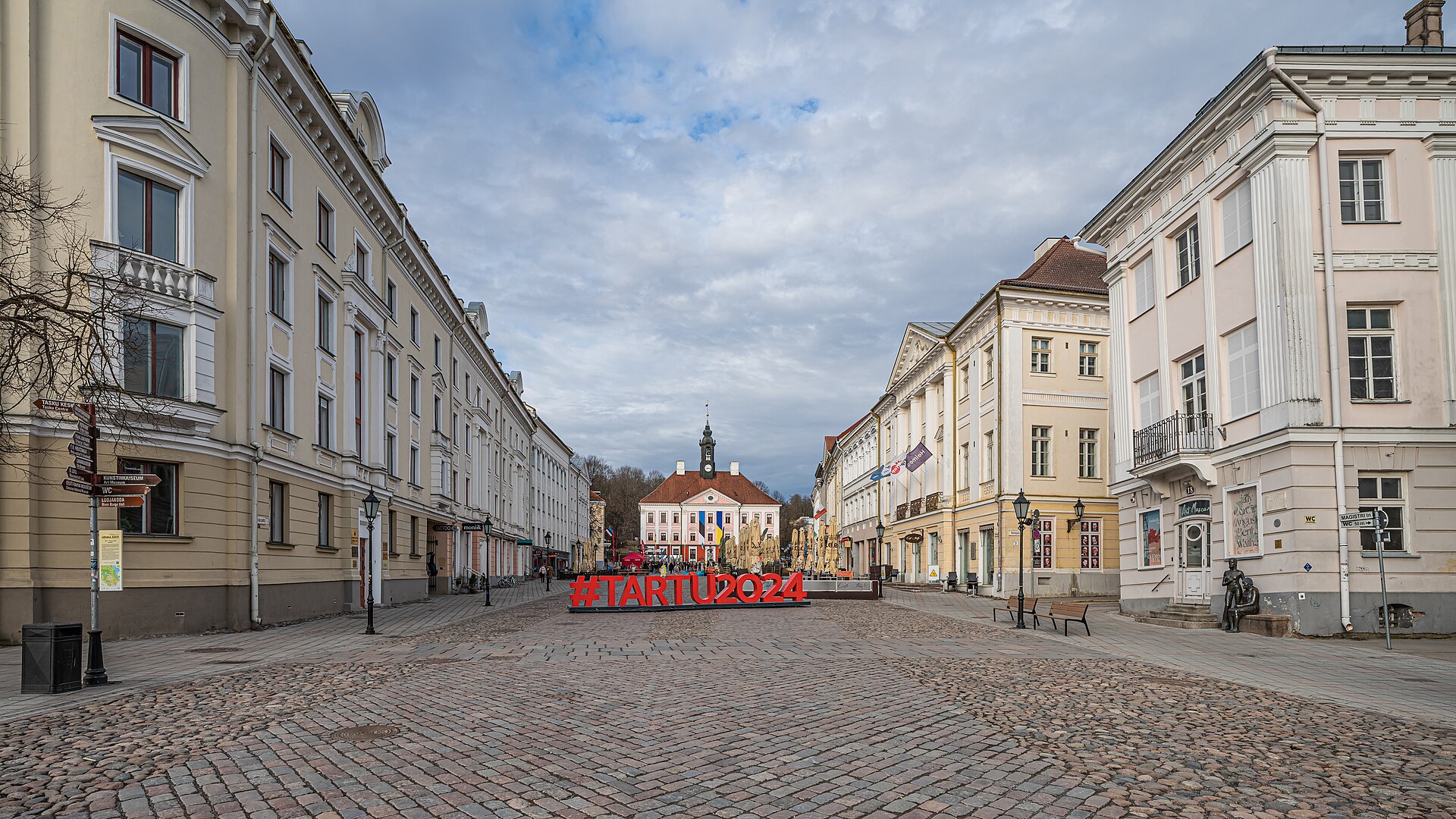
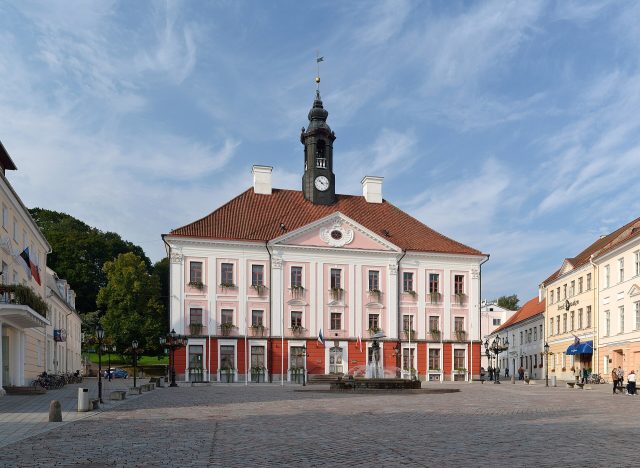
Tartu’s Town Hall Square is the kind of place that feels both timeless and quietly alive. It sits at the heart of the city, where the past and present seem to meet without fuss. The square is framed by low, pastel-colored buildings, their facades worn smooth by centuries of Baltic winds and the footsteps of generations. At its center stands the Town Hall itself, a pale yellow structure with a clock tower that has watched over Tartu since the 18th century. The building is modest in scale but carries a certain dignity, its arched windows and simple columns reflecting the restrained elegance of the time when it was built.
The square has always been more than just a pretty face. For hundreds of years, it was the commercial and social hub of Tartu, where merchants traded goods, students debated philosophy, and townspeople gathered for festivals or protests. Even today, it retains that role, though in a quieter way. On any given day, you might see university students lounging on the steps of the Town Hall, tourists snapping photos of the leaning house at number 18, or locals sipping coffee at one of the outdoor cafés. The atmosphere is unhurried, as if the square itself has decided there’s no need to rush.
What makes Town Hall Square particularly interesting is how it tells the story of Tartu’s resilience. The city has been destroyed and rebuilt multiple times—by wars, fires, and even the shifting ambitions of empires. The square, however, has always been there, adapting to each new era. The Town Hall, designed by Johann Heinrich Bartholomäus Walter after the Great Fire of 1775, replaced an earlier Gothic structure. Its current form is a blend of Baroque and Neoclassical styles, a compromise between the grandeur of the past and the practical needs of a growing city. The leaning house, meanwhile, is a reminder of the challenges of building on Tartu’s soft, clay-rich soil. It’s not as dramatic as Pisa’s tower, but it has its own charm, a subtle tilt that makes it feel almost human.
The square is also a stage for Tartu’s cultural life. In summer, it hosts open-air concerts, film screenings, and the occasional market where farmers sell fresh berries and handmade crafts. In winter, the Christmas tree here is one of the most beloved in Estonia, its lights casting a warm glow over the cobblestones. The Hanseatic Days festival, held every July, transforms the square into a medieval marketplace, complete with costumed performers and the scent of grilled sausages. These events aren’t just for tourists; they’re a way for the city to reconnect with its history, to remember that Tartu has always been a place where ideas and traditions flow freely.
Beyond the square, the surrounding streets offer their own discoveries. To the east, you’ll find the University of Tartu’s main building, its white facade and grand staircase a short walk away. To the west, the Emajõgi River winds through the city, its banks lined with parks and cafés. The square itself is small enough to cross in a few minutes, but it’s the kind of place where you might linger, watching the light change over the rooftops or listening to the chime of the Town Hall clock. There’s no grand monument here, no towering statue—just the quiet confidence of a place that has seen it all and still stands.
For those who visit, Town Hall Square offers a glimpse into what makes Tartu special. It’s not a city that shouts about its importance; it’s one that invites you to look closer. The square is a microcosm of that—unassuming on the surface, but full of layers if you take the time to notice. Whether you’re here for an afternoon or a week, it’s the kind of place that stays with you, not because of any single landmark, but because of the way it feels. Like the best public spaces, it doesn’t just belong to the city; it belongs to the people who pass through it, leaving their own small marks on its history.