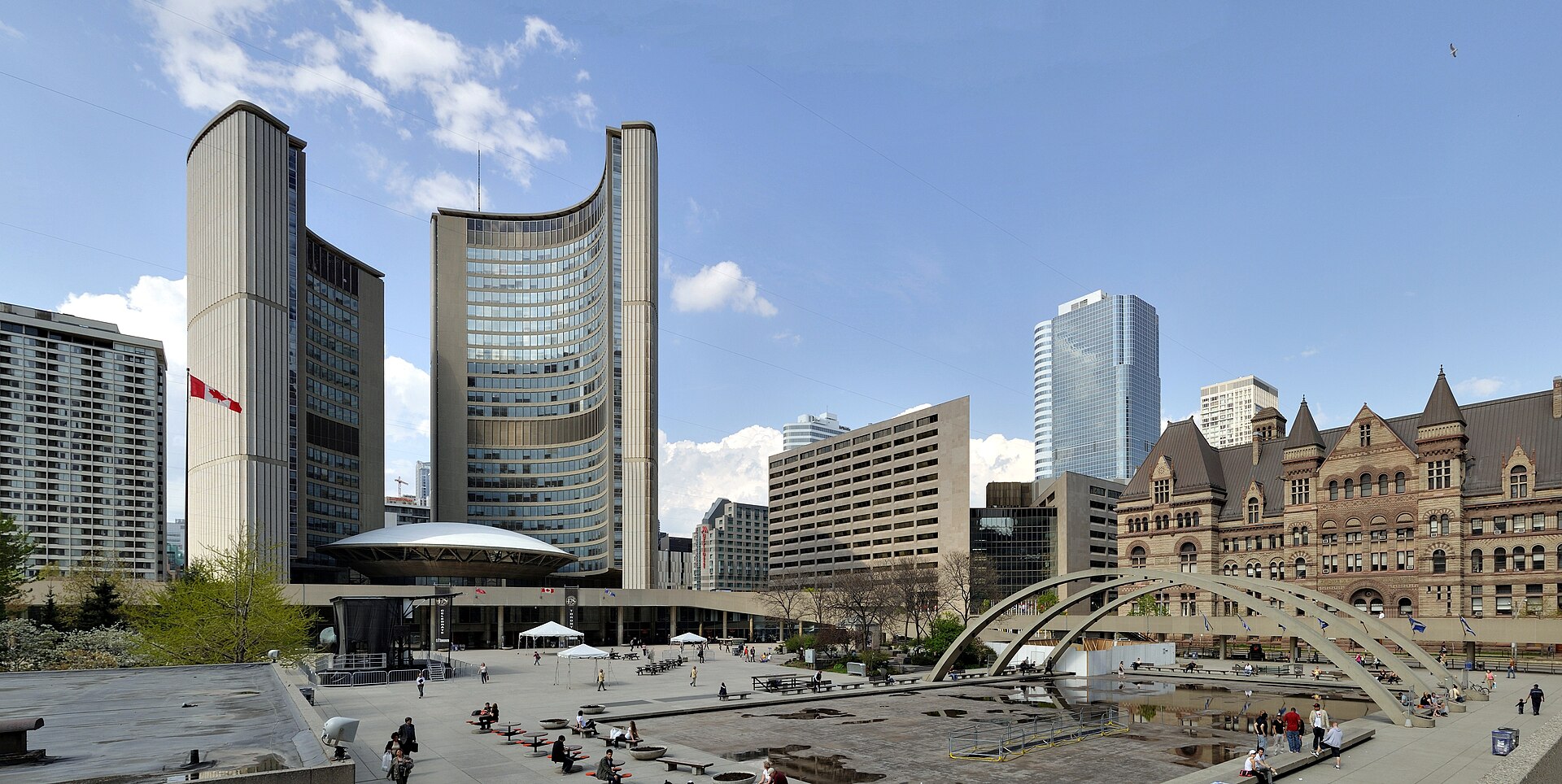
Nathan Phillips Square is where Toronto breathes. Tucked into the heart of the downtown core, it’s the kind of place that doesn’t announce itself with fanfare but quietly absorbs the city’s energy—office workers cutting through on their lunch breaks, tourists pausing to take photos, students sprawled on the steps with coffee, and street performers testing out new material. There’s no grand entrance, no velvet ropes, just a broad expanse of pavement and greenery where the rhythm of the city plays out in real time. On any given day, you might see a protest march setting up, a couple arguing over directions, or a group of friends debating where to grab dinner. It’s not polished, but that’s the point. This is where Toronto shows its unfiltered self.
The square’s defining feature is Toronto City Hall, a building that still feels bold more than half a century after it was completed. Designed by Finnish architect Viljo Revell, the complex broke away from the city’s traditional architecture with its futuristic curves—two towering, crescent-shaped office buildings that cradle a domed council chamber like hands cupping a flame. The design was controversial at the time, but today it’s hard to imagine the skyline without it. The building’s modernist lines contrast sharply with the Gothic Revival Old City Hall just across the street, a reminder of how quickly Toronto has reinvented itself. The square itself was part of the same vision, a public space meant to balance the cold efficiency of government with the messiness of civic life.
Winter transforms Nathan Phillips Square into something closer to a fairy tale. The ice rink that takes over the plaza is one of the city’s most beloved seasonal rituals, drawing everyone from toddlers wobbling on skates for the first time to elderly couples gliding in sync. The rink isn’t just a tourist attraction; it’s a social equalizer, where bankers and baristas stand in the same line for hot chocolate. When the holidays roll around, the square becomes even more festive, with lights strung overhead and the occasional outdoor concert. But even on a quiet January evening, with the rink nearly empty and the wind biting, there’s a certain magic to it—the way the cold sharpens the lights, the way the ice hums under the blades. Summer brings a different kind of life: outdoor film screenings, food festivals, and impromptu dance performances. The square never feels like a museum exhibit; it’s always in motion.
The man the square is named after, Nathan Phillips, was Toronto’s first Jewish mayor and a key figure in the city’s mid-century transformation. He championed the idea of a new city hall, though he didn’t live to see it built. His legacy isn’t just in the architecture, though. The square has long been a stage for public discourse—rallies, vigils, and protests have all played out here, from civil rights demonstrations in the 1960s to climate strikes in recent years. It’s a place where the city’s ideals are tested, where people come to be heard. That tension between celebration and dissent is part of what makes the square feel alive. It’s not just a backdrop for history; it’s where history is still being written.
Surrounding the square are some of Toronto’s most recognizable landmarks. The Old City Hall, with its clock tower and ornate stonework, is a relic of the 19th century, when Toronto was still finding its identity. Nearby, the Eaton Centre—a sprawling shopping mall with a glass-vaulted ceiling—represents the city’s more commercial side. The contrast between these buildings tells a story: Toronto has always been a place of layers, where the old and the new coexist uneasily but inevitably. The square sits at the center of that tension, a public space that refuses to be pinned down. It’s not just a gathering spot; it’s a crossroads.
At night, the square takes on a different character. The lights from the surrounding skyscrapers reflect off the glass and steel of City Hall, turning the plaza into a kind of urban lantern. The steps leading up to the council chamber become an unofficial hangout, where musicians play for spare change and teenagers share headphones. There’s a sense of possibility in the air, the feeling that anything could happen—an impromptu poetry reading, a stranger striking up a conversation, a sudden downpour sending everyone scrambling for cover. It’s not the kind of place that tries to impress; it just is. And that’s why people keep coming back.
What makes Nathan Phillips Square special isn’t any single feature, but the way it absorbs the city’s moods. It’s where Toronto lets its guard down. There are no velvet ropes here, no curated experiences—just the raw, unscripted energy of a city that’s always in motion. You might come for the architecture, or the history, or the chance to people-watch from a bench. But what you’ll leave with is something harder to define: the feeling of having touched the pulse of the place. The square doesn’t belong to any one group. It’s for the commuters rushing through, the tourists snapping photos, the activists holding signs, the kids learning to skate. It’s for everyone, and for no one in particular. That’s the beauty of it.