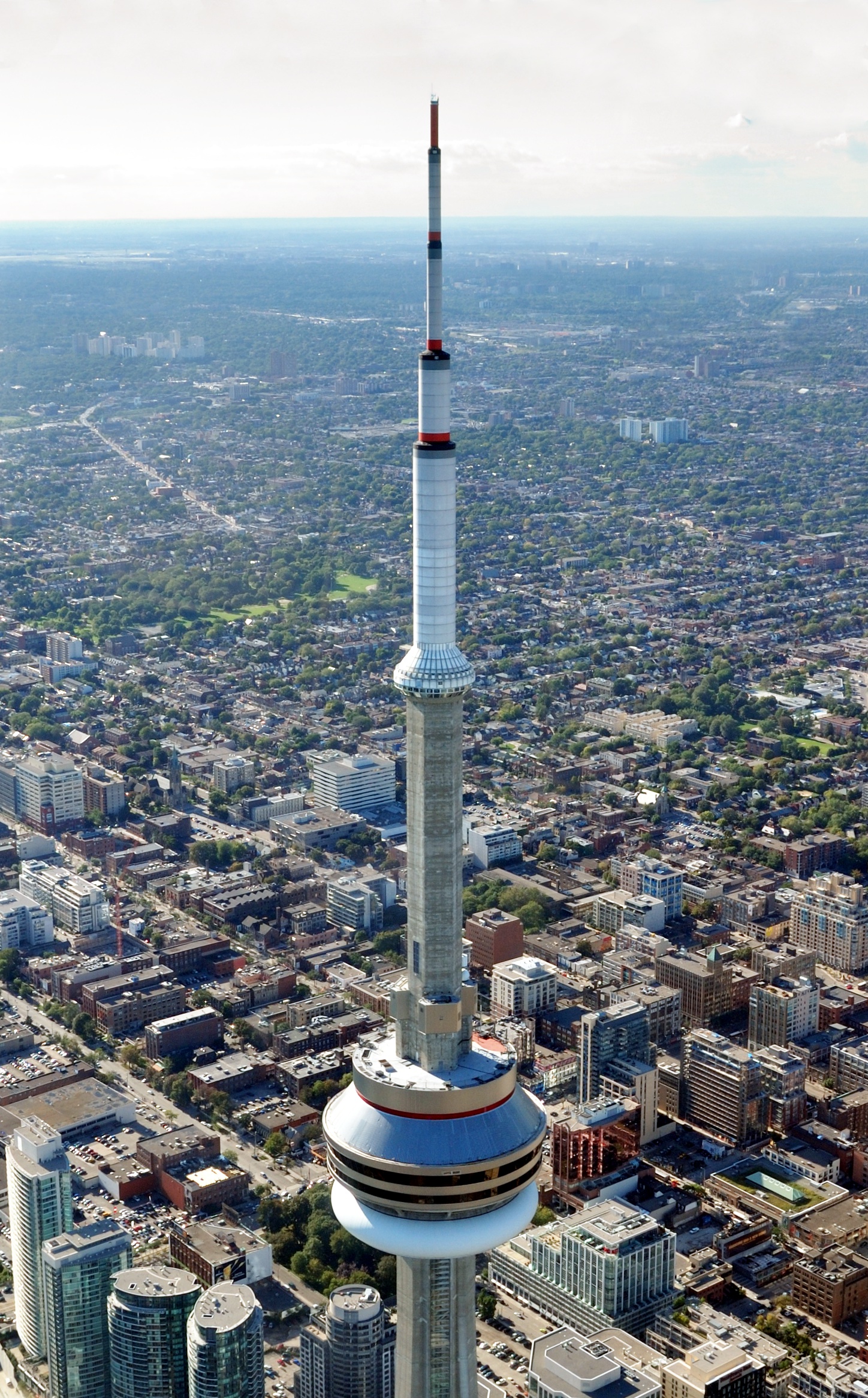
The CN Tower has been a defining feature of Toronto’s skyline for nearly half a century. Rising 553 metres above the city, it was built in 1976 to solve a practical problem: the growing cluster of downtown skyscrapers was blocking television signals, and broadcasters needed an antenna tall enough to clear them. Construction was an engineering feat of its time. The concrete shaft was poured using a sliding formwork that moved upward as the structure grew, while the steel antenna at the top was assembled piece by piece, lifted into place by helicopter.
For over thirty years, the tower held the title of the world’s tallest freestanding structure, a record that stood until the completion of the Burj Khalifa. But beyond its height, the CN Tower was designed with public access in mind. The main observation deck sits at 346 metres, offering a sweeping view of the city and Lake Ontario. A section of the floor is made of glass, allowing visitors to look straight down at the streets below—a disorienting but unforgettable experience. For those who want to go higher, the SkyPod at 447 metres is the highest publicly accessible point, where the air feels thinner and the horizon stretches farther than most people ever see.
One of the tower’s most talked-about features is the EdgeWalk, a hands-free walk around the outside of the main pod, secured by a harness. It’s not for the faint of heart, and it only runs in warmer months when the weather cooperates. Back inside, the revolving restaurant on the main level completes a full rotation in about seventy-two minutes, giving diners a slowly shifting panorama of the city. The meal includes admission to the observation deck, making it a popular choice for those who want more than just a quick visit.
On clear days, the view extends beyond the city limits. To the south, Lake Ontario glitters under the sun, while the Toronto Islands appear as a green fringe along the water. On exceptionally clear days, the mist from Niagara Falls can sometimes be seen on the horizon, nearly 130 kilometres away. At night, the tower becomes a beacon, its lights changing colours to mark holidays, local events, or simply the rhythm of the seasons. Tickets are timed, and the slots around sunset are the first to sell out, as the city transforms below into a grid of glowing streets and office towers.
The base of the tower houses Ripley’s Aquarium, a separate attraction with a walk-through tunnel that winds beneath a shark tank. While it’s not part of the tower experience, it’s a common stop for visitors, especially families. The entire complex is easily accessible from Union Station, connected by a covered walkway that’s particularly welcome during Toronto’s cold winters. Just next door, the Rogers Centre, with its retractable roof, hosts everything from baseball games to concerts, adding to the area’s draw as a hub of activity.
The CN Tower wasn’t just built for function—it was meant to be used. Unlike many communication towers around the world, it was designed with public spaces from the start, a decision that turned it into one of Canada’s most recognizable landmarks. Over the years, it has become more than just a broadcasting tool; it’s a place where people come to see the city from a new perspective, to test their nerves, or simply to share a meal with a view that never gets old. Whether it’s the first thing you notice when arriving in Toronto or the last thing you see before leaving, the tower has a way of making the city feel a little more extraordinary.