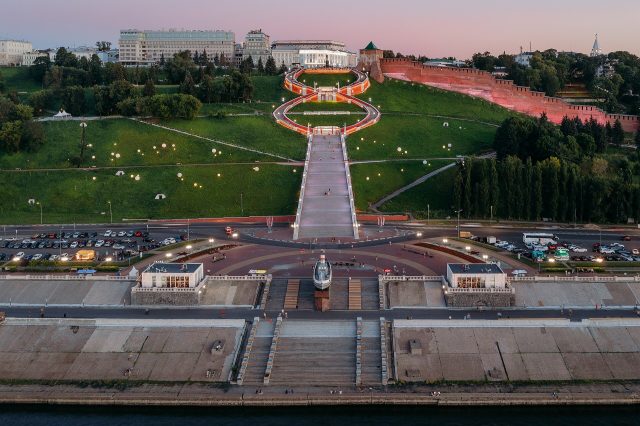
Minin and Pozharsky Square is one of those places in Nizhny Novgorod where history isn’t just something you read about—it’s something you feel underfoot with every step. Perched on the high bank of the Volga, the square sits at the very heart of the city, where the main streets converge like spokes in a wheel. It’s a place where the past and present intersect effortlessly, where the echoes of pivotal moments in Russian history still seem to linger in the air.
The architectural ensemble of the square didn’t take shape all at once. It evolved over centuries, with the most striking feature being the Nizhny Novgorod Kremlin. Its walls and towers rise above the square, a reminder of the time when the city was a frontier fortress. While not as ancient as the kremlins in Moscow or Pskov, this one has its own compelling story. Construction began in the early 16th century under the orders of Vasily III, and from the start, it served as a crucial defensive stronghold. Today, the Kremlin houses old cathedrals, museums, and viewing platforms that offer sweeping vistas of the Volga and the city’s low-lying districts across the river.
At the center of the square stands a monument to Kuzma Minin and Dmitry Pozharsky, two figures who played a decisive role in liberating Moscow from Polish-Lithuanian invaders in the early 17th century. Nizhny Novgorod became the rallying point for the people’s militia, with Minin, a local zemstvo elder, calling on citizens to raise funds and resist the occupiers. The monument was unveiled in 1828, and since then, it has become an inseparable part of the city’s landscape. Interestingly, it was originally intended for Moscow, but in the end, Nizhny Novgorod—where the movement began—was chosen as its home.
The square hasn’t always been known by its current name. Over the centuries, it has been called Upper Posad Square, Cathedral Square, and Soviet Square. After the revolution, it became a stage for rallies and demonstrations, and in Soviet times, it hosted parades and public celebrations. Today, it remains a gathering place for locals and visitors alike, hosting concerts, fairs, and festivals. In summer, cafes spill out onto the pavement, while in winter, the square transforms with a towering New Year’s tree and an ice rink.
One of the most significant events tied to the square is the annual Unity Day celebration on November 4th. The holiday marks the events of the Time of Troubles, and the square comes alive with ceremonies, concerts, and historical reenactments. For many in Nizhny Novgorod, the day is a source of pride, a reminder that their city was the birthplace of a movement that reshaped Russian history.
The architecture surrounding the square is a blend of different eras. The Kremlin’s medieval walls stand alongside buildings like the City Duma, constructed in the late 19th century with its classical columns, or the Soviet-era Communications House. Each structure tells its own story, and together they create a unique skyline where styles and periods overlap seamlessly.
The square changes with the seasons. In spring, flowerbeds burst into color; in summer, the air hums with music and conversation; in autumn, the trees turn golden; and in winter, snow blankets everything, lending the place a fairy-tale quality. Yet no matter the time of year, the square remains a place where people come to sit on a bench, take in the views, or duck into a nearby café.
For visitors, Minin and Pozharsky Square is the perfect starting point for exploring Nizhny Novgorod. From here, you can stroll down Bolshaya Pokrovskaya Street, visit the Kremlin’s museums, or descend to the Volga for a riverboat ride. But even if you never leave the square itself, you’ll still get a sense of the city’s spirit—a place where history isn’t just preserved in books but woven into the very fabric of daily life.