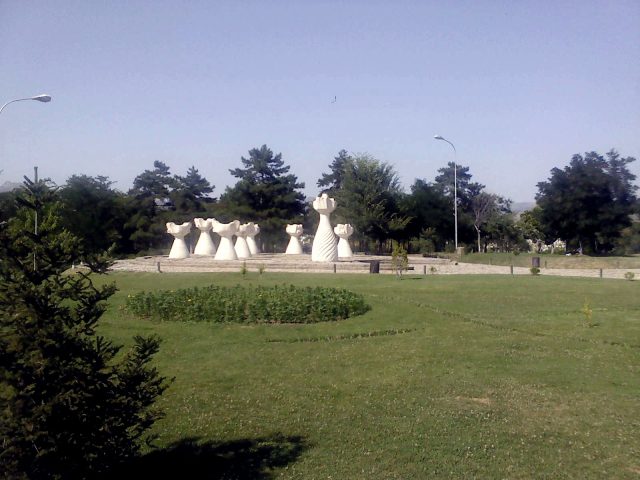
Macedonia Square in Prilep is where the city breathes at its own unhurried pace, a place that feels lived-in without being worn out. There’s no rush here, no crowds jostling for space, just the quiet rhythm of daily life unfolding under the open sky. The square doesn’t announce itself with grand monuments or flashy facades—it simply exists, as it has for generations, a natural gathering point where people come and go without fanfare. The light here has a particular quality, soft and golden in the late afternoon, as if the past hasn’t quite faded into the present but lingers just beneath the surface.
Prilep isn’t a city that tries to impress. It doesn’t have the tourist draw of Ohrid or the political weight of Skopje, and that’s precisely why it feels authentic. Macedonia Square sits at its heart, a place where the ordinary and the historic blend seamlessly. In the mornings, the scent of fresh bread drifts from nearby bakeries, and the first cups of strong Turkish coffee are poured in the cafés that line the edges of the square. By midday, it’s a meeting point for friends catching up, old men playing backgammon under the shade of plane trees, and children darting between the benches. As evening falls, the square fills with the murmur of conversation, the clink of glasses, and the occasional burst of laughter—nothing staged, just the sound of a city unwinding after another day.
The architecture here is unassuming but telling. The buildings around the square are mostly two or three stories high, their facades a mix of Ottoman-era stonework and more recent renovations. Some still have the intricate wooden balconies that were once common in the region, their carvings softened by time. Others bear the faint traces of neoclassical details, a nod to the brief period of Bulgarian influence in the early 20th century. The fountain at the center isn’t particularly grand, but it’s well-loved—always surrounded by people sitting on its low walls, watching the water spill into the basin below. There’s no need for grand statements here; the square’s charm lies in its quiet consistency, in the way it has absorbed layers of history without losing its character.
Prilep has always been a crossroads, and Macedonia Square was once at the center of that exchange. During the Middle Ages, the city was an important stop on the trade routes that connected Europe to the East, a place where merchants from Venice rubbed shoulders with Ottoman traders and Balkan caravans. The square would have been bustling then, filled with the shouts of vendors, the clatter of hooves, and the scent of spices and leather. The Ottomans left their mark on the city’s layout, widening streets and building mosques, though many of those structures have since been repurposed or replaced. By the late 19th century, Prilep had become a hotspot for Macedonian nationalism, a place where ideas of independence were debated in the very cafés that still stand today. If you look closely, you can still see the faint outlines of old political slogans on some of the buildings, remnants of a time when this square was a stage for revolution.
Today, the square is as much a cultural hub as it is a historical one. In the summer, it transforms into an open-air venue for concerts, folk dances, and craft fairs. Local musicians set up near the fountain, playing traditional songs on the *tambura* or *gaida*, while dancers in embroidered vests and skirts perform the *oro*, their movements precise and full of energy. The air fills with the scent of grilled meat and sweet *baklava*, and for a few hours, the square feels like the center of the world. Even outside of festival season, there’s always something happening—an impromptu gathering of friends, a street performer, or the quiet hum of a café where old men argue over politics and young couples share a slice of *burek*.
Just steps from the fountain, the old bazaar spills out in a tangle of narrow alleys, its stalls piled high with goods that have been sold here for centuries. The market is a sensory overload in the best way: sacks of dried peppers and mountain herbs, wheels of tangy white cheese, jars of honey still warm from the hive. Vendors call out prices, pressing samples into your hands—try the *ajvar*, the smoky red pepper spread, or the *kaymak*, a rich clotted cream that’s spread on fresh bread like butter. The bazaar isn’t just a place to shop; it’s where the city’s pulse is strongest, where the past and present collide in the most ordinary of ways. The same families have been selling here for generations, their stalls passed down like heirlooms, and there’s a sense that the market hasn’t changed so much as it has simply endured.
What makes Prilep—and Macedonia Square in particular—so compelling is its lack of pretense. This isn’t a city that puts on a show for visitors. There are no tourist traps, no overpriced souvenir shops, no guided tours hustling you from one landmark to the next. Instead, there’s the quiet confidence of a place that knows its own worth. You might see a bride and groom posing for wedding photos in traditional Macedonian dress, their outfits a riot of embroidery and gold, while just a few meters away, teenagers scroll through their phones at a café table. The square doesn’t try to reconcile these contrasts; it simply holds them all at once, a living record of a city that has always been a little bit old and a little bit new.
If you find yourself in Prilep, the best thing to do is slow down. Take a seat by the fountain, order a coffee from one of the nearby cafés, and watch the square come to life. There’s no script here, no must-see attractions demanding your attention. Just the easy rhythm of a city that has long since learned how to exist without apology. The light shifts as the day goes on, the shadows lengthening across the cobblestones, and if you stay long enough, you’ll start to notice the small details—the way an old man taps his cane against the pavement as he walks, the laughter of children chasing pigeons, the clatter of a backgammon board being set up for another game. It’s the kind of place that doesn’t reveal itself all at once but unfolds gradually, like a story you’ve heard before but never quite like this.