Praça do Comércio is one of Lisbon’s most iconic spaces, a vast square that opens directly onto the Tagus River like a grand stage set for the city’s history. Before the devastating earthquake of 1755, this was the site of the royal palace, a sprawling complex that stood at the heart of Portugal’s monarchy. The quake reduced much of Lisbon to rubble, including the palace, and what you see today is the result of a deliberate reinvention.
The man behind that reinvention was the Marquis of Pombal, the prime minister who oversaw Lisbon’s reconstruction. He cleared the ruins and designed the Baixa district as a model of Enlightenment urban planning—straight, orderly streets laid out in a grid, with Praça do Comércio as its centerpiece. The square was conceived as Lisbon’s ceremonial gateway from the river, a place where dignitaries and goods arriving by sea would first set foot in the capital. The uniform yellow arcades that line three sides of the square were part of this vision, housing government offices and ministries, their symmetry lending the space a sense of grandeur.
At the water’s edge, a broad stone staircase descends to the river, a reminder of the days when ships docked here and passengers disembarked directly onto the square. Today, the steps are a popular spot to sit, especially in the evening when the light softens and the river reflects the glow of the city. In the center of the square stands an equestrian statue of King José I, a bronze monument that has become one of Lisbon’s most recognizable landmarks. The king’s gaze is fixed toward the river, as if surveying the city he helped rebuild.
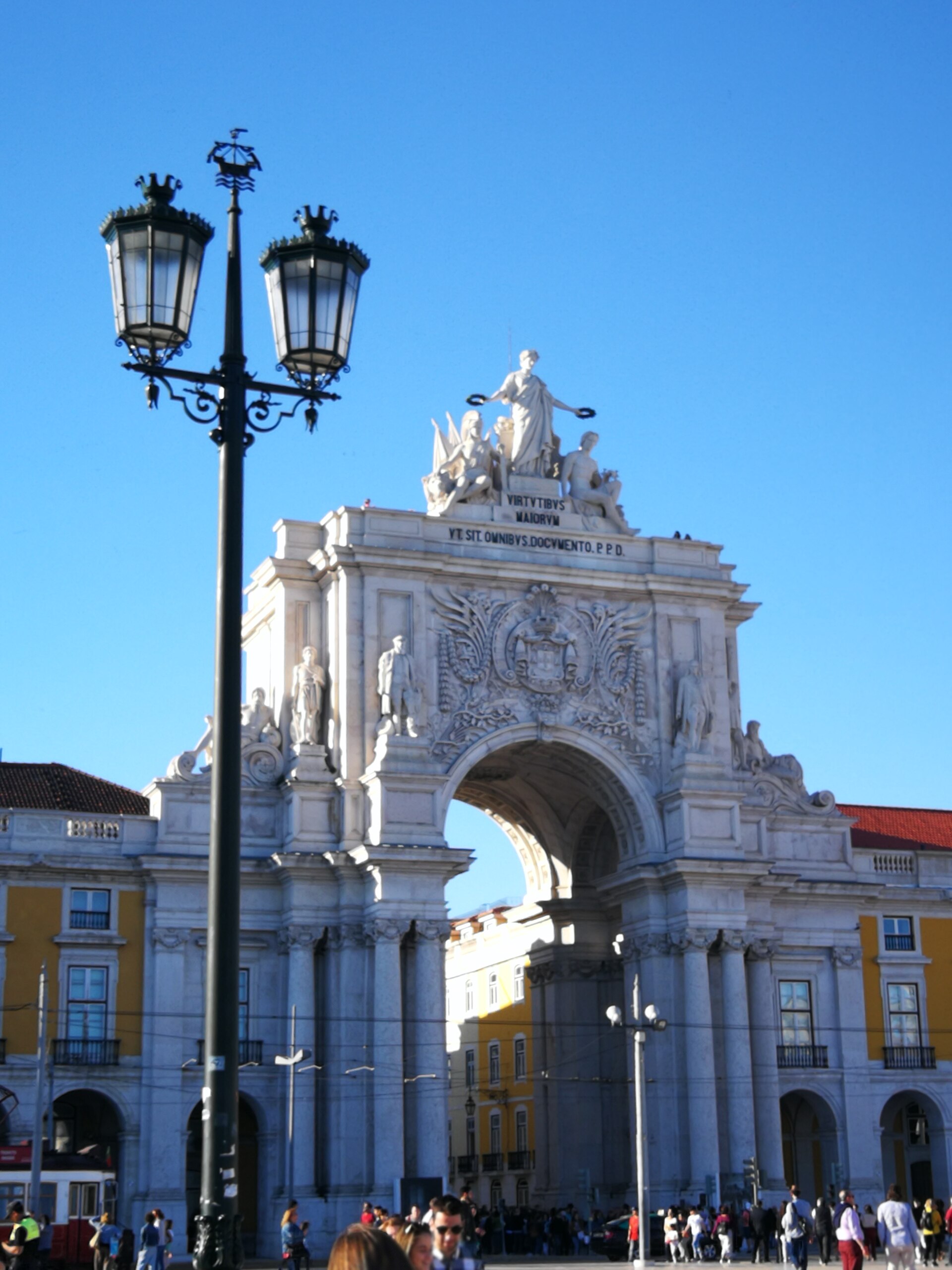
The northern side of the square is dominated by the Arco da Rua Augusta, a triumphal arch that serves as a gateway to Rua Augusta, one of Lisbon’s busiest pedestrian streets. Climbing the arch offers a sweeping view of the square, the river, and the red suspension bridge in the distance—the Ponte 25 de Abril, which lights up at night like a string of fireflies. The arch itself is a later addition, completed in the 19th century, and its intricate carvings tell the story of Portugal’s maritime exploits and the rebuilding of Lisbon.
Praça do Comércio has witnessed its share of dramatic moments. In 1908, King Carlos I and his eldest son were assassinated here, an event that sent shockwaves through the monarchy and hastened its eventual collapse. Today, the square is far removed from such violence, though its history lingers in the details—the worn stones underfoot, the way the arcades echo with footsteps, the sense of a place that has always been a crossroads.
By day, the square is a hub of activity. Tourists gather at the visitor center to pick up maps and advice, while locals and visitors alike linger in the cafés tucked beneath the arcades. One of the oldest pastry shops in Lisbon, a holdover from the 18th century, still operates here, serving pastries and coffee to those who pause for a moment’s rest. The square is also a natural starting point for exploring the Baixa district, with its shops, plazas, and the Santa Justa Lift, an ornate iron elevator that connects the lower city to the Chiado neighborhood above.
As evening falls, the atmosphere shifts. The cafés fill with people enjoying glasses of wine, and the sound of fado or jazz drifts from the street musicians who set up near the river. The steps leading down to the water become impromptu seating, a place to watch the sunset paint the sky in shades of pink and gold. The Ponte 25 de Abril glows in the distance, its reflection shimmering on the Tagus, while the arcades cast long shadows across the square.
From Praça do Comércio, it’s easy to imagine the Lisbon of centuries past—the ships arriving from distant colonies, the merchants haggling in the arcades, the royal processions making their way through the square. But it’s also a place that feels very much alive in the present, a space where history and daily life overlap. Whether you’re starting a walk along the river toward Alfama, catching a tram to Belém, or simply sitting on the steps with a drink in hand, the square offers a moment of stillness in a city that is always moving.