Plaza 24 de Septiembre isn’t just the geographical center of Santa Cruz de la Sierra—it’s the place where the city’s past and present collide in the most ordinary, unscripted ways. This is where the pulse of eastern Bolivia beats strongest, where the rhythms of daily life unfold without pretense. Walk here on any given afternoon, and you’ll find students lounging on benches, vendors hawking fresh fruit under the shade of towering ceiba trees, and old men playing chess with the kind of concentration that suggests the game has been going on for decades. The square doesn’t demand attention; it simply exists, as much a part of the city as the air itself.
The plaza takes its name from the date Santa Cruz was founded—September 24, 1561—when the Spanish conquistador Ñuflo de Chávez established the settlement in a valley far from the colonial power centers of the time. For years, it was little more than an outpost, a dusty frontier town overshadowed by the silver-rich highlands. But as trade routes shifted and the region’s agricultural wealth grew, so did the city’s importance. The plaza witnessed it all: the slow creep of colonial rule, the fires of independence, and the rapid modernization of the 20th century. Today, the layers of history aren’t preserved in glass cases or plaques—they’re lived in, walked over, and occasionally ignored by the people who pass through every day.
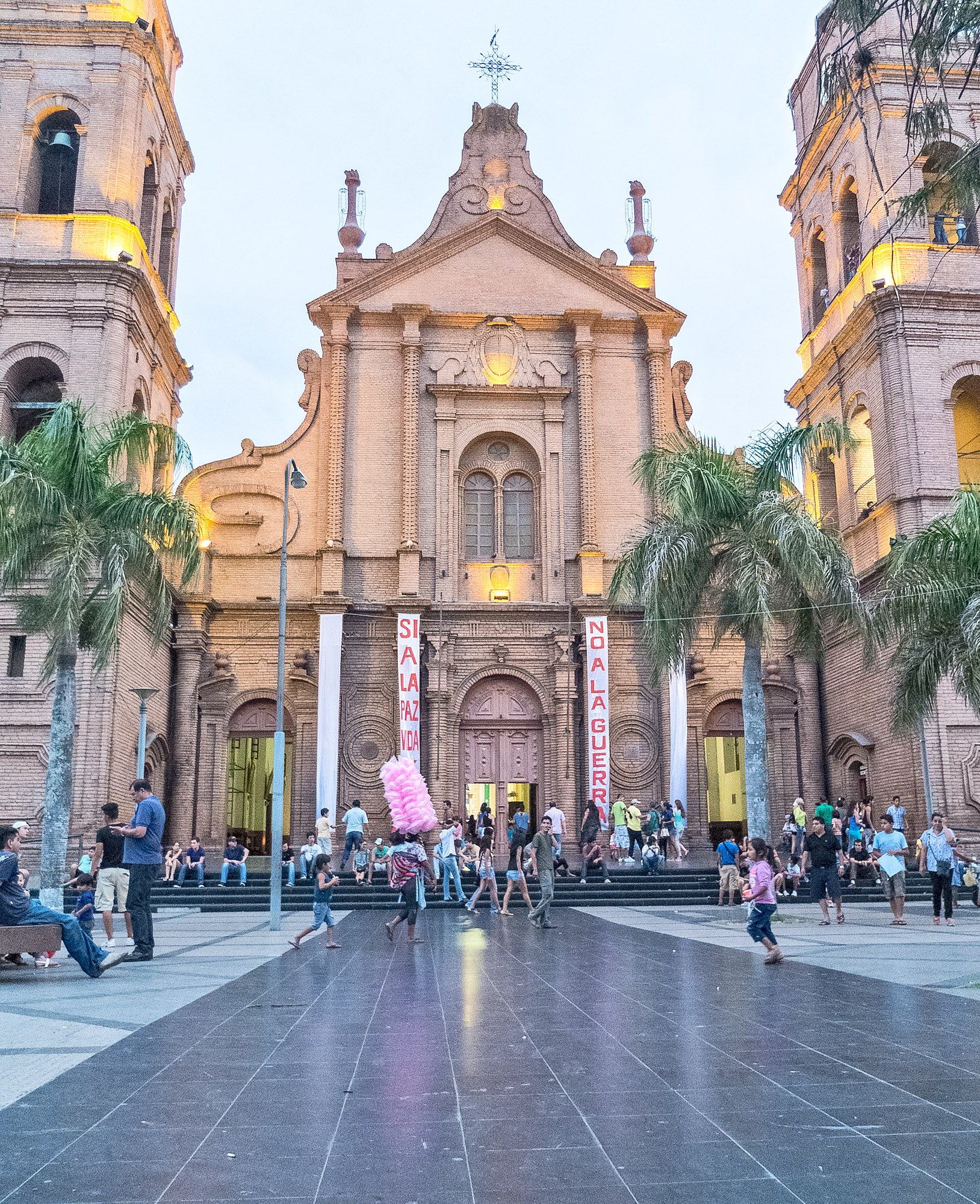
The architecture around the plaza tells its own story, one of adaptation rather than grand design. The Cathedral, with its neoclassical facade and baroque flourishes, dominates the square, its white towers visible from blocks away. Inside, the air is cool and dim, the scent of candle wax mingling with the faint humidity of the tropics. Nearby, the prefecture building—once the seat of colonial authority—now houses local government offices, its corridors echoing with the same bureaucratic bustle as any municipal building in the world. The surrounding structures are a patchwork of styles: crumbling colonial balconies next to sleek modern storefronts, their facades weathered by decades of sun and rain. There’s no master plan here, just the slow accumulation of time.
What makes the plaza feel alive isn’t the architecture, though, but the way people use it. In the mornings, the square belongs to the vendors, their stalls overflowing with mangoes, papayas, and the sticky-sweet juice of sugarcane pressed right in front of you. By midday, the crowd shifts—office workers grabbing a quick lunch, students cutting through on their way to class, tourists pausing to get their bearings. As evening falls, the energy changes again. Couples stroll along the paths, children chase pigeons that scatter in sudden clouds, and the sound of live music drifts from the cafes lining the square. There’s no schedule, no set performance—just the ebb and flow of a place that refuses to stand still.
The plaza’s atmosphere is shaped by small, unremarkable details. The ceiba trees, their massive trunks and sprawling branches offering respite from the heat, are a constant presence, their leaves rustling in the breeze. The pigeons, bold and unafraid, weave between the feet of passersby, while stray dogs nap in the sun, undisturbed by the commotion around them. On weekends, the square often hosts impromptu events—a local band playing cumbia, an art fair with paintings propped against the benches, or a political rally that spills out from the prefecture’s steps. During the city’s anniversary celebrations in September, the plaza becomes the heart of the festivities, with parades, traditional dances, and enough food stalls to feed an army.
For locals, Plaza 24 de Septiembre is more than a landmark; it’s a backdrop to everyday life. It’s where you meet a friend for coffee, where your grandmother takes her afternoon walk, where you bring your kids to feed the pigeons. There’s a sense of ownership here, a feeling that the square belongs to everyone and no one at the same time. It’s crowded but never claustrophobic, public yet intimate. You can sit on a bench for hours and watch the world go by, or you can rush through on your way somewhere else, barely noticing the details. Either way, the plaza absorbs it all without judgment.
Santa Cruz is often called the gateway to eastern Bolivia, and the plaza is where many visitors get their first real taste of the city. There’s no grand entrance, no ceremonial arch—just the sudden realization that you’ve stepped into the middle of something vibrant and unpolished. The square sets the tone for Santa Cruz: warm, chaotic, and unapologetically itself. It’s not a place that tries to impress; it simply is. You could spend an entire day here, watching the light change over the cathedral’s towers, listening to the hum of conversation, and feeling the weight of centuries pressing gently against your shoulders.
In the end, Plaza 24 de Septiembre is less a destination than a living thing. It remembers the people who built Santa Cruz, the generations who have walked its paths, and the countless stories that have unfolded in its shadow. But it’s also constantly evolving, absorbing the energy of the present and carrying it forward. The stones underfoot, the trees overhead, the faces in the crowd—all of it is part of a larger narrative, one that’s still being written. The plaza doesn’t just represent the city; it is the city, in all its messy, beautiful, ever-changing glory.