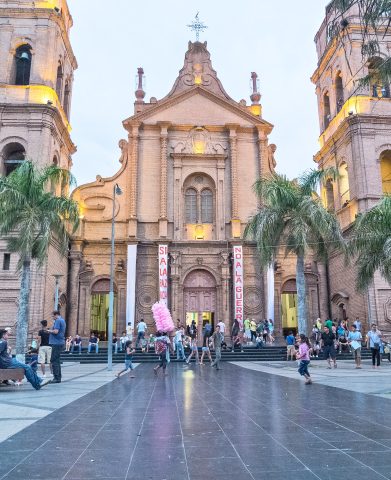
The Basilica Menor de San Lorenzo in Santa Cruz de la Sierra is one of those places that doesn’t announce itself at first glance but lingers in your memory long after you’ve left. Tucked away in the heart of the city, it stands on Plaza 24 de Septiembre, where life unfolds in its most ordinary and vibrant forms. Here, vendors sell fresh fruit under the shade of trees, families stroll past, and elderly locals sit on benches, watching the ebb and flow of daily routines. The church doesn’t resemble the grand cathedrals of Europe or the ornate colonial churches of the Andes. Its modest facade is almost hidden behind foliage, and only the bell tower rises above the rooftops, a quiet marker of its presence. That understated quality is what makes it special—it doesn’t demand attention but simply exists as part of the city’s rhythm.
The basilica’s history stretches back to the mid-19th century, when Santa Cruz was still a remote outpost surrounded by jungle and savanna. The first church on this site was built in 1845, a wooden structure that repeatedly fell victim to fires and floods. Construction of the current building began in the 1890s, by which time the city was expanding, and its elite sought to give it a more refined appearance. The architecture reflects the eclectic tastes of the era, blending neoclassical and neo-Gothic elements—a common feature in Latin American churches of the time. Unlike the colonial strongholds of the highlands, Santa Cruz was always more of a gateway to the lowlands, and its main church bears little trace of Spanish imperial grandeur. Instead, it feels like a place shaped by the practical needs of its people.
Step inside, and the basilica surprises with its sense of space and light. High vaulted ceilings rest on white columns, while the stained glass—though not as vivid as in European cathedrals—casts a soft, diffused glow. The altar is carved from wood and gilded, but without the opulence you might find elsewhere. There are no frescoes or marble sculptures, just a simplicity that feels purposeful, as if the building was designed for worship rather than spectacle. In the side chapels, statues of saints stand draped in flowers and candlelight, tended to by locals who come to pray. Among them, the image of the Virgin of Candelaria, the city’s patron saint, holds particular reverence. Her feast day in February is celebrated with processions and music, drawing crowds from across the region.
Beyond its religious role, the basilica has been a witness to Santa Cruz’s evolving identity. Over the decades, it has hosted generations of baptisms, weddings, and funerals, serving as a backdrop to the city’s most personal and public moments. In the early 20th century, during periods of political unrest, the church became a gathering place for locals to voice their concerns and shape the future of their region. Even today, it remains a living part of the community. On Sundays, the pews fill with families, while on weekdays, the silence is broken only by the occasional footsteps of visitors or the rustle of prayer books.
Architecturally, the basilica is a study in contrasts. The facade, with its symmetrical arches and columns, echoes the Renaissance churches of Italy, while the pointed towers and arched windows nod to Gothic influences. Inside, the altar’s baroque detailing adds another layer to the mix. This blend of styles wasn’t accidental—19th-century Bolivia lacked a unified architectural tradition, and builders often borrowed from whatever inspired them. The result is a building that defies easy categorization but has a character all its own.
For travelers, the basilica offers a quiet counterpoint to Santa Cruz’s modern reputation. The city is often seen as a bustling economic hub, all skyscrapers and shopping malls, but the historic center tells a different story. Here, old mansions with wooden balconies line cobblestone streets, and the air carries the scent of fresh fruit from the market. The basilica sits at the heart of this slower, more traditional side of the city. Nearby, small cafes serve local dishes like *sopa de maní* or *majao*, and vendors sell tropical fruits that burst with flavor. The church isn’t a museum piece but a living part of the urban fabric, and that authenticity is palpable.
In recent decades, Santa Cruz has transformed into one of Bolivia’s most dynamic cities, drawing migrants from across the country. Yet even amid this growth, the basilica remains a steadfast presence. It’s still where couples marry, where parents bring their newborns for baptism, and where mourners gather to say goodbye. For visitors accustomed to the grandeur of Latin America’s more famous churches, it might seem unassuming, but that’s precisely its charm. It doesn’t exist to impress; it simply endures, a quiet reminder that a city’s history is shaped as much by everyday rituals as by monumental events.
If you find yourself in Santa Cruz, take a moment to step inside. You don’t need to be religious to appreciate the atmosphere—the scent of wax and aged wood, the way sunlight filters through the stained glass, warming the stone walls. Every so often, the bells toll, and for a brief moment, the city seems to pause. This isn’t a place for rushing. Like Santa Cruz itself, it reveals its layers slowly, rewarding those who take the time to look.