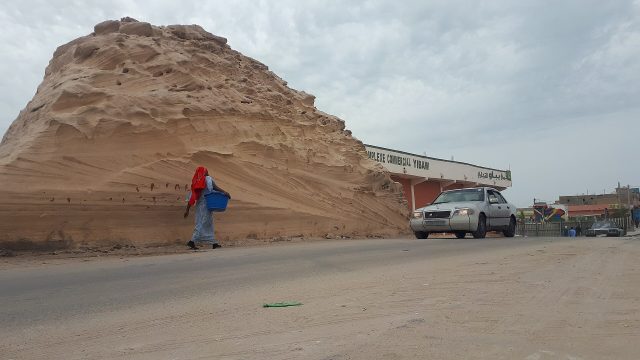
Nouadhibou’s beach is where the Atlantic meets the Sahara in a way that feels almost unreal. There are no palm-lined promenades, no sun loungers under striped umbrellas, no resort crowds. Instead, there’s a long stretch of sand fading into the distance, where waves crash against the shore while the desert dunes rise behind you. This isn’t a place for comfort or entertainment—it’s raw nature, where humans are just passing through, not in charge.
Nouadhibou itself is a city caught between two worlds. It grew from a fishing port, one of the largest in West Africa, into a place where life moves to the rhythm of the tides. The beach isn’t so much a vacation spot as it is part of daily existence. Fishermen haul their boats ashore, nets dry in the sun, and locals come to sit by the water, watching the ocean as if it were an old friend. There’s nothing staged about it—just the quiet, unfiltered reality of a place shaped by the sea.
The sand here isn’t the fine white powder of Caribbean beaches. It’s coarse and gray, mixed with shells and pebbles, baking under the sun until it’s too hot to walk on barefoot. Yet that doesn’t stop children from playing soccer or racing along the water’s edge. The Atlantic is cold even in summer, and few people swim, but the ocean here is powerful—strong currents, towering waves, a draw for surfers despite the lack of any real infrastructure.
Sunset over Nouadhibou’s beach is worth the trip alone. The sun sinks straight into the ocean, painting the sky in shades of orange, pink, and violet. The shore grows quiet, the only sounds the crash of waves and the cries of gulls. If you’re lucky, you might spot dolphins cutting through the water close to shore. In those moments, time seems to slow, as if the rest of the world has faded away.
The history of this place is tied to the sea. Nouadhibou began as a fishing village, and fishing still drives the city’s life. The beach was once the heart of the industry—where catches were cleaned, fish dried, and nets mended. You can still see wooden boats pulled onto the sand, nets spread out to dry. In the distance, ships sometimes anchor offshore, waiting to load their holds with fish and seafood.
Nouadhibou’s architecture reflects its split identity. On one side, there are the port’s warehouses and colonial-era buildings, remnants of French rule. On the other, low clay houses with flat roofs, built for the desert. The beach sits between these two worlds. There are no luxury hotels or beachfront restaurants, just a handful of small cafés where you can drink tea and eat grilled fish fresh from the ocean.
For travelers, the beach isn’t so much a place to relax as it is a window into the city’s rhythm. You can sit for hours, listening to the waves, watching fishermen prepare their boats for the next voyage. Sometimes the ocean washes up seaweed or shipwreck debris, a reminder of its unpredictability. When the winds pick up, sandstorms swallow the shore, turning it briefly into an extension of the desert.
Nouadhibou isn’t built for mass tourism. There are no crowds, no souvenir stalls, no tour buses. It’s a place for those who want solitude, who come to see Africa without the gloss—where the ocean and the desert exist side by side. Here, you can feel like you’ve reached the edge of the world, where beyond the horizon there’s nothing but endless water and endless sand. That untouched quality is what makes this beach truly special.