Dambulla Cave Temple feels like a place where time moves differently. Tucked into the rocky hills of central Sri Lanka, it carries the weight of centuries in its quiet, dimly lit chambers. Unlike grand cathedrals or ornate palaces, this temple doesn’t announce itself with towering facades or gilded domes. Instead, it waits inside the mountain, revealing its beauty slowly as your eyes adjust to the soft glow of oil lamps and the faint light filtering through narrow openings.
The origins of the temple trace back to the first century BCE, when King Valagamba sought refuge in these caves during a time of war. After reclaiming his throne, he transformed the natural grottos into a sanctuary, a gesture of gratitude that would endure for generations. Over the centuries, rulers and devotees expanded the site, carving out new spaces and filling them with statues and murals, but the heart of the temple remains the same—raw stone shaped by human hands and devotion.
The first cave is the largest and most striking. At its center lies a massive reclining Buddha, its form hewn directly from the rock, stretching nearly fifteen meters in length. The soles of its feet are intricately patterned, each line a symbol of Buddhist teachings. Around it, dozens of smaller statues depict the Buddha in various poses, along with figures of gods and historical figures tied to the temple’s past. The walls and ceiling are covered in vibrant frescoes, their colors still vivid despite the passage of time. The scenes unfold like an ancient storybook, illustrating key moments in Buddhist history.
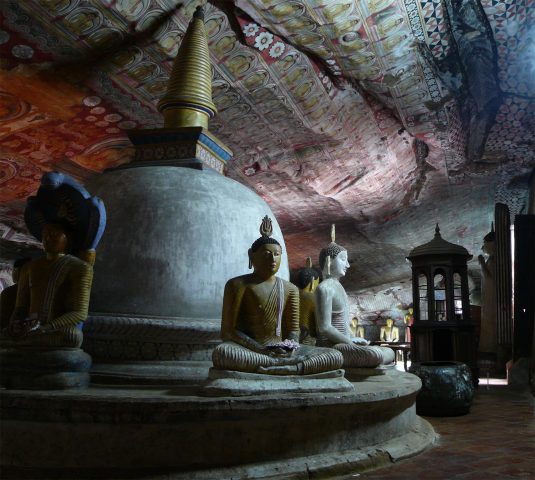
The second cave is perhaps the most atmospheric. Here, statues stand shoulder to shoulder, creating the sense of a crowded monastery frozen in time. A meditating Buddha takes center stage, surrounded by disciples and deities, their expressions serene yet watchful. The ceiling is a tapestry of jataka tales—stories of the Buddha’s past lives—rendered in rich hues that seem to shift in the flickering light. The play of shadows adds to the sense of mystery, as if the cave itself is breathing.
Smaller but no less meaningful, the third cave holds a standing Buddha, its presence calm and steady. The walls here feature depictions of Hindu deities, a reminder of the island’s layered spiritual history. The fourth and fifth caves are more modest, yet they hold their own quiet charm. Carved pillars, faded inscriptions, and fragments of murals hint at stories that may never be fully told.
The climb to the temple is part of the experience. The stone steps, worn smooth by centuries of pilgrims, lead upward through the shade of trees and the scent of incense. Along the way, you might pass monks in saffron robes or families pausing to offer prayers. From the top, the view stretches across the surrounding landscape—patchwork fields, clusters of palm trees, and the distant silhouette of mountains. It’s easy to see why this place has drawn people for so long. The temple sits at the edge of the earthly and the divine, a threshold where the past feels close enough to touch.
What makes Dambulla different from other historical sites is its sense of continuity. This isn’t just a relic of the past; it’s a living place of worship. Visitors will still find devotees lighting oil lamps, leaving offerings of flowers, or sitting in quiet meditation. The temple doesn’t demand attention like a tourist attraction—it simply exists, as it has for over two thousand years, offering a space for reflection, prayer, or simply a moment of stillness.
In a country where ancient sites often share space with bustling modern life, Dambulla remains a refuge. There’s no grand entrance fee to the experience, no guided tour required to appreciate its significance. The temple invites you to step inside, look closely, and listen—not just to the stories carved into its walls, but to the quiet hum of history that lingers in the air. For those who come seeking more than just a photograph, it offers something rare: a connection to the past that feels both personal and timeless.