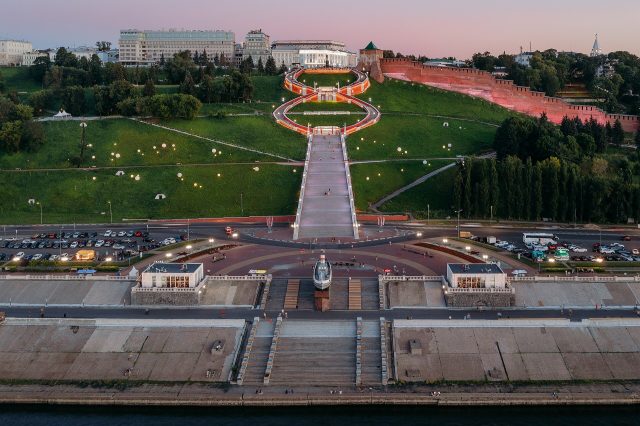
Switzerland Park isn’t for rides or attractions. It’s where the sky feels heavier, the trees stand quieter, and the land falls steeply toward the Oka River. The name fits—from some angles, the slopes and forest resemble the Alps, minus the peaks. What you find here is rare in a city: open space that asks nothing of you, where the air moves differently and street noise dissolves into rustling leaves.
The park’s history starts with the aristocracy. In the 1800s, noble families owned these hills and turned them into an estate with ponds, paths, and pavilions. The city later took over, but the name endured, especially in winter when snow softens the slopes and the river below seems distant. Soviet-era additions brought trails and benches, yet the park kept its character—a forest within city limits, not a manicured garden. The old alleys, lined with oaks and lindens, still feel like they belong to a slower time.
The grotto’s ruins are the most striking remnant. Its stone walls once framed artificial waterfalls and statues. Now, overgrowth adds to its charm. Nearby, a staircase leads to a viewpoint over the Oka. The river bends away from the city, and on clear days, you see the Bor Bridge and the smokestacks beyond—a contrast between this quiet height and the working city below.
Switzerland Park balances wildness and accessibility. A short tram ride from the center, yet once you step onto its paths, civilization feels far away. No crowds, no music, no souvenir stalls—just joggers, dog walkers, and birds. Some trees, planted in the 19th century, are so wide two people couldn’t circle their trunks. In summer, the canopy blocks the heat; in autumn, trails vanish under red and gold leaves. Winter brings cross-country skiers to the gentler slopes.
The park sits where the city meets the wild. Foxes and hares sometimes cross the paths. Squirrels approach visitors in the early morning. Butterflies drift through summer meadows; animal tracks mark the snow in winter. You can forget you’re in a city of over a million—until you reach the bluff and see the skyline: churches, Soviet blocks, new construction. The view shifts with the seasons, but the park remains.
There’s no schedule, no checklist. Visit in any weather, at any hour, and each time it’s different. Some come to think, others to walk, others to meet under the trees. The park asks only for quiet respect. Sit on a bench at the bluff’s edge, watch the river, and let time pass. Locals return year after year because here, the city remembers how to breathe.