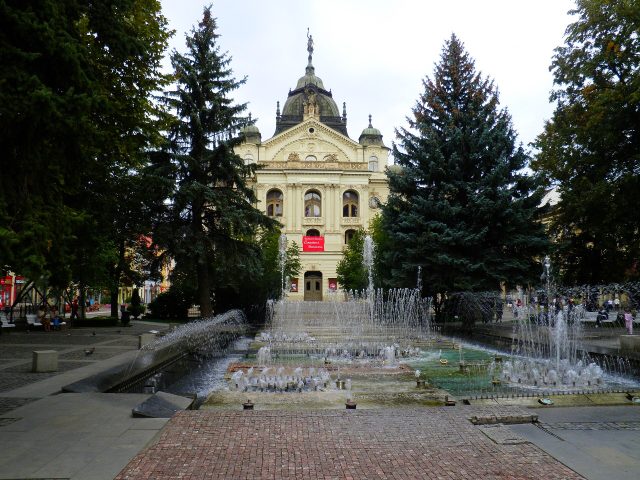
Rožňava’s Park Mladeže is one of those quiet, unassuming places that doesn’t announce itself with grand monuments or flashy attractions, yet somehow becomes the heart of a town. Tucked away in the middle of this small Slovak city, it offers a pause from the rhythm of daily life—a place where the only agenda is to sit on a bench, watch children chase each other across the grass, or simply listen to the rustle of leaves overhead.
The park’s origins are tied to Rožňava’s history as a mining town. In the 18th and 19th centuries, the region thrived on copper and silver extraction, and the city grew alongside the industry. When local authorities decided to create a public green space, it wasn’t just about aesthetics—it was a practical gesture, a way to give miners and their families a place to rest. Back then, parks like this were rare in industrial towns, and their creation was a sign of progress. Some of the original layout remains today: the wide, paved paths, the sturdy old trees that have stood here for generations, their roots stretching back to a time when the city’s streets were filled with the clatter of carts and the shouts of workers.
The design of the park is simple. At its center, a modest fountain trickles water into a shallow basin, its gentle sound blending with the hum of the city. It’s not the kind of fountain that draws crowds of tourists, but it has a quiet charm, especially in summer when children gather around its edges, dipping their fingers into the cool water. The benches scattered along the paths are mostly unremarkable, though a few still bear the marks of Soviet-era craftsmanship—thin metal legs and slatted wooden seats that have weathered decades of use.
What gives the park its real personality are the trees. Linden, maple, and chestnut trees tower over the paths, their branches forming a canopy that shifts with the seasons. In summer, their shade is a refuge from the heat, while in autumn, the ground becomes a carpet of gold and amber. Locals often come here in the fall to gather chestnuts, filling baskets with the glossy brown nuts that later become crafts or keepsakes. The trees are old enough that some of them must have been planted when the park was first laid out.
Though the park isn’t a museum, it holds a few quiet reminders of Rožňava’s past. Near the entrance, a small monument honors the miners who once worked the local shafts. It’s a humble structure, made of stone and metal, but it’s well-tended, with fresh flowers often left at its base. Not far from it, a low wooden stage occasionally hosts concerts or community events. On those days, the park comes alive in a different way—music spills from the speakers, the scent of grilled sausages fills the air, and families spread out blankets on the grass.
For the people of Rožňava, the park is more than just a patch of green. It’s where life happens in small, everyday ways. Couples stroll along the paths in the evenings, dogs trot beside their owners, and groups of friends gather on the benches to talk. In the mornings, you might see older residents doing gentle exercises near the fountain, while in the afternoons, teenagers lounge in the shade, scrolling through their phones or sharing snacks. On weekends, the park fills with families—parents pushing strollers, children racing on bikes, grandparents sitting on benches, watching the world go by.
Winter transforms the park entirely. Snow blankets the paths and clings to the branches of the trees, turning everything soft and silent. The fountain freezes, and the usual crowds thin out, leaving the space to those who don’t mind the cold. Sometimes, locals carve out a makeshift ski trail along the main path, while children build snowmen on the lawns. The holidays bring a different kind of warmth—strings of lights are draped over the trees, and a Christmas tree stands near the center, drawing people together for carols and celebrations.
There’s nothing extravagant about Park Mladeže. It doesn’t have manicured flowerbeds or rare plants, and it won’t make it onto any lists of must-see attractions. But that’s part of its appeal. It’s a place that feels lived-in, shaped by the people who use it every day. For visitors, it might seem like just another city park, but for those who call Rožňava home, it’s a small sanctuary—a place where time slows down and where the simplest moments often mean the most.