Nestled in the quiet hills of northern Lazio, the small town of Bomarzo feels like a place time forgot. It doesn’t appear on most tourist maps, and that’s precisely why it holds a certain allure. There are no grand piazzas here, no crowded trattorias serving overpriced pasta to snap-happy visitors. Instead, Bomarzo offers something far more intriguing—a garden where the boundaries between reality and myth blur, where stone creatures seem to breathe, and where every path leads to another enigma. This is the Park of Monsters, or Sacro Bosco, a sixteenth-century creation that still feels alive with mystery.
The park was the vision of Pier Francesco Orsini, a Renaissance nobleman whose life was marked by both triumph and tragedy. A military leader by necessity, Orsini was also a man of deep intellect and emotion, shaped by the loss of his beloved wife, Giulia Farnese. In the wake of her death, he sought to channel his grief into something enduring, a place where sorrow, philosophy, and mythology could coexist. While ornamental gardens were fashionable among the aristocracy of the time—often designed to reflect order, symmetry, and classical ideals—Orsini’s creation defied convention. There are no manicured hedges here, no geometric flowerbeds. Instead, the park embraces the wild, its tangled woods and jagged rocks serving as the perfect stage for his stone visions.
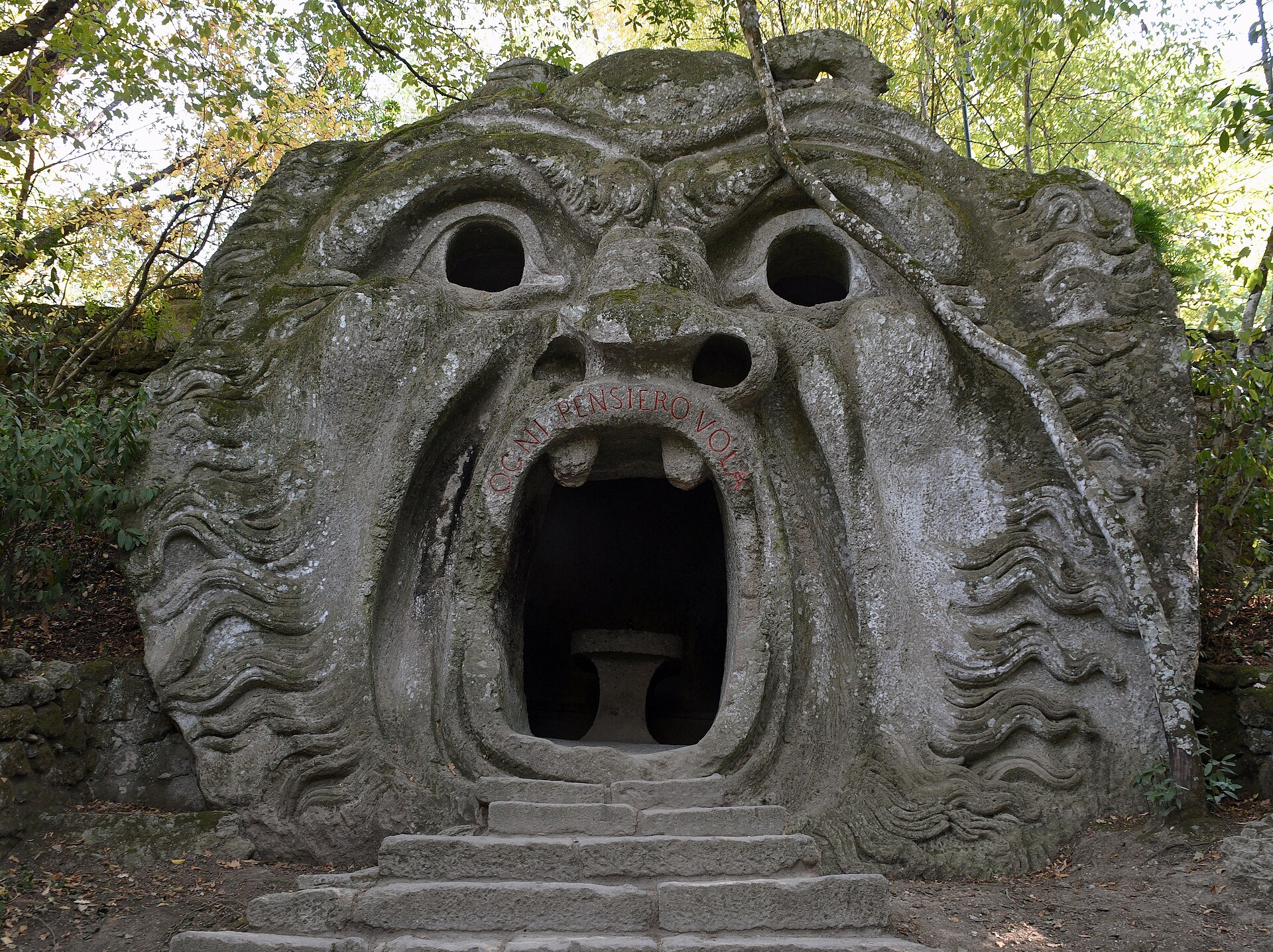
Walking through the Park of Monsters is like stepping into a dream. The sculptures aren’t merely placed within the landscape; they emerge from it, as if the earth itself has given birth to them. Towering figures of gods and beasts loom between the trees, their expressions twisted into grimaces or serene smiles, depending on the angle. Some seem to watch you, their hollow eyes following your every move. The most famous of these is the colossal open mouth of an ogre, its gaping jaws forming the entrance to a small cave. Local lore claims this is a gateway to the underworld, a test for those brave enough to pass through. In reality, it’s just stone—but the illusion is so convincing that it’s easy to believe the stories.
The park’s design is deliberately disorienting. There’s no clear path, no logical progression from one sculpture to the next. Narrow trails wind through the undergrowth, suddenly revealing a new monstrosity or an unexpected view of the valley below. One moment, you’re standing before a tilted pyramid; the next, you’re confronted with a house built at such a precarious angle that it appears to be sliding downhill. The effect is unsettling, as if the park is playing a game with you, challenging your sense of balance and perception. It’s not a place meant to be understood at first glance but rather experienced, one strange encounter at a time.
Scholars have debated the park’s meaning for centuries. Some see it as an allegory of life’s trials, each monster representing a different obstacle or temptation. Others argue that Orsini intended it as a philosophical statement, a fusion of ancient myths, Christian symbolism, and personal reflection. There’s even a theory that the park contains a hidden message, a code lost to time. The truth is, no one knows for certain—and perhaps that’s the point. The ambiguity is part of its magic, inviting visitors to impose their own interpretations onto the stone figures.
Unlike many Renaissance gardens that have been restored or modernized, the Park of Monsters remains largely untouched. The trees have grown wild, the sculptures bear the marks of centuries, and the silence is broken only by the rustling of leaves. There’s a sense that the park exists outside of time, a relic of an era when gardens were more than just decorative spaces—they were expressions of the soul. Visiting it feels less like a tourist stop and more like a pilgrimage, a chance to connect with the mind of a man who lived over four hundred years ago.
Bomarzo itself is a quiet town, its narrow streets lined with medieval houses that have stood for generations. There’s no rush here, no sense of urgency. After wandering through the park, it’s worth lingering in one of the local cafés, where the food is simple and hearty—think handmade pasta with wild boar ragù or pecorino cheese drizzled with local honey. The pace of life is slow, the kind that allows for reflection. It’s the perfect counterpoint to the park’s eerie energy, a reminder that even in a place of monsters, there’s room for warmth and human connection.
The Park of Monsters isn’t for everyone. It doesn’t offer thrills or Instagram-worthy moments. What it does offer is something far rarer: a sense of wonder, a glimpse into a world where art and nature collide, and the chance to ponder questions that have no easy answers. Orsini’s creation was never meant to be straightforward. It was meant to provoke, to unsettle, to make you see the world a little differently. And in that, it succeeds brilliantly. Whether you leave feeling enlightened or simply bewildered, one thing is certain—you won’t forget it.