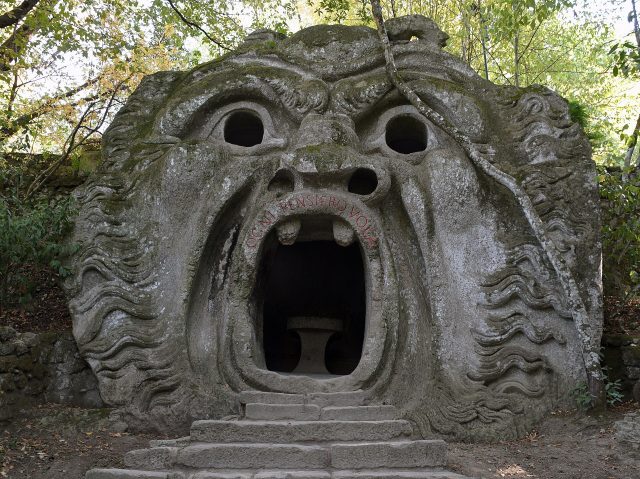
Santa Maria Assunta in Bomarzo is one of those rare places that feels suspended in time, where every stone seems to carry the weight of centuries. Perched on a hill in the quiet town of Bomarzo, in northern Lazio, the church overlooks a valley dotted with olive groves, vineyards, and the occasional crumbling villa. Bomarzo itself is best known for its surreal Park of the Monsters, but the church, though less famous, holds its own quiet significance. It stands as a testament to the town’s layered history, where faith, power, and daily life once intertwined in ways that still linger in its walls.
Built in the 12th century, Santa Maria Assunta was commissioned by the Orsini family, one of the most influential dynasties of medieval Italy. At the time, Bomarzo was a strategic stronghold, and the church served not only as a place of worship but also as a symbol of the Orsini’s authority over the region. The original structure has been altered over the centuries, yet its core remains intact: thick walls of local tuff stone, a simple but striking Romanesque façade, and a bell tower that rises above the town like a silent sentinel. The materials themselves tell a story—the porous, golden-hued tuff, quarried nearby, gives the building a warmth that shifts with the light, from soft amber in the morning to deep ochre at dusk.
Inside, the church reveals a striking contrast between its unassuming exterior and its richly decorated interior. The main nave is adorned with frescoes spanning several centuries, from medieval to Renaissance. The most notable are the 15th-century scenes depicting the life of the Virgin Mary, their colors faded but still vibrant enough to suggest the hand of the artist who painted them. The marble altar gleams under the dim light filtering through small windows, while the side chapels hold ancient tombs and faded coats of arms—remnants of the families who once patronized the church. The air is cool and still, carrying the faint scent of aged plaster and candle wax.
Beneath the main floor lies the crypt, a space that predates the current church, possibly dating back to the 11th century. It’s a small, dimly lit chamber where the past feels almost tangible. The walls bear traces of early frescoes, their outlines barely discernible, and a few stone sarcophagi rest in the shadows. The crypt’s atmosphere is one of quiet reverence, a place where the weight of history presses a little closer. It’s easy to imagine the generations of worshippers who once gathered here, their voices echoing in the confined space.
Santa Maria Assunta has always been more than just a religious building. In the Middle Ages, it functioned as a communal hub where townspeople gathered not only for prayer but also for trade, governance, and shelter during times of conflict. Over the centuries, its role evolved—it weathered periods of neglect and revival—but it never lost its place at the heart of Bomarzo. Even today, the church remains a living part of the town, though its congregation is small. Services are still held here, though most visitors come not for worship but to glimpse the past. The church’s enduring presence is a reminder of how deeply history is woven into the fabric of even the smallest Italian towns.
The architecture of Santa Maria Assunta is a study in the Romanesque style that defines much of central Italy, yet it carries a distinct local character. The use of tuff stone, with its rough texture and warm tones, sets it apart from the more polished churches of nearby cities. The façade is modest, marked by a small rose window and a portal adorned with simple but elegant carvings. The bell tower, added later, blends seamlessly with the rest of the structure, its lines complementing rather than competing with the original design. The overall effect is one of harmony, a building that feels rooted in its surroundings.
Visiting the church is as much about the journey as it is about the destination. Bomarzo is not a place of crowds or tourist traps; it moves at its own unhurried pace. The church isn’t always open, and sometimes you might have to wait for a local to appear with the key. But that’s part of the charm. The walk up the narrow, winding streets to the church is a step back in time, past houses with terracotta roofs and shuttered windows. The square in front of the church is quiet, often empty except for the occasional cat or the sound of water trickling from the small fountain nearby. In summer, the air is thick with the scent of herbs and warm stone; in winter, a light dusting of snow can transform the scene into something almost magical.
From the church’s hilltop perch, the view stretches across the valley, where patches of green give way to the soft outlines of distant villages. Other churches dot the landscape, their bell towers rising like exclamation points against the rolling hills. It’s a view that hasn’t changed much in centuries, a reminder of how deeply the past is embedded in the present. Santa Maria Assunta may not have the grandeur of Rome’s basilicas or the fame of Florence’s cathedrals, but it possesses something rarer: authenticity. There’s no need for gilded altars or elaborate frescoes here. The church’s power lies in its simplicity, in the way it quietly insists on being seen not as a relic, but as a living piece of history.
For those who take the time to visit, the church offers more than just a glimpse into the past. It’s a place where the boundaries between then and now blur, where the stories of the people who built it, prayed in it, and preserved it still resonate. In a country filled with monumental churches, Santa Maria Assunta stands out precisely because it doesn’t try to impress. It simply endures, a quiet witness to the passage of time in a town that has always existed just beyond the spotlight. And perhaps that’s why, once you’ve been here, you find yourself wanting to return.